

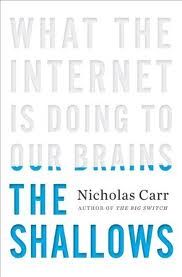
The Shallows
Introduction
Nova: Have you ever sat down with a book, one you were actually excited to read, and found that after just two or three pages, your mind starts wandering? You feel this physical itch to check your phone, or you realize you have been staring at the same paragraph for five minutes without absorbing a single word.
Atlas: Honestly, that is my life every single day. I used to be a total bookworm, but now I feel like my brain is constantly scanning for the next notification. I thought I was just getting older or more stressed, but it turns out there might be a much deeper reason for it.
Nova: Exactly. That is the core mystery Nicholas Carr explores in his landmark book, The Shallows: What the Internet Is Doing to Our Brains. He noticed the same thing in himself. He was a professional writer who suddenly found he could no longer immerse himself in long narratives or complex arguments. He felt like his brain was being reprogrammed.
Atlas: It is a scary thought, right? The idea that the tools we use every day are actually changing the physical structure of our minds. It is not just about being distracted; it is about becoming a different kind of thinker altogether.
Nova: That is exactly what we are diving into today. We are going to look at the science of neuroplasticity, the history of how technology has always shaped human thought, and why the internet might be the most radical shift in human consciousness since the invention of the printing press.
Key Insight 1
The Malleable Mind
Nova: To understand Carr's argument, we have to start with a concept that flipped the world of neuroscience on its head about thirty years ago: neuroplasticity. For a long time, scientists believed the adult brain was basically fixed, like a piece of hardware that was finished being built in your twenties.
Atlas: Right, I remember being told that you are born with a certain number of neurons and it is all downhill from there. But that is not true, is it?
Nova: Not at all. Carr explains that our brains are actually more like plastic or clay. They are constantly reorganizing themselves based on our experiences and habits. Every time we perform a task or experience a sensation, a specific set of neurons fires. If we keep doing it, the synaptic links between those neurons grow stronger.
Atlas: So, if I spend four hours a day scrolling through short, punchy headlines and 15-second videos, my brain is literally building a highway for that kind of information?
Nova: Precisely. Carr uses the analogy of a path in the woods. The more you walk a certain way, the deeper the path becomes. But here is the kicker: neuroplasticity is a double-edged sword. While we are building those high-speed highways for quick, fragmented information, the old paths—the ones used for deep, focused, linear thinking—are starting to grow over with weeds.
Atlas: Use it or lose it. That is terrifying. So, my brain is basically optimizing itself to be a professional skimmer because that is what I am training it to do every time I pick up my phone.
Nova: That is the essence of it. Carr cites studies by researchers like Michael Merzenich, who showed that our mental circuits can be rewired almost in real-time. Our brains are incredibly efficient. If they see that we no longer need to focus for long periods, they reallocate those resources to something else, like processing fast-moving visual stimuli or multitasking.
Key Insight 2
Tools of the Mind
Atlas: I can hear the skeptics already, though. People have been complaining about new technology since the beginning of time. Did not Socrates hate the idea of writing because he thought it would destroy our memory?
Nova: He absolutely did! And Carr actually addresses that. He calls things like the alphabet, the map, and the clock intellectual technologies. These are tools that extend or support our mental powers. And Socrates was right in a way—writing did change our memory. We stopped memorizing epic poems because we could just write them down.
Atlas: But we would all agree that writing was a net positive, right? It allowed for the explosion of human knowledge. So why is the internet different?
Nova: Carr argues that every intellectual technology comes with a trade-off. Take the mechanical clock. Before the clock, time was a flow, tied to the sun and the seasons. Once the clock became common, we started thinking of time as a series of discrete, measurable units. It made us more efficient, but it also made us more detached from the natural world and our own internal rhythms.
Atlas: So the tool changes the way we perceive reality itself. It is not just a neutral helper.
Nova: Exactly. Carr tells this fascinating story about Friedrich Nietzsche. Later in his life, Nietzsche's vision was failing, and he could no longer write by hand for long periods. He bought one of the first typewriters—a Malling-Hansen Writing Ball. A friend noticed that his writing style changed almost immediately. His prose became tighter, more telegraphic, almost like he was punching out his thoughts.
Atlas: Even Nietzsche was not immune to the medium! If a typewriter can change the way a genius thinks, what is a smartphone doing to the rest of us?
Nova: That is the point. The medium is not just a pipe for information. It is an active participant in the thinking process. The internet is unique because it is the first tool that combines almost all our previous intellectual technologies—the map, the clock, the book, the typewriter—into one single, high-speed stream.
Key Insight 3
The Juggler's Brain
Atlas: Okay, let's get into the nitty-gritty of the internet itself. Carr calls the modern online experience the Juggler's Brain. What does he mean by that?
Nova: Think about what happens when you read a webpage. You have the main text, but you also have flickering ads, sidebar links, notifications popping up, and most importantly, hyperlinks. Every time you see a blue, underlined word, your brain has to make a micro-decision: Should I click this or keep reading?
Atlas: I never thought of it as a decision, but I guess it is. It is a tiny distraction every single time.
Nova: It is! And those tiny distractions add up to what psychologists call cognitive load. Our working memory—the part of our brain that holds information while we process it—is very small. It is like a tiny thimble. If you try to pour a waterfall of information into that thimble, most of it just spills out.
Atlas: And the internet is definitely a waterfall. So, because we are constantly deciding whether to click or scroll, we never actually move that information into our long-term memory?
Nova: Spot on. Carr points to a famous study by Gary Small, a professor of psychiatry at UCLA. He took people who were net-savvy and people who were net-naive and scanned their brains while they used Google. The net-savvy people showed way more activity in the prefrontal cortex—the part of the brain responsible for decision-making and problem-solving.
Atlas: Wait, that sounds like a good thing! Their brains were working harder, right?
Nova: That is what people thought at first. But Small realized that the extra activity was actually the brain struggling to filter out distractions. They were so busy managing the interface that they were not actually absorbing the content. When the net-naive people spent just five days using the internet for an hour a day, their brains rewired to look exactly like the net-savvy ones.
Atlas: Five days? That is all it takes to change your neural circuitry? That is incredibly fast.
Nova: It is. And the result is that we become very good at scanning and skimming—what Carr calls power browsing—but we lose the ability to engage in deep reading. We are becoming like a computer, processing data in small bursts, but losing the human capacity for contemplation.
Key Insight 4
The Loss of Depth
Atlas: There is a really haunting metaphor in the book that I can't get out of my head. Carr talks about us becoming Pancake People. What is that about?
Nova: It is a term coined by the playwright Richard Foreman. He suggests that as we offload our memory to the vast database of the internet, we are spreading ourselves wide and thin. We have access to everything, but we have no depth within ourselves. We are becoming as thin as a pancake.
Atlas: That hits hard. I definitely feel like I know a little bit about a thousand things, but I don't know if I could give a deep, hour-long lecture on any of them without my phone in my hand.
Nova: And that has real consequences for creativity. Carr argues that true intelligence isn't just about being able to find a fact; it is about the connections your brain makes between those facts when they are stored in your own long-term memory. If you outsource your memory to Google, you are outsourcing your ability to think original thoughts.
Atlas: It is like we are becoming the peripherals for the computer, rather than the computer being a tool for us. But Nova, the book was written in 2010. That was before TikTok, before the explosion of AI, before smartphones were literally in every single hand 24/7. Does Carr think it has gotten worse?
Nova: In the 10th-anniversary edition, he wrote a new afterword, and his outlook is pretty grim. He says that the trends he identified have only accelerated. The smartphone has made the internet an appendage. We are now interrupted not just when we sit at a desk, but every waking second of our lives.
Atlas: So, is there any hope? Or are we just destined to be shallow-brained forever?
Nova: Carr doesn't offer a simple three-step plan, but he does emphasize that because our brains are plastic, we can work to rewire them back. It requires intentionality—things like digital minimalism, carving out time for deep reading, and literally practicing the act of being alone with our thoughts without a screen.
Conclusion
Nova: As we wrap up our look at The Shallows, it is worth reflecting on what we are trading for all this convenience. We have gained the world's information at our fingertips, but we might be losing the very thing that makes us human: our capacity for deep, quiet, sustained attention.
Atlas: It is a wake-up call, for sure. I think the biggest takeaway for me is that my inability to focus isn't a personal failure or a sign of getting old. It is a physical response to the environment I have built for myself. If I want my deep brain back, I have to fight for it.
Nova: Exactly. Nicholas Carr isn't saying we should throw our computers in the river. He is saying we need to be aware of the cost. Every time we choose the quick click over the deep dive, we are shaping our future selves. The question is: what kind of mind do you want to have ten years from now?
Atlas: That is a question worth putting the phone down for. Thanks for walking me through this, Nova. I think I am going to go find a physical book and see if I can make it through chapter one without checking my email.
Nova: Good luck, Atlas. It is a muscle—you just have to start training it again. To our listeners, thank you for spending some of your precious attention with us today. If you found this insightful, maybe try sitting with these ideas for a few minutes before moving on to the next thing.
Atlas: This is Aibrary. Congratulations on your growth!