

Mastering the Art of Deep Work: Achieving Focused Productivity
Golden Hook & Introduction
SECTION
Nova: Atlas, if I asked you to describe a truly productive day, what comes to mind? What does it look like for you?
Atlas: Oh man, a productive day for me? It's a whirlwind! I'm juggling emails, jumping between projects, responding to Slack messages, maybe a quick social media check to stay "informed," then back to a report, then a meeting where I'm half-listening, half-drafting an email. I'm moving, I'm reacting, I'm... things. It feels like I'm a conductor, keeping a hundred different instruments playing.
Nova: That's a fantastic, and I'd argue, incredibly common description, Atlas. It sounds exhausting, frankly. And here’s the kicker: what you just described, while certainly, might actually be sabotaging your ability to produce anything truly meaningful or groundbreaking.
Atlas: Whoa, hold on. Sabotaging? But I'm getting things done! I'm checking boxes! Are you telling me my entire approach to "getting things done" is fundamentally flawed? That's going to resonate with anyone who feels like they're constantly in motion but not making real progress.
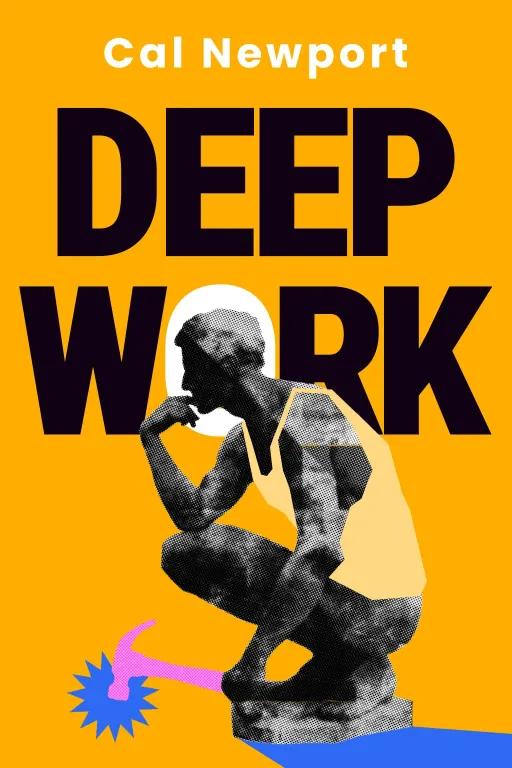
Nova: Exactly. And that's precisely why we need to talk about a concept that's becoming increasingly rare, yet more vital than ever: Deep Work. Today, we're diving into the transformative ideas from Cal Newport's seminal book, "Deep Work: Rules for Focused Success in a Distracted World." What's fascinating about Newport, who's a computer science professor, is that he practices what he preaches. He famously doesn't use social media, which gives him an almost mythical status in this conversation about focus. He’s built a career on the very principles he writes about.
Atlas: Okay, so a social media abstainer telling us to focus. I'm intrigued, if not a little intimidated. So what exactly this "deep work" he's talking about, and how is it different from just, you know, "working hard"?
The Imperative of Deep Work
SECTION
Nova: That's the core question, isn't it? Deep work, as Newport defines it, is "professional activities performed in a state of distraction-free concentration that push your cognitive capabilities to their limit. These efforts create new value, improve your skill, and are hard to replicate." Think of it as intense, focused, uninterrupted mental exertion. It's the opposite of your whirlwind day, Atlas.
Atlas: So, basically, it's locking yourself in a closet for hours, staring at a wall until brilliance strikes? That sounds a bit out there for most of us who can't just ditch our responsibilities.
Nova: Not quite a closet, though some might argue for it! The key isn't isolation for isolation's sake, but. Imagine a master craftsman, say a luthier, meticulously carving a violin. They're not checking their phone every five minutes. Their entire being is focused on the wood, the sound, the shape. That's deep work. It's about pushing your cognitive limits, which is where true innovation and high-quality output come from. Newport argues that in our increasingly complex and competitive economy, the ability to do deep work is becoming the most valuable skill.
Atlas: I guess that makes sense. It's like when you're trying to solve a really complex puzzle, and you need complete quiet to really see the patterns. But how do you that in an environment that's constantly demanding your attention? For our listeners who are managing high-pressure teams, or trying to write a report while their inbox is exploding, this concept might feel impossible to implement.
Nova: That's where Newport offers concrete strategies, not just philosophical musings. He talks about scheduling deep work, almost like an appointment you can't miss. It's not about "finding" time, it's about time. He suggests rituals: deciding where you'll work, how long, how you'll start, and how you'll support the work—like a specific coffee routine, or a particular type of music. He even outlines different "philosophies" for integrating deep work, from monastic to bimodal to journalistic.
Atlas: So he's saying it's not about being a monk, but about being intentional? I can see how that would be a game-changer. I mean, my "productive" day often feels like I'm just reacting to whatever dings next. What's the real cost of that "shallow work" you mentioned?
Nova: Shallow work, by contrast, is non-cognitively demanding, logistical-style tasks, often performed while distracted. Think email replies, meeting coordination, social media updates. It's necessary, but it doesn't move the needle on your most important goals. The cost? It fragments your attention. Every time you switch tasks, especially from something deep to something shallow, there's what's called "attention residue." A part of your mind stays tethered to the previous task, making it harder to fully engage with the new one. It's like leaving a tiny window open to another conversation while you're trying to have a deep discussion. You're never fully present.
Atlas: Oh, I know that feeling! It’s like when I close one tab but my brain is still buffering the content from it. So, the more we do shallow work, the harder deep work becomes because our brains are constantly playing catch-up.
Nova: Exactly. And it’s not just about efficiency. Newport argues that deep work is essential for learning complex things quickly and producing at an elite level. Without it, you're relegated to tasks that are easy to automate or outsource. It’s about building skills that machines can’t replicate.
The Digital Brain Drain
SECTION
Nova: Now, understanding deep work is crucial is one thing, but actually it in our modern world? That's where Nicholas Carr steps in with his powerful book, "The Shallows: What the Internet Is Doing to Our Brains." He provides a sobering look at the formidable enemy of deep work: our digital environment.
Atlas: I've been thinking about this. Is it really the internet's fault, or are we just easily distracted? Like, my grandpa used to complain about TV rotting our brains. Is this just the new version of that?
Nova: That's a great question, and Carr would argue it's far more profound than just a new form of distraction. He explores how internet use, with its constant hyperlinks, notifications, and fragmented information, is literally. Our brains are incredibly plastic, meaning they adapt to how we use them. If we constantly jump between tasks, our brains become adept at, but less adept at. It's a fundamental shift in our cognitive processes, not just a bad habit.
Atlas: Rewiring our brains? That's actually really unsettling. Are you saying the internet isn't just a tool we use, but an environment that's actively changing who we are? Like, physically changing our neural pathways?
Nova: Precisely. Carr describes how traditional reading—deep, linear, immersive—cultivates qualities like contemplation, reflection, and imagination. The internet, by contrast, encourages quick scanning, skimming, and shallow processing. Our brains are optimizing for efficiency in finding information, but at the cost of processing it deeply. It's like we're training our brains to be sprinters, but forgetting how to run a marathon.
Atlas: That’s a perfect analogy. So, in this context, deep work isn't just a productivity hack; it's almost an act of cognitive self-preservation. It's fighting back against the tide of constant stimulation that's making deep concentration harder and harder.
Nova: That's it. Carr's work highlights the importance of recognizing these cognitive shifts so we can intentionally reclaim our capacity for sustained attention. It's not about demonizing the internet, which has incredible benefits, but about being mindful of its impact and actively structuring our environment to counteract its default settings.
Atlas: So what can we actually? If our brains are getting rewired for distraction, how do we rewire them back for focus? Can you give an example of someone who’s successfully resisted this digital brain drain?
Nova: Well, it starts with understanding the neuroscience of attention. Our brains thrive on novelty, which is why every notification or new email feels so compelling. To resist that pull, we need deliberate strategies. A great example isn't a famous person, but a simple, relatable scenario: imagine a student trying to write a paper. Instead of having 20 tabs open, their phone buzzing, and their email client refreshed every minute, they dedicate a specific block of time – say, ninety minutes – to that paper. They turn off all notifications, close all unnecessary tabs, put their phone in another room. The initial impulse to check something is strong, but they resist. Over time, that resistance builds a new neural pathway for focus.
Atlas: So it's about building "focus muscles," essentially. That sounds like a long game. But what about the "Tiny Step" you mentioned earlier? That one hour, tomorrow, no notifications, single challenging task. How does that fit into this rewiring fight?
Synthesis & Takeaways
SECTION
Nova: That tiny step is your first, crucial rep in the mental gym. It's a deliberate act of cognitive resistance. By consciously turning off those distractions for even sixty minutes and dedicating yourself to one demanding task, you're sending a powerful signal to your brain: "This is important. This deserves my full, undivided attention." You're giving your brain a chance to practice sustained focus, to build those deep neural pathways again.
Atlas: I love that. It's not about being perfect, it's about taking that first, intentional step. Because if we don't actively fight for our focus, the digital world will happily fragment it for us. The core of our discussion today is really about recognizing that deep work isn't just a nice-to-have, it's a critical skill for thriving, and that our digital environment is actively working against it. The power lies in our intentionality.
Nova: Absolutely. It's about taking control of your attention, which is arguably the most valuable currency in the modern age. So, for everyone listening, try that tiny step tomorrow. Pick a challenging task, give it one hour of your undivided, distraction-free attention, and observe the difference. You might be surprised by not just your output, but your mental state.
Atlas: That's actually really inspiring. And for those of you who take that step, we'd love to hear about it. Share your experiences with us; tell us what you discovered about your focus. Your insights help all of us on this journey.
Nova: This is Aibrary. Congratulations on your growth!