

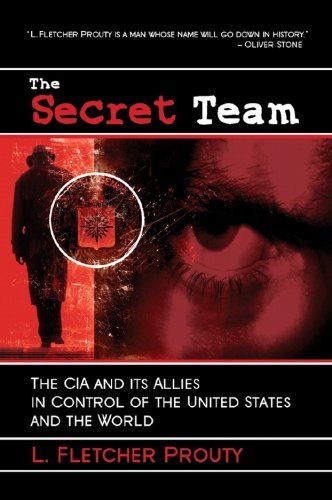
The Secret Team
The CIA and Its Allies in Control of the United States and the World
Introduction
Nova: Imagine writing a book so explosive that thousands of copies simply vanish from bookstore shelves overnight. Not banned by the government, not recalled by the publisher, but quietly purchased en masse by unidentified buyers until the book essentially ceases to exist. That is exactly what happened in 1974. And the book was The Secret Team by Colonel L. Fletcher Prouty.
Nova: And yet it happened. The Secret Team was published by Prentice-Hall in 1973, a hardcover from a major mainstream publisher, not some fringe press. The paperback rights were sold to Ballantine Books with a planned printing of a hundred thousand copies. But as Prouty himself later described it, the paperback simply began to disappear. He went to New York to speak with the new owner of Ballantine and the man said he knew nothing about Prouty or his book.
Nova: That's exactly the question we're going to explore today. Colonel L. Fletcher Prouty served as the Chief of Special Operations for the Joint Chiefs of Staff under President John F. Kennedy. For nearly a decade, from 1955 to 1964, he was the official Focal Point Officer, the man who coordinated all military support for CIA clandestine operations around the world. If anyone knew where the bodies were buried, it was Fletcher Prouty.
Key Insight 1
The Man Behind the Book
Nova: Let's understand who Fletcher Prouty was, because his credentials are central to the credibility of everything he wrote. Born in 1917 in Springfield, Massachusetts, he joined the military in 1941 and served in World War II as a transport pilot. He personally flew General Omar Bradley around North Africa and the Middle East. He flew the US Geological Survey team into Saudi Arabia in 1943 to confirm oil discoveries ahead of the Cairo Conference. He was at the Cairo and Tehran conferences that brought together Roosevelt, Churchill, Chiang Kai-shek, and Stalin.
Nova: Exactly. After the war he was assigned to set up the ROTC program at Yale University, which is where he overlapped with a young George H. W. Bush and with William F. Buckley. He ran Tokyo International Airport during the Korean War. And then in 1955 came the assignment that would define the rest of his life: he was made the liaison between the US Air Force and the CIA for covert operations. Later, CIA Director Allen Dulles transferred all duties dealing with CIA-Pentagon support into Prouty's office. He became the single point of contact, the Focal Point Officer.
Nova: That's right. And he built a global network to do it. He had staff stationed in military commands worldwide, hundreds of experts and agents embedded in positions where they could provide support to CIA operations. He traveled to more than sixty countries, visiting CIA stations from Frankfurt to Saigon. He personally met with Allen Dulles, the legendary CIA director, to work out the arrangements, including setting up dummy companies for equipment transfers, all authorized under a Depression-era law called the Economy Act of 1932, which allowed the transfer of goods and services between branches of government.
Nova: That's exactly how Prouty described it. And he noted that this was the same law cited by Secretary of Defense Caspar Weinberger during the Iran-Contra affair. Prouty served nine consecutive years in this position, retiring in 1964 as a full colonel. He was awarded one of the first three Joint Service Commendation Medals by General Maxwell Taylor. This was not some minor functionary. He was at the center of the machine.
Key Insight 2
What Is the Secret Team?
Nova: So what exactly did Prouty mean by The Secret Team? Let me read you his own definition. He wrote: The Secret Team consists of security-cleared individuals in and out of government who receive secret intelligence data gathered by the CIA and the National Security Agency and who react to those data, when it seems appropriate to them, with paramilitary plans and activities.
Nova: Prouty's fundamental argument was that the CIA, working through this Secret Team network, had effectively created a government within the government. These people were planted inside the State Department, the FBI, Customs, the Treasury Department. They would rise through the ranks while maintaining their primary loyalty to the CIA. Their colleagues wouldn't know their true affiliation. Prouty argued that this network could execute operations that the President and Congress never explicitly authorized. He called it a high cabal of industrialists and bankers operating behind the Cold War as a cover story.
Nova: Prouty believed that the Cold War framework, the idea of containing communism at all costs, was deliberately used to justify an enormous expansion of secret power, budgets, and operations. He argued that the intelligence community needed a perpetual enemy to justify its existence and its growing power. The Soviet Union provided that enemy. And the secrecy surrounding Cold War operations meant that almost no one, not even senior military commanders, had a complete picture of what was happening. He describes briefing the Chairman of the Joint Chiefs of Staff, General Lyman Lemnitzer, on a massive clandestine operation, and hearing the general say, "I just can't believe it. I never knew that." The nation's highest-ranking military officer didn't know the full scope of what was being done.
Nova: Yes, this is one of the most important ideas in the book. Prouty argued that under Allen Dulles, the CIA stopped being an agency that executed policies set by diplomats and elected leaders, and instead started using intelligence to drive policy. Intelligence information would come in, and the Secret Team would react to it with operations, which would then create facts on the ground that policymakers had to respond to. The tail was wagging the dog. Even the CIA's own internal journal, Studies in Intelligence, grudgingly acknowledged that Prouty raised an important point about "the danger of clandestine actions precipitated as a reaction to intelligence rather than in deliberate support of a national foreign policy plan."
Key Insight 3
The Legal Architecture of Secrecy
Nova: Prouty's book is not just a series of shocking anecdotes. It's also a detailed examination of how the legal and bureaucratic architecture for covert operations was constructed. And it starts with something called National Security Council Directive 10/2.
Nova: This was a directive issued under President Truman in 1948 that authorized the CIA to conduct covert operations. But here's the crucial detail Prouty highlighted: it specified that when the military supported the CIA for an operation, that support "was to be limited to that one time only and afterwards withdrawn." The idea was that the CIA shouldn't build its own permanent military capability. Each operation would be a one-off. But as Prouty documented, this restriction was steadily ignored. The CIA accumulated its own stockpiles of equipment. It built a permanent paramilitary infrastructure.
Nova: Right. Then came NSC 5412 in 1954, under Eisenhower. This was the directive that Prouty described as finally formally defining covert operations and how the Pentagon would support them. It's what created the official structure for his Focal Point office. And then there was NSC 5412/2, which Prouty argued essentially handed control of covert operations to the CIA with minimal oversight. He wrote that all of these operations were brought about and masterminded by what he called a renegade Secret Team operating without Presidential direction and without National Security Council approval.
Nova: Exactly. And he illustrated this with concrete examples. The Bay of Pigs operation was planned under Eisenhower and inherited by Kennedy, who was barely briefed on it before being asked to approve it. Prouty's office was two doors down from the Taylor Committee, the group Kennedy assembled to investigate the Bay of Pigs failure, and Prouty spoke with almost everyone going in and out. He saw firsthand how the Secret Team operated and how Kennedy tried to rein it in. Kennedy famously said he wanted to splinter the CIA into a thousand pieces after the Bay of Pigs. Prouty argues that this was the moment Kennedy made mortal enemies of the very people who controlled the levers of covert power.
Key Insight 4
JFK, Vietnam, and the Alleged Coup
Nova: Prouty's analysis of the Kennedy assassination is woven throughout The Secret Team and became the central focus of his second book, JFK: The CIA, Vietnam, and the Plot to Assassinate John F. Kennedy. But here's the connection to The Secret Team: Prouty argues that Kennedy's National Security Action Memorandum 263, issued in October 1963, ordered the beginning of a withdrawal of American troops from Vietnam, with a thousand men coming home by Christmas and a complete withdrawal by the end of 1965.
Nova: Prouty was in a unique position to document it. He was still serving in the Pentagon at the time. He describes how, just a month or two before the assassination, he was unexpectedly assigned to accompany a group of VIPs to the South Pole from November 10 to 23, 1963. He was told this was to activate a nuclear power plant at McMurdo Sound. Prouty later described this as a way to remove him from Washington during the critical period leading up to the assassination. He believed it was orchestrated by Brigadier General Edward Lansdale.
Nova: That's right. Prouty claimed Lansdale was in Dallas "like the orchestra leader, coordinating these things." He viewed the assassination as a coup d'état carried out by elements of the military and intelligence communities, specifically to prevent Kennedy from ending the Vietnam War and from taking control of the CIA. In Oliver Stone's film JFK, Prouty was the inspiration for the character Mr. X, played by Donald Sutherland, who delivers a sixteen-minute monologue explaining this entire hidden history.
Nova: Absolutely. Journalist Max Boot noted that Prouty also claimed the fall of the Berlin Wall was stage-managed by David Rockefeller to profit from rubles and gold, and that he personally saw a UFO. The CIA's internal reviewer called reading The Secret Team "like trying to push a penny with one's nose through molten fudge." And when Prouty accused White House aide Alexander Butterfield of being a CIA plant, Senator Frank Church's committee investigated and found "no scintilla of evidence" to support the claim. Prouty partially walked it back.
Nova: That's the central tension of The Secret Team. Even critics who found the book flawed acknowledged that Prouty had considerable background and knowledge. The book correctly identified real systemic problems: the danger of combining intelligence collection with covert operations in one agency, the risk of operations driving policy instead of the reverse, the lack of meaningful congressional oversight. These are now mainstream critiques. And as The Guardian noted in Prouty's obituary, in light of Iran-Contra and CIA drug-running controversies, many of his revelations have been confirmed.
Key Insight 5
Suppression and Legacy
Nova: Let's return to the story of the book's disappearance, because it's central to the mystique of The Secret Team. The hardcover from Prentice-Hall in 1973 sold well and got favorable reviews. The paperback rights were sold to Ballantine Books for a hundred thousand copies. And then the books simply vanished.
Nova: That's the question Prouty spent years asking. He went to New York to meet with the new owner of Ballantine, who had acquired the company after the deal was made. The new owner told Prouty he knew nothing about him or his book. The paperback was effectively extinct. The hardcover from Prentice-Hall also ran out. Prouty was left without a publisher for his book, and his writing career took a sharp turn. He had been published in The Nation, The New Republic, Air Force Magazine. After the disappearance, he was relegated to publishing in men's magazines like Genesis and Gallery, and in the Church of Scientology's Freedom magazine.
Nova: In the 1980s, the Church of Scientology hired Prouty as an expert witness to investigate L. Ron Hubbard's military record. They were trying to prove that Hubbard's records were incomplete and that he had been an intelligence agent whose records had been sheep-dipped, meaning two sets of government records were created. Prouty wrote an affidavit supporting this claim. He then became a senior editor of Freedom magazine, which published a nineteen-part series by Prouty on the lead-up to the Vietnam War.
Nova: It's a complicated legacy. But here's what I think is most significant: The Secret Team was republished multiple times, in 1992, 1997, 2008, and most recently in 2011 by Skyhorse Publishing with an introduction by former Minnesota Governor Jesse Ventura. The book has never fully gone away. And in the decades since its publication, the phrase deep state has entered the mainstream political vocabulary. When people talk about a permanent national security establishment that operates regardless of who wins elections, they are describing something very close to what Prouty called the Secret Team.
Nova: That's the paradox of The Secret Team. It's a book that identified genuine structural problems in American governance, written by a man who had extraordinary access and firsthand experience, but who also made claims that strain credulity. Maybe the best way to read it is as a primary source document, the testimony of an insider who saw things that troubled him deeply and tried to warn the public, even if his explanations for what he saw sometimes veered into speculation.
Conclusion
Nova: So where does that leave us? The Secret Team is a book that refuses easy categorization. It's part memoir, part exposé, part conspiracy theory, part bureaucratic history. It was written by a man who spent nearly a decade as the essential link between the Pentagon and the CIA's covert operations, who briefed presidents and generals, who traveled the world setting up the infrastructure for secret wars. He saw things that genuinely troubled him, and he spent the rest of his life trying to tell the American people about them.
Nova: Whether you accept all, some, or none of Prouty's conclusions, The Secret Team raises questions that remain urgently relevant. Who controls covert operations? How much does Congress really know? Can intelligence agencies be trusted to serve policy rather than drive it? What happens when the people charged with keeping secrets decide what the public is allowed to know? These are not just historical questions. They are questions about the nature of democratic governance in a national security state.
Nova: The Secret Team remains in print today. You can find it. And in an era when terms like deep state have become part of everyday political conversation, Prouty's book, for all its flaws and excesses, was remarkably ahead of its time.
Nova: Congratulations on your growth.