

Strategic Learning & Unbiased Vision: Navigating Your New Frontier
Golden Hook & Introduction
SECTION
Nova: Most of us think we know how to learn. We read, we highlight, maybe we re-read our notes a few times before a big presentation or exam. But what if those very habits, those comforting rituals, are actually sabotaging our ability to truly master complex information and see the world as it really is?
Atlas: Whoa, that sounds a bit out there, Nova. Are you saying my trusty highlighter is actually working against me? Because my yellow marker collection would beg to differ!
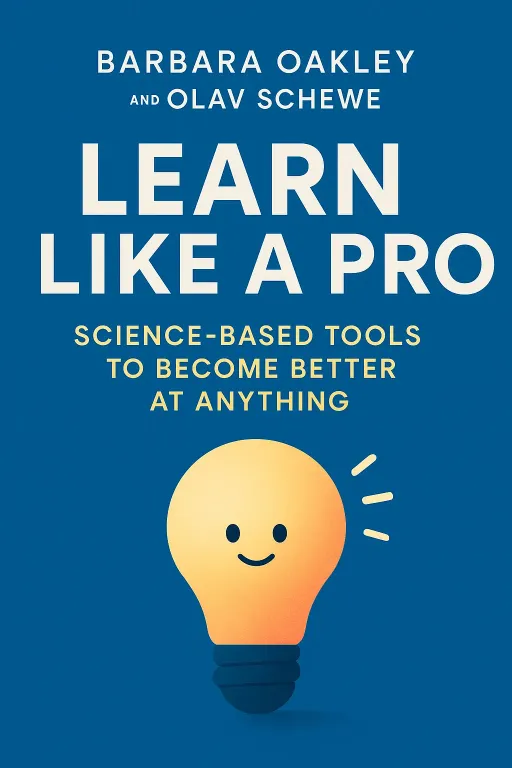
Nova: It might be, Atlas. And we’re diving into why today, with some incredibly powerful insights from two brilliant books. First, we’re drawing from by Olav Schewe and Barbara Oakley. For anyone unfamiliar, Barbara Oakley is a titan in the world of learning science, renowned for her groundbreaking work and her wildly popular online course, "Learning How to Learn," which has empowered millions globally.
Atlas: I can see that. For anyone who's ever felt like they're hitting their head against a wall trying to absorb a new skill or complex financial model, the idea of learning to learn effectively is gold. That's a profound understanding right there.
Nova: Absolutely. And then, we're going to connect that deep learning with an equally crucial mental framework from Julia Galef’s. Because what good is mastering information if you’re only learning what confirms your existing biases?
Atlas: That makes me wonder, how often are we learning, versus just reinforcing what we already believe? This sounds like it's going to challenge some deeply ingrained habits.
Deep Dive into Strategic Learning Techniques
SECTION
Nova: Precisely. And that brings us to our first core idea: Strategic Learning Techniques. Forget passive re-reading. Schewe and Oakley introduce us to two powerhouses: Active Recall and Spaced Repetition. Let's start with Active Recall. Imagine you’re trying to learn a new language, say, the intricacies of market dynamics for a global geopolitics course. Most people would just read the textbook chapter over and over.
Atlas: Yeah, I can definitely relate to that. Or listen to a lecture multiple times, hoping it just… sinks in.
Nova: Right? But Active Recall demands more. Instead of passively looking at the answers, you force your brain to retrieve the information from scratch. Think of it like this: your brain is a jungle, and every piece of information is a path. The more you that path, the clearer and more accessible it becomes. Re-reading is like flying over the jungle in a helicopter; you see the path, but you don't actually build the muscle memory of walking it.
Atlas: So you’re saying I should actually myself? Like, close the book and try to explain the concept out loud, or write down everything I remember?
Nova: Exactly! It could be flashcards, blurting out key concepts, or even trying to teach the material to an imaginary friend. The effortful retrieval is the magic. For example, a student studying for a certification in financial management might think they understand portfolio theory after reading it. But if they close the book and try to the efficient frontier formula, or explain the assumptions behind the Capital Asset Pricing Model without looking, they immediately expose the gaps in their understanding.
Atlas: That’s a great way to put it. It’s like stress-testing your knowledge. It feels harder in the moment, but you’re building something more robust. But how do you make sure you don't just forget it all a week later?
Nova: That’s where our second powerhouse comes in: Spaced Repetition. It’s the art of strategically distributing your learning over time. Most of us cram. We pull an all-nighter before a big presentation, download everything into short-term memory, ace it, and then poof! It’s gone.
Atlas: Oh, I’ve been there. Honestly, that sounds like my Monday mornings trying to remember everything from a weekend workshop.
Nova: Well, Spaced Repetition leverages how our memory naturally works. Our brains are constantly deciding what to keep and what to discard. If you encounter a piece of information, then revisit it right before you're about to forget it, your brain says, "Hey, this must be important!" and strengthens the memory. Then you wait a little longer before the next review, and so on.
Atlas: So, it’s not about how time you spend, but you spend it? Like, instead of a ten-hour cram session, it's better to do ten one-hour sessions spread out over a month?
Nova: Precisely. Think of it like building a sturdy wall. Cramming is like trying to stack all the bricks at once; it'll collapse. Spaced Repetition is about laying a few bricks, letting the mortar set, then adding more. Each layer builds on a solid foundation. For someone leading a team, trying to internalize complex strategic frameworks, this means reviewing key principles not just once, but at increasing intervals. It ensures those core ideas become part of your mental architecture, not just temporary notes.
Atlas: That’s actually really inspiring. For our listeners who are managing high-pressure teams or trying to grasp the nuances of global geopolitics, this isn't just about memorizing facts; it's about building a deep, resilient understanding. But how do you implement this when you're already swamped with daily demands? Are we talking about elaborate scheduling systems?
Nova: Not necessarily. It can be as simple as setting calendar reminders to review notes from a meeting a day later, then a week later, then a month later. Or using digital flashcard apps that automatically schedule reviews. The key is consistency over intensity. Even five to ten minutes of active recall on strategically spaced intervals can be incredibly powerful. It’s a pragmatic approach for anyone seeking profound understanding without burning out.
Deep Dive into Unbiased Vision: The Scout Mindset
SECTION
Nova: Now, Atlas, what if all that deep, resilient understanding you just built, all that effortful learning, was focused on the wrong things? Or worse, what if your brain was subtly twisting the information to fit a narrative you to believe?
Atlas: That makes me wonder about the quest for truth. If you're driven by impact and authenticity, you need to be sure you're operating on accurate information, not just convenient fictions. This is where Julia Galef’s comes in, right?
Nova: Exactly. Galef introduces us to two archetypes: the Soldier Mindset and the Scout Mindset. The Soldier is driven by self-preservation, defending their beliefs at all costs, even when evidence mounts against them. They see information as ammunition in an argument.
Atlas: So, like a politician doubling down on a flawed policy, even when the data screams otherwise, because admitting error feels like losing face?
Nova: A perfect example. Their goal isn't necessarily to find the truth, but to protect their ego, their reputation, or their existing worldview. The Scout, on the other hand, is driven by a desire to see reality as accurately as possible, even if it contradicts their most cherished beliefs. Their goal is to map the terrain, not to conquer it. They view information as a map, not a weapon.
Atlas: That sounds rough, but… isn’t it just human nature to want to be right? To defend what you believe, especially if you’re a visionary leader with strong convictions? For anyone leading with purpose and skill, isn't conviction part of the job?
Nova: It absolutely is human nature to gravitate towards the Soldier Mindset. It feels safer. But the Scout Mindset isn't about conviction; it's about having convictions that are rooted in reality. Galef’s core message is "Truth-Seeking Over Self-Preservation." It’s the willingness to be wrong, recognizing that accurate beliefs are a more reliable path to achieving your goals. Think of a brilliant scientist whose initial hypothesis is disproven by her own experiments. A Soldier would cherry-pick data or dismiss the findings. A Scout would say, "Fascinating. My initial map was wrong, but now I know more accurately where the treasure, which brings me closer to where it."
Atlas: That’s such a hopeful way to look at it. It reframes being wrong not as a failure, but as progress. But how do you even to cultivate that, especially when you're looking at complex global dynamics or trying to discern truth from spin in business success narratives? It feels like you'd have to constantly question everything.
Nova: You do, to an extent, but it's not about cynicism; it's about curiosity. One strategy is to actively seek out disconfirming evidence. Don't just read articles that agree with you; find the smartest arguments against your position. Another is to consider alternative explanations for events. Instead of immediately assigning malice or incompetence, think about other factors that could be at play. Most importantly, it's about separating your identity from your beliefs. Your worth isn't tied to being right; it's tied to being intellectually honest and growing.
Atlas: I guess that makes sense. It's like, if you're a strategist, you wouldn't just stick to your initial battle plan if new intelligence comes in, right? You'd adapt. The Scout Mindset is applying that same adaptability to your fundamental understanding of the world.
Nova: Exactly. It's the ultimate pragmatic approach. If your goal is truly to lead with purpose and skill, and to make an impact, then having an accurate map of reality is your most powerful tool. It allows you to navigate the world's true fight, whether that's in geopolitics or in the competitive business landscape, with clarity, not delusion.
Synthesis & Takeaways
SECTION
Nova: So, when we bring these two powerful ideas together – the strategic learning of Active Recall and Spaced Repetition, and the unbiased vision of the Scout Mindset – we see a truly potent combination for anyone navigating a new frontier. It’s about not just learning, but learning the things, and learning them.
Atlas: That’s a great way to put it. It’s like the Scout Mindset helps you decide to point your learning tools at, ensuring you’re not wasting effort mastering incorrect or irrelevant information. And then Active Recall and Spaced Repetition ensure that the information actually sticks.
Nova: Precisely. Imagine a visionary leader who needs to understand emerging market trends. They adopt a Scout Mindset to critically evaluate all the hype and common narratives, seeking out unbiased data and diverse perspectives. Once they've identified the signals, they then apply Active Recall and Spaced Repetition to deeply internalize that complex market intelligence, ensuring they can recall it, analyze it, and act on it effectively.
Atlas: It’s a powerful feedback loop. The more accurately you see reality, the more effectively you can learn from it, and the more robust your understanding becomes. For our listeners who are seekers of profound understanding, strategists, and visionaries, this isn't just about personal growth; it's about building a foundation for genuine impact and authenticity in everything they do.
Nova: It is. So, our deep question for you, the listener, is this: How can you intentionally apply active recall and spaced repetition to your financial management studies or leadership development, while simultaneously adopting a 'scout mindset' to critically evaluate common narratives about global dynamics and business success? We encourage you to journal your insights daily, connect these dots, and see where this dual approach takes you.
Atlas: And maybe even try to identify one belief you hold strongly, and then actively seek out evidence that contradicts it, just for a few minutes this week. See what you discover.
Nova: It's a small step that can lead to a giant leap in clarity. Thank you for joining us on this journey of intellectual exploration. We love hearing your thoughts and how these ideas resonate with you. Find us online and share your insights.
Atlas: This is Aibrary. Congratulations on your growth!









