

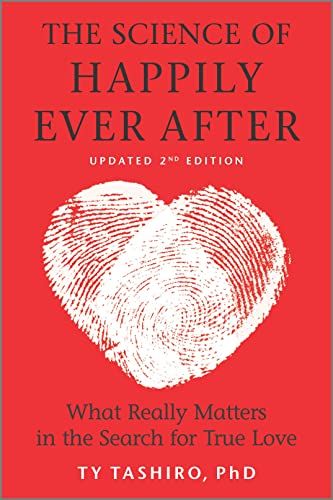
The science of happily ever after
What Really Matters in the Quest for Enduring Love
Introduction
The Science of Love: Debunking the Fairytale
Nova: Welcome to the show. I want to hit you with a statistic right out of the gate that might make you rethink every romantic comedy you've ever loved. Did you know that of all the people who get married, only about three in ten—that’s 30%—remain in what researchers define as a healthy, happy marriage?
Nova: Exactly! That’s the central question that psychologist Dr. Ty Tashiro tackles in his fantastic book, "The Science of Happily Ever After: What Really Matters in the Quest for Enduring Love." He argues that we are approaching love with the wrong operating system.
Nova: That’s the fairytale fallacy he dismantles. Tashiro, whose research focuses on translating lab findings into real-world relationship advice, suggests that our deeply ingrained, often Disney-fueled ideas about romance are actively sabotaging our long-term happiness. We’re looking for fireworks when we should be looking for a steady, reliable power source.
Nova: Precisely. The book is a deep dive into making smarter choices about one of the most important decisions in our lives. We’re going to explore why our decision-making abilities seem to fail us when romance is involved, and what three core elements, backed by decades of psychological research, actually keep love alive past the honeymoon phase.
Nova: We start by looking at the honeymoon phase itself, and the shocking speed at which satisfaction plummets. Get ready, because the numbers are stark.
Key Insight 1: The Statistical Cliff
The Honeymoon Hangover: Satisfaction's Steep Decline
Nova: Tashiro points out a truly alarming trend in relationship satisfaction. He notes that couples entering marriage often report incredibly high satisfaction—sometimes scoring as high as 86% in that very first year. It feels like the peak of human experience, right?
Nova: But here’s the gut punch. By the seventh year, that satisfaction score often dips below 50%. Think about that drop—it’s a statistical cliff dive. It suggests that the initial chemistry, the intense bonding, is not sustainable in its raw form.
Nova: Tashiro attributes a significant portion of this to what we bring into the relationship, specifically our unrealistic expectations rooted in cultural narratives. We expect the intensity of the beginning to last forever. We expect our partner to fulfill every emotional niche, which is an impossible burden.
Nova: It’s a powerful starting fuel, but it’s not the engine for the long haul. Tashiro’s research strongly suggests that lust, that initial intoxicating attraction, depreciates at a much faster rate than 'liking' someone. Lust is the spark; liking is the slow-burning log.
Nova: He emphasizes that we need to actively invest in the liking component. It’s about appreciating their character, their humor, their reliability—the things that don't fade when the initial biological cocktail wears off. It’s a conscious shift from being swept away to choosing to build.
Nova: Precisely. It’s a transition from the 'falling' phase to the 'standing together' phase. And to stand together, we need better criteria for who we choose to stand with. That brings us to the core of his partner selection algorithm.
Nova: Weeding out is the perfect term. Tashiro suggests we need to be ruthless in identifying traits that are incompatible with long-term happiness, even if those traits are currently masked by intense attraction. It’s about anticipating future conflict, not just enjoying present chemistry.
Key Insight 2: Prioritizing Traits Over Chemistry
The Selection Algorithm: Weeding Out Undesirables
Nova: Tashiro argues that our brains are actually wired to overlook red flags in the pursuit of mating, which is a massive evolutionary hangover. We need to consciously override that wiring by focusing on what he calls 'enduring traits.'
Nova: Humor is great, but Tashiro often contrasts passion with commitment-oriented traits. For instance, he suggests that traits like loyalty, emotional stability, and shared core values are far more predictive of that 30% success rate than shared hobbies or physical attraction. Loyalty, in particular, seems to be a cornerstone.
Nova: It is! And he points out that we often overvalue traits that are easy to spot early on—like charisma or physical appeal—and undervalue traits that take time to observe, like integrity under pressure or how they treat service staff.
Nova: It’s about observation over time, and asking the right questions, or rather, paying attention to the answers you get when discussing past experiences. For example, how do they talk about past relationships? Are they capable of taking responsibility for their role in past failures, or is every ex a complete villain?
Nova: Exactly. Tashiro’s research implies that the ability to self-reflect and accept imperfection is crucial. If someone presents a perfectly curated, flawless history, that’s a massive red flag that they are prioritizing image over authenticity—and authenticity is what you need when the satisfaction score is hovering near 50%.
Nova: It absolutely does. Because even the happiest couples fight. The difference isn't they fight, but they fight, and more importantly, how quickly they repair. That leads us perfectly into the next crucial element: managing the inevitable friction without letting it erode the foundation we’ve just discussed building.
Key Insight 3: Repair Attempts and Shared Meaning
The Repair Kit: Navigating Inevitable Conflict
Nova: We’ve established that we need to choose wisely based on enduring traits like loyalty. But even the most perfectly selected couple will have a disagreement about finances, in-laws, or whose turn it is to empty the dishwasher. Tashiro draws heavily on established relationship science here, particularly the work of researchers like John Gottman, to explain what keeps the relationship afloat during these storms.
Nova: They are the relationship killers, yes. Contempt, in particular, is the single greatest predictor of divorce. It’s that feeling of moral superiority over your partner. But Tashiro focuses heavily on the antidote: the Repair Attempt.
Nova: A repair attempt is any statement or action—silly or serious—that prevents negativity from escalating out of control. It can be as simple as saying, 'Whoa, I’m getting too angry, can we take a five-minute break?' or even using humor to diffuse tension, like saying, 'This is ridiculous, we sound like two angry squirrels fighting over an acorn.'
Nova: That’s the reciprocity of successful relationships. Tashiro emphasizes that successful couples are not just good at repair attempts; they are exceptionally good at them. They give each other the grace to pull back from the brink.
Nova: Absolutely. And beyond conflict management, the final piece of the puzzle that Tashiro stresses is the creation of shared meaning. This is where the relationship moves from being just two individuals coexisting to being a true unit.
Nova: It’s deeper than just logistics. It’s about creating a shared culture. It’s the inside jokes, the rituals you develop—like Sunday morning coffee on the porch, or the way you celebrate small victories. These shared meanings become the glue that holds the 30% happy couples together when the initial 86% satisfaction has long since evaporated.
Nova: Resilience is the key word. It’s about understanding that love isn't a destination you arrive at; it’s a structure you continuously maintain and reinforce. And that maintenance requires constant, conscious effort, informed by science, not just by feeling.
Conclusion
The Science of Lasting Love
Nova: We’ve covered a lot of ground today, moving from the harsh reality that only 30% of marriages are truly happy, to the practical steps we can take to join that successful minority. The central message from Ty Tashiro’s research is clear: love requires intelligence and strategy.
Nova: Our biggest takeaway for listeners should be the shift in partner selection criteria. Be skeptical of the dazzling, charismatic person who can’t take responsibility for their past. Instead, prioritize enduring traits like loyalty and emotional stability—the boring stuff that actually keeps the lights on.
Nova: Ultimately, Tashiro gives us permission to be pragmatic about romance. Enduring love isn't about finding a perfect person; it’s about making a smart choice, managing conflict with skill, and diligently building a shared culture of meaning together.
Nova: That’s the goal. Stop hoping for magic, and start applying the science. This is Aibrary. Congratulations on your growth!