

The PM's Paradox: Unlocking the Science of Getting Started
Golden Hook & Introduction
SECTION
Nova: Have you ever had that feeling? You’re staring at a brand new project, a blank page, that blinking cursor on the screen, and you just… freeze. The sheer size of the task feels like a mountain, and you have no idea where to even take the first step.
Wadhha: Oh, absolutely. In project management, we call that 'analysis paralysis.' It's the moment before the Gantt chart is filled, and it can be the most intimidating part of the entire project lifecycle. You know you need to start, but the 'how' is a huge wall.
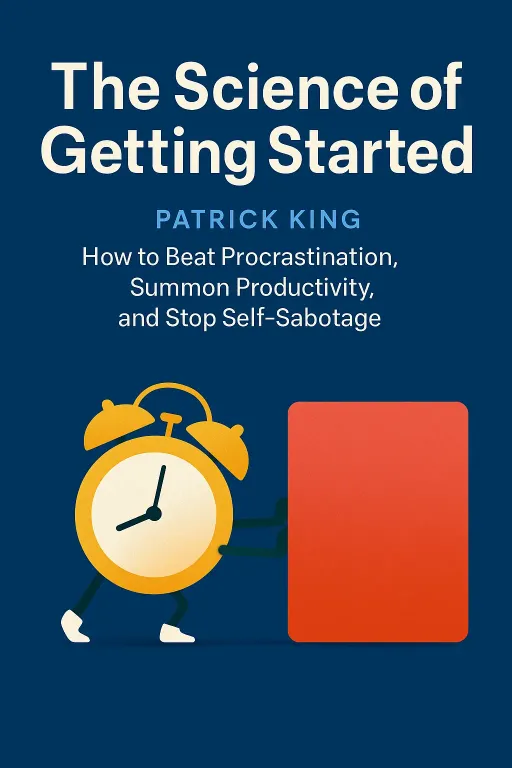
Nova: Exactly! And that's why we're so excited today. We're diving into a book that feels like a secret playbook for that exact moment. It's "The Science of Getting Started" by Patrick King. And I'm here with Wadhha, a project manager who lives and breathes the challenge of turning ideas into action. Welcome, Wadhha!
Wadhha: Thanks for having me, Nova. This topic is so relevant. It’s the core of what I do every day—or try to do!
Nova: Well, this book argues that beating procrastination isn't about willpower or waiting for inspiration. It's about science and strategy. So today, we'll dive deep into this from two perspectives. First, we'll become detectives and uncover the five secret identities of procrastinators—you'll definitely see yourself or your colleagues in one of them.
Wadhha: I'm already intrigued. Knowing the 'who' behind the delay is critical.
Nova: Then, we'll shift from psychology to physics and reveal the simple, powerful law of motion that can get any project, and any person, unstuck. Ready to get started?
Wadhha: Let's do it. No procrastination on this podcast!
Deep Dive into Core Topic 1
SECTION
Nova: Alright, so let's start with the diagnosis. The book says we often think of procrastination as a single bad habit, but it's not. King identifies five distinct types of procrastinators, each with a different hidden motive. There's the Thrill-Seeker, who loves the last-minute rush; the Avoider, who fears judgment; the Indecisive, who fears blame; the Busy Procrastinator, who does everything except the important thing; and the one I think many of us can relate to: the Perfectionist.
Wadhha: The Perfectionist. That one sounds deceptively like a good thing, but I have a feeling it’s not. In my field, it can be a real hidden danger.
Nova: You are so right. The book tells this perfect story about it. Let's call her Sheena. Sheena is tasked with updating the company manual. It's a straightforward job: add the new policies, tidy it up. But Sheena is a perfectionist. She doesn't just want to update it; she wants to create the manual.
Wadhha: I've met Sheena. Or at least, versions of her.
Nova: Right? So, the fear of delivering anything less than a flawless, revolutionary document paralyzes her. Instead of starting the manual, what does she do? She decides her office workspace isn't optimized for peak performance. So she spends a day reorganizing her desk. Then, she color-codes all her file folders. She's incredibly busy, she productive, but the manual remains untouched.
Wadhha: That is a classic case of what we call 'gold-plating' in project management. You're adding features or polish that the client—or in this case, the task—never asked for. It feels like you're adding value, but you're actually just delaying the core deliverable and burning through the budget, or in this case, the timeline.
Nova: That's such a great way to put it. The book says perfectionists delay tasks for fear of doing things wrong. The standard is so impossibly high that it's safer to do nothing at all, or to do other, smaller tasks perfectly.
Wadhha: And from a PM's perspective, that's a massive risk. A perfectionist on your team can completely derail a sprint. They might spend a week on a single line of code or a single slide in a presentation, trying to make it perfect, while the rest of the project is waiting on them. It’s a bottleneck disguised as high standards.
Nova: So identifying that in yourself or your team is the first step. Are you avoiding the main task because you’re afraid it won’t be perfect? Or maybe you're an Avoider, afraid of what your boss will think. Or a Busy Procrastinator, filling your day with unimportant tasks to feel productive.
Wadhha: It’s a powerful idea. It shifts the question from 'Why am I so lazy?' to 'What am I afraid of?' Fear of imperfection, fear of blame, fear of judgment... that's a much more useful question to ask. It gives you a starting point for a solution.
Nova: Exactly. Self-awareness is the first domino. And that leads us perfectly to our next point. Once you know you're stuck, how do you actually get moving? The answer, surprisingly, has less to do with motivation and more to do with physics.
Deep Dive into Core Topic 2
SECTION
Nova: The book brings up this brilliant analogy using Newton's Laws of Motion. I know you have an interest in great thinkers like Einstein, Wadhha, so this might resonate. The first law states that an object at rest stays at rest, and an object in motion stays in motion. That's procrastination in a nutshell! It's pure inertia.
Wadhha: I love that. It’s so true. A project that hasn't started is the hardest thing in the world to get moving. But once it has momentum, it's much easier to keep it going. We talk about 'activation energy' for a project, and this is the perfect description of it.
Nova: And here’s the mind-blowing part that turns everything we think we know on its head. We usually think we need to find motivation, and then we'll take action. We wait to 'feel like it.' But King argues, and the science backs this up, that we have it completely backward. The core idea is: Motivation action.
Wadhha: Say that again. That’s a big one.
Nova: Motivation follows action. You don't wait for the feeling. You act first, and the feeling of motivation and confidence comes the action itself. The hardest part is just overcoming that initial inertia.
Wadhha: That completely reframes the problem. We're all waiting for this magical 'motivation fairy' to show up, but the book is saying we have to create our own magic just by doing. Anything.
Nova: Precisely! And it doesn't have to be a big something. The book talks about the "Two-Minute Rule." The idea is, if you're procrastinating on a task, just commit to doing a version of it that takes less than two minutes. You want to write a report? Don't think about the whole report. Just open a new document and write the title. That's it. That's the task.
Wadhha: That is so aligned with agile project management principles. We break down huge projects into tiny 'user stories' or tasks that can be completed in a short time. The goal of a sprint isn't to finish the entire product; it's to produce a small, tangible piece of it. That small win, that finished task, is what builds the team's morale and momentum for the next one.
Nova: It's the exact same principle. The book gives the example of someone needing to write a 20,000-word research paper. The thought is crushing. But if the task is just "Jot down three bullet points for the introduction," it's almost impossible to say no to. It's too small to fail. But once you've done that, you've broken the inertia. You're in motion. And an object in motion tends to stay in motion.
Wadhha: It lowers the barrier to entry to almost zero. You're tricking your brain, that 'lizard brain' the book talks about that's always seeking comfort and avoiding effort. A two-minute task isn't threatening. It's easy. So the lizard brain says, "Okay, fine," and before you know it, you've started.
Nova: And once you've written the title, maybe you'll write the first sentence. And then a paragraph. The action itself generates the confidence and the motivation to continue. You're not the same person who was staring at a blank page five minutes ago. You're now a person who has.
Wadhha: That's a powerful mindset shift. It’s not about the mountain; it’s about picking up a single stone. As a PM, I can see myself using this with my team. Instead of saying "We need to build this entire feature," I can say, "Let's just define the single most important function. What's the two-minute version of that?"
Synthesis & Takeaways
SECTION
Nova: So, it really boils down to this elegant, two-step process. First, you play detective. You look at your own behavior and use the book's profiles to understand your personal brand of procrastination. Are you a Perfectionist like Sheena? An Avoider? That gives you the 'why'.
Wadhha: And once you have the 'why,' you don't fight it with feelings. You fight it with physics. You accept that motivation isn't coming to the rescue. You have to create it. And you do that by taking one, tiny, almost laughably small step. A two-minute action.
Nova: It’s so simple, but it’s not easy, because it goes against our every instinct to wait until we 'feel ready.' But the book's promise is that 'ready' is a state you create through action, not one you wait for.
Wadhha: I think for anyone listening, especially if you're in a role like mine where starting things is your job, this is liberating. It takes the pressure off. You don't have to be a hero and conquer the whole mountain today. You just have to take one step. The rest will follow.
Nova: That's the perfect way to summarize it. So, as our call to action for everyone listening, let's take this advice to heart. Think of one thing—just one—that you've been putting off. It could be a project, a difficult email, or even just cleaning the garage.
Wadhha: And don't think about the whole task. Just ask yourself: What is a two-minute version of this? What is one tiny step I can take right now to break the inertia?
Nova: Maybe it's just finding the email address you need. Or taking the trash out of the garage. Or, like the book says, just writing the title. Do that one small thing, and see if the motivation doesn't start to find you.
Wadhha: A fantastic challenge. It’s about proving to yourself that you can get started. And that's a science we can all master.
Nova: Wadhha, thank you so much for bringing your project manager's insight to this. It was incredibly valuable.
Wadhha: It was my pleasure, Nova. This was a great conversation.









