

The Power Trap: Why Leaders Fall and Empires Crumble
Golden Hook & Introduction
SECTION
Nova: Atlas, if you had to review “The Power Trap: Why Leaders Fall and Empires Crumble” in exactly five words, what would they be?
Atlas: Oh, easy: “Power's a fickle, crumbling house.” Your turn?
Nova: Hmm, I’d go with: “History's hidden, hungry, human engine.”
Atlas: Oh, I like that! “Human engine.” That’s a great way to put it, especially for a book that really pulls back the curtain on something we constantly observe but rarely truly understand.
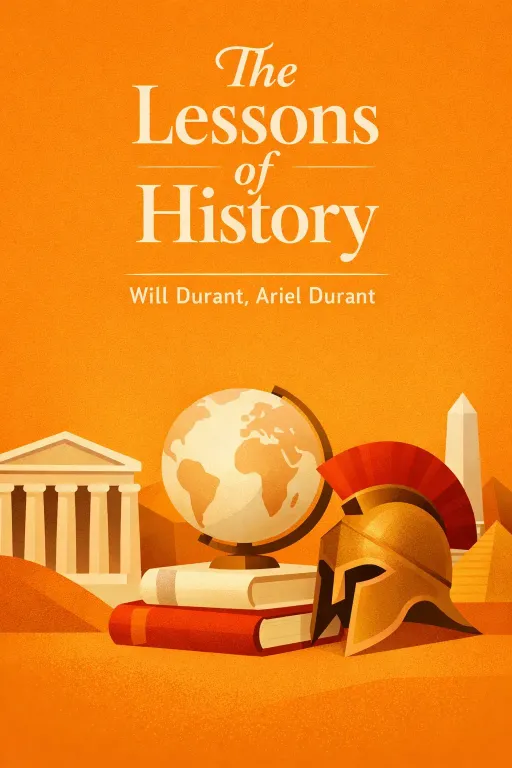
Nova: Exactly. We’re talking about “The Power Trap: Why Leaders Fall and Empires Crumble,” a book that takes the grand narratives of history, from the sweeping analyses of Will and Ariel Durant’s “The Lessons of History” to Paul Kennedy’s “The Rise and Fall of the Great Powers,” and synthesizes them into a surprisingly fresh framework for today. It’s not just a history book; it's a guide to decoding the hidden forces shaping our world.
Atlas: That’s fascinating. I’m curious, what do you mean by “hidden forces”? Because a lot of us, myself included sometimes, look at historical events and see a collection of dates, names, and maybe some epic battles. What’s the blind spot the book is trying to illuminate?
The Seductive Blind Spot of Power
SECTION
Nova: That’s the perfect question to kick us off, Atlas. The book argues there’s a fundamental blind spot, a constant, often overlooked force beneath those dates and names: the seductive and destructive nature of power itself. We tend to see power as a static thing, something you either have or you don't.
Atlas: So you’re saying we focus on the of power, but not the of it?
Nova: Precisely. We focus on the empire’s borders, the leader’s decrees, the economic output. But we often ignore the dynamic, living entity that power is. It's like looking at a magnificent skyscraper and only admiring its height, without ever considering the geological shifts beneath its foundation, or the corrosion silently eating away at its steel beams.
Atlas: That makes me wonder, how does ignoring that dynamic leave us vulnerable? Because for a lot of our listeners who are trying to understand current global leadership, or even the power dynamics in their own organizations, this sounds pretty crucial.
Nova: It leaves us perpetually surprised, doesn't it? We gasp when a seemingly unshakeable leader falls, or a global power suddenly stumbles. The Durants, in “The Lessons of History,” observed this pattern across all civilizations. They concluded that power corrupts, and absolute power corrupts absolutely. But they didn’t present it as a moral judgment.
Atlas: Hold on, “not a moral judgment”? That sounds a bit counterintuitive. When we talk about corruption, it almost always carries a moral weight.
Nova: That’s a great point. What the Durants meant was that it’s an, almost like a law of physics for human systems. It’s a predictable outcome of unchecked power, regardless of the initial intentions of the person wielding it. The system itself, the structure of absolute power, tends to erode the very qualities that might have brought a leader to prominence – humility, empathy, a connection to reality.
Atlas: So the blind spot isn't just about failing to see power, but failing to see its? That’s a deep insight. Like a beautiful machine that, by its very design, eventually wears itself out.
Nova: Exactly. If you’re only looking at the surface-level facts – who’s in charge, what policy they just passed – you miss the deeper, systemic forces at play. You're vulnerable to repeating past mistakes in your analysis because you haven't grasped the underlying dynamic. You’re always reacting, never truly anticipating.
Atlas: That gives me chills, honestly. Because it suggests that even the most well-intentioned leaders, if placed in a system of absolute power, are almost destined for a certain trajectory. It’s not about their character, necessarily, but the they’re operating within.
The Inevitable Lifecycle of Power
SECTION
Nova: And once you acknowledge that blind spot, you start to see the patterns. This brings us to the second core idea, which often acts as a counterpoint to the initial seduction: the inevitable lifecycle of power. Paul Kennedy, in “The Rise and Fall of the Great Powers,” laid this out with stunning clarity.
Atlas: I’m curious, “lifecycle of power”? That sounds like a biological process. What’s the core idea there?
Nova: It’s precisely that, Atlas. Kennedy illustrates how economic strength and technological innovation are the bedrock of global power. They are the nutrients, the sunlight, the water that allows a power to grow. But here’s the crucial part: their decline, or the rise of these factors elsewhere, inevitably leads to a shift in world order. No power stays at the top forever.
Atlas: So it’s like a global game of musical chairs, but the music always stops for everyone eventually? What causes that decline? Is it always external forces chipping away?
Nova: Not always, and this is where it gets really interesting. Kennedy emphasizes that the internal decay of a system often precedes its external collapse. It’s not just about a rival nation attacking. It's about a slow, often imperceptible, erosion from within – economic stagnation, social unrest, a failure to innovate, or an overextension of military reach that drains resources.
Atlas: That makes me wonder, how does that play out in real life? Can you give an example of that internal decay happening before an external collapse?
Nova: Think about the later Roman Empire. It wasn't just barbarians at the gates. It was hyperinflation, political instability, reliance on slave labor that stifled innovation, and a vast, expensive military that stretched its resources thin. The external pressures certainly played a role, but the empire was already hollowed out from within. The seeds of its destruction were planted long before the final harvest.
Atlas: Wow. So it’s like a body fighting off an infection, but it’s already got a chronic illness nobody’s treating. That’s a great analogy. For our listeners who are navigating complex geopolitical dynamics, how does understanding this lifecycle help predict, rather than just observe, what’s happening today?
Nova: It allows you to move beyond the superficial news cycle, beyond the daily headlines, and look for deeper trends. You start asking: where is the economic bedrock shifting? Who is innovating, and who is stagnating? Where are the internal stresses – the social, economic, technological – that are quietly eroding power from the inside?
Atlas: That’s a serious lens shift. It’s not just about who has the biggest army, or the loudest voice, but about foundational strength and adaptability. It makes you look at current global leadership and emerging dynamics with an entirely different set of questions. You’re not just watching the boxing match; you’re examining the fighters' conditioning and their diet over the last decade.
Nova: Exactly. It’s about understanding power’s lifecycle, its birth, growth, and eventual decline, so you can anticipate the next shifts rather than just reacting to them. It's about seeing the forest, not just the trees.
Synthesis & Takeaways
SECTION
Nova: So, what we’ve really been discussing today is how power is never static. It's this living, breathing, and ultimately fragile force. Acknowledging its seductive blind spots and its inevitable lifecycle isn't about cynicism.
Atlas: No, it's about clarity. It's about gaining foresight, isn’t it? Because if you understand the internal decay that often precedes external collapse, you can start to identify those vulnerabilities in systems, whether they’re empires or even smaller organizations.
Nova: Absolutely. It’s like understanding that even the strongest steel beam will eventually corrode if left unattended. The lifespan of great powers, historically, averages around 250 years. That’s not a lot in the grand scheme of things, and it highlights just how temporary and vulnerable even the most dominant systems can be.
Atlas: That’s such a hopeful way to look at it, actually. Because it means we’re not just passive observers of history. By understanding these dynamics, we can potentially influence them, or at least navigate them with more wisdom.
Nova: It's about developing an informed perspective, a deeper connection to the truth that history offers. We want to encourage all of you to delve deeper into these ideas. What are the blind spots you’re seeing in current events? What internal decays are you observing that might signal future shifts?
Atlas: Share your insights with us! We love hearing your perspectives and how these historical lessons resonate with your understanding of today’s world.
Nova: This is Aibrary. Congratulations on your growth!