

How Information Broke the World
Introduction
Narrator: What if the most powerful force reshaping our world isn't a government, a corporation, or an ideology, but a tidal wave of pure information? Imagine an explosion of data so vast that in a single year, humanity produced more information than in all of prior history combined. This isn't a futuristic scenario; it's the reality we entered at the dawn of the 21st century. This information tsunami has fundamentally broken the old rules of power, leaving our most established institutions—from governments and media to science and finance—reeling in a state of perpetual crisis.
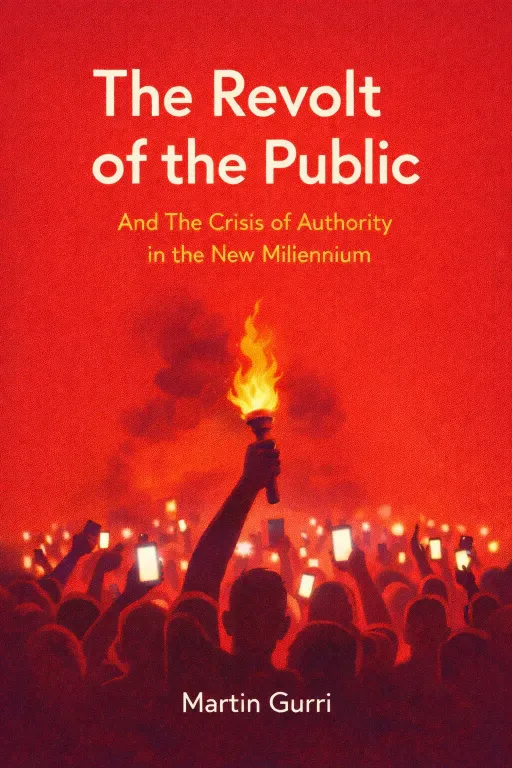
In his prescient book, The Revolt of the Public: And The Crisis of Authority in the New Millennium, former CIA analyst Martin Gurri provides a powerful lens to understand this chaotic new era. He argues that we are witnessing a slow-motion collision between two worlds: the old, top-down world of hierarchical authority and a new, bottom-up world of the networked public. This clash explains the seemingly disconnected phenomena of our time, from the Arab Spring to Occupy Wall Street, and the deep, corrosive distrust that now defines our relationship with authority.
The Information Tsunami That Drowned Authority
Key Insight 1
Narrator: For most of human history, information was scarce and controlled by elite gatekeepers. Think of Walter Cronkite, the CBS news anchor once called "the most trusted man in America." When he spoke, the nation listened, because sources of information were few and the cost of broadcasting was high. This scarcity created a monopoly on information that was the bedrock of institutional authority.
Gurri explains that this all changed with what he calls the "information tsunami." Beginning with cable TV and accelerating exponentially with the internet and social media, the volume of information exploded. Researchers at UC Berkeley found that the year 2001 alone generated more information than all previous human existence. This flood of content shattered the old monopolies. Suddenly, the official narrative from a government or a major newspaper was just one voice in a deafening chorus of millions. As Gurri powerfully states, "Uncertainty is an acid, corrosive to authority. Once the monopoly on information is lost, so too is our trust." The public, now armed with endless alternative sources, began to see the gap between what institutions claimed and what was actually happening, and the age of automatic trust came to an abrupt end.
The Public Awakens: From Passive Masses to Networked Actors
Key Insight 2
Narrator: The information tsunami didn't just undermine authority; it transformed the very nature of "the public." In the 20th century, political theorist Walter Lippmann described the public as a "phantom"—a passive, uninformed mass easily swayed by elite-crafted narratives. This "mass audience," Gurri argues, was a fantasy created by the monopoly conditions of the industrial age.
The digital revolution disintegrated this passive mass. In its place rose what Gurri calls "vital communities"—active, networked groups of amateurs coalescing around shared interests. These are the people who have evolved into Homo informaticus, individuals who are no longer just consumers of information but active producers and critics. A stunning example of this is Wael Ghonim, a Google employee who, in 2011, anonymously created a Facebook page called "We Are All Khaled Said" to protest police brutality in Egypt. What started as a digital gathering point for outrage transformed into a real-world revolution. Ghonim scheduled the first day of the Egyptian uprising as a Facebook event, and millions responded. The passive phantom public had become a powerful political actor, capable of challenging and even overthrowing entrenched regimes.
2011: The Year the World Reached a Boiling Point
Key Insight 3
Narrator: Gurri identifies 2011 as a "phase change," a moment when the simmering conflict between the public and authority boiled over into a global phenomenon. While the Arab Spring saw revolts against dictators, a similar spirit of outrage erupted in the heart of Western democracies. In Spain, the indignados (the "outraged") movement, organized on Facebook, saw hundreds of thousands occupy city squares to protest a political and economic system they viewed as corrupt and broken.
These protests were defined not by a clear ideology or set of demands, but by what they were against. They were a great roar of negation. The indignados employed a tactic called the "silent scream," a gesture meant to represent an internal revolution rather than a specific policy proposal. Similarly, the Occupy Wall Street movement in the United States famously refused to issue demands, arguing that the movement itself was the message. This reveals a central feature of the public's revolt: it is brilliant at repudiating the existing order but struggles to articulate a coherent alternative, a dynamic Gurri calls the "politics of negation."
The Politics of 'No': Why the Public Can Overthrow but Not Govern
Key Insight 4
Narrator: The public's greatest strength—its ability to unite in negation—is also its greatest weakness. Gurri illustrates this with a sharp contrast between two presidential failures. In 1961, after the disastrous Bay of Pigs invasion, President John F. Kennedy's approval rating actually rose by 10 points. The public and a deferential media rallied around a leader in an era of high institutional trust. Fast forward to 2009. When President Barack Obama's economic stimulus plan failed to meet its lofty projections, the public response was not forgiveness but fury. The online-organized Tea Party movement erupted, delivering a crushing defeat to Obama's party in the 2010 midterm elections.
This shows the new reality: the public is quick to punish failure but has no interest in the messy business of governing. Networks can protest and overthrow, but they can't rule. This creates a dangerous stalemate. As Gurri writes, "The Border... can neutralize but not replace the Center. Networks can protest and overthrow, but never govern. Bureaucratic inertia confronts digital nihilism. The sum is zero." This paralysis, this cycle of protest and backlash without resolution, leads to a destructive impulse Gurri identifies as nihilism—a belief that simply destroying the failed system is a form of progress.
The Failure of the Experts and the Rise of Zombie Institutions
Key Insight 5
Narrator: The crisis of authority isn't confined to politics. Gurri shows it has infected nearly every pillar of the establishment. He points to the "Climategate" scandal of 2009, when hacked emails revealed top climate scientists discussing how to "hide the decline" in certain data and suppress dissenting views from amateur critics. To the public, this looked less like a search for truth and more like a cartel protecting its turf. The result was a devastating blow to the credibility of scientific authority.
Likewise, the 2008 financial crisis exposed the "bankruptcy of the expert class." Figures like Fed Chairman Alan Greenspan, once hailed as a "Maestro," were forced to admit a fundamental "flaw" in their understanding of the economy. These repeated, high-profile failures have hollowed out our institutions. They still exist in form—the government, the university, the legacy newspaper—but they have lost their "authorizing magic," their legitimacy. Gurri calls them "zombie institutions": they shamble on, but the vital spirit of public trust is gone.
The Choice: Embracing Reality or Repeating Failure
Key Insight 6
Narrator: So, where does this leave us? Gurri argues that both the government and the public are complicit in this crisis. Governments, clinging to an outdated "high modernist" belief that they can engineer society from the top down, make heroic promises they can't possibly keep. The public, in turn, demands impossible outcomes.
Gurri uses a brilliant analogy from Charles Dickens' novel Bleak House: the character of Mrs. Jellyby, who is obsessed with a philanthropic project for a distant African tribe while her own children live in squalor around her. He calls this "telescopic philanthropy." The public today often acts like Mrs. Jellyby, demanding that government solve vast, abstract problems while neglecting the actionable choices within their own personal sphere. The path forward, Gurri suggests, requires a radical dose of honesty. Governments must become "open" and transparent, admitting their limits and uncertainties. And the public must align its demands with reality, abandoning the politics of the impossible.
Conclusion
Narrator: The single most important takeaway from The Revolt of the Public is that the conflict between the networked public and hierarchical authority is not a temporary phase, but the new, permanent condition of our political reality. The old world of top-down control is broken beyond repair, but the new world of bottom-up revolt has not yet learned how to build. We are trapped in a state of "perpetual turbulence," defined by a public that will not rule and institutions that are progressively less able to.
Gurri leaves us with a profound and unsettling challenge. Democracy is a fragile system that depends on compromise, trust, and a shared acceptance of imperfect outcomes. In an age of absolute negation and radical distrust, can it survive? The choice is stark: we can either learn to navigate this new reality with honesty and humility, or we can watch as our democratic institutions are ground to pieces in this ongoing war of the worlds.