

Are We in a Zombie Democracy?
Golden Hook & Introduction
SECTION
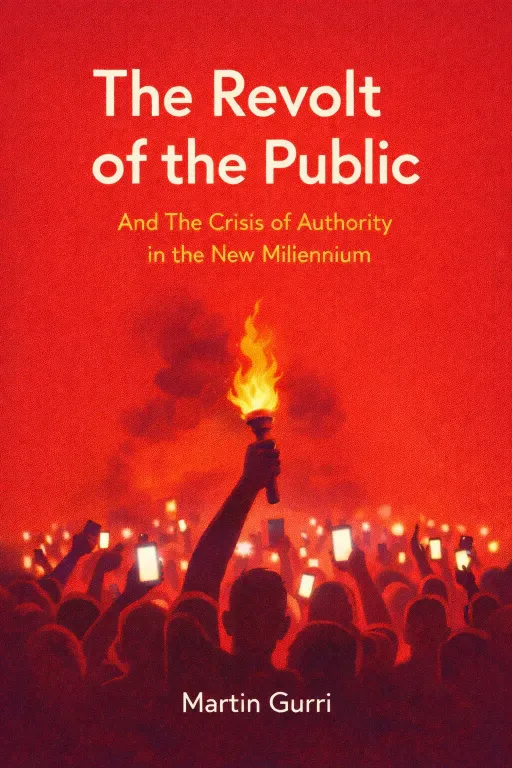
Michael: In the year 2001, humanity generated more information than in all of previous human history combined. Then, in 2002, we did it again. This wasn't an information boom; it was a tsunami. And according to our book today, it broke the world. Kevin: Whoa. Okay, that’s a heck of an opening statement. More information in one year than in all of history? That’s almost impossible to wrap your head around. What does that even mean for us? Michael: It means everything. That data point is the explosive engine at the heart of the book we’re diving into today: The Revolt of the Public and the Crisis of Authority in the New Millennium by Martin Gurri. And what’s fascinating is that Gurri isn't your typical academic prognosticator. Kevin: Right, who is this guy? Michael: He spent nearly three decades as a CIA analyst, specializing in how information and media shape global events. He was watching this from the inside. He saw this collision coming long before most of us did. The book was first published in 2014, and it’s become almost legendary for its prescience, with many people saying it predicted the dynamics that led to Brexit and the election of Donald Trump. Kevin: A former spy who basically wrote the instruction manual for the political chaos of the last decade? Okay, I'm in. So this information tsunami is the key? Michael: It’s the key to everything. Gurri calls it the "Fifth Wave," a fundamental shift in how society is organized, as big as the invention of the printing press or the industrial revolution. And it all starts with the death of a very specific kind of authority.
The Information Tsunami: How Abundance Killed Authority
SECTION
Michael: Think about the world your parents or grandparents grew up in. In the 1960s, if you wanted to know what was happening in the world, you turned on the TV at 6:30 PM and watched Walter Cronkite. He was famously called "the most trusted man in America." When he declared the Vietnam War unwinnable, President Lyndon Johnson reportedly said, "If I've lost Cronkite, I've lost Middle America." One man, one broadcast, could shape the nation's reality. Kevin: Right, because he was the gatekeeper. There were only three channels. He, and a few others, decided what was news. Michael: Exactly. That was a world of information scarcity. Authority, whether it was the media, the government, or the scientific establishment, was built on a monopoly over information. They had the facts, the access, the credentials. The public were just passive consumers. Gurri says that monopoly is now shattered forever. Kevin: But hold on, isn't more information and less gatekeeping a good thing for democracy? I mean, transparency, citizen journalism, holding power to account... that all sounds great. Why does Gurri call it a 'crisis'? Michael: It’s a fantastic question. The issue isn't that information is bad. The issue is that when the volume of information becomes a tsunami, the authority of any single source plummets. Gurri has this brilliant quote: "Uncertainty is an acid, corrosive to authority. Once the monopoly on information is lost, so too is our trust." Kevin: I think I see. When you have three news channels, you might trust one of them. When you have three million blogs, YouTube channels, and Twitter accounts, who do you trust? You end up trusting the ones that confirm what you already believe. Michael: Precisely. And it dismantled entire industries. Take the daily newspaper. For a century, it was an industrial marvel. It profited by 'bundling' everything together: world news, sports scores, horoscopes, classified ads, movie times. You bought the whole package. Kevin: My grandpa still gets it for the crossword puzzle. Michael: Gurri’s 93-year-old mother does the same thing! But for everyone else, the internet 'disaggregated' that bundle. You want sports scores? You go to ESPN.com. You want to sell a couch? You use Craigslist or Facebook Marketplace. Each piece of the newspaper was torn away by a specialized, better alternative online. And as the business model collapsed, so did the newspaper's magisterial authority. Kevin: Ah, so it's like the all-you-can-eat buffet suddenly had to compete with a thousand specialized food trucks. The buffet is still there, but it's no longer the only game in town, and it suddenly looks a lot less appealing. Michael: That's a perfect analogy. And Gurri argues this exact process happened to every major institution. It happened to science, for instance. Remember 'Climategate' in 2009? Hackers released emails from a top climate research unit, and they seemed to show scientists trying to hide data and silence skeptics. Kevin: I remember the uproar. The scientists were eventually cleared of misconduct, weren't they? Michael: They were, by their own institutions. But in the court of public opinion, the damage was done. For the first time, amateur bloggers and online sleuths could access the data, run their own analyses, and mount a credible challenge to the scientific priesthood. The high priests of science were suddenly being fact-checked by the congregation. Their authority, once taken for granted, was now up for debate. And that dynamic—the public challenging the experts—set the stage for a global political earthquake.
The Politics of 'NO': Why the Public Can Overthrow but Never Govern
SECTION
Michael: And this newly empowered public, armed with a firehose of information and a deep distrust of experts, started to act. But their actions took a very specific, and ultimately self-defeating, form. This brings us to the great paradox of the year 2011. Kevin: You mean the Arab Spring, Occupy Wall Street, all of that global unrest. It felt like the whole world was rising up. Michael: It was. And the story of the Egyptian revolution is a perfect case study. It was, in many ways, started by one man: a 30-year-old Google marketing executive in Dubai named Wael Ghonim. After a young Egyptian man, Khaled Said, was beaten to death by police, Ghonim anonymously created a Facebook page called "We Are All Khaled Said." Kevin: I remember that page. It went viral. Michael: It exploded. It became a gathering place for outrage. Then, inspired by the uprising in Tunisia, Ghonim posted an event on the page. He scheduled a revolution. He called for a protest in Tahrir Square on January 25th. He was an "extraordinary ordinary person," as Gurri puts it, bridging the gap between online anger and real-world action. And it worked. Millions turned out. The regime was stunned. Kevin: That's just mind-blowing. A Google employee basically schedules a revolution on Facebook. But they succeeded, right? They got rid of the dictator, Hosni Mubarak. That’s a win. Michael: It was a win. They toppled a 30-year dictatorship. But that’s where Gurri's thesis gets really dark. The public, he argues, is fantastically good at uniting around what it's against. Mubarak. The corrupt system. The police state. But it has no idea what it's for. Kevin: What do you mean? They wanted democracy, freedom... Michael: In the abstract, yes. But when it came to the messy business of building a new government, the movement fractured. The one thing that united the secular liberals, the students, and the Muslim Brotherhood was their hatred of Mubarak. Once he was gone, that unity dissolved. The public, Gurri says, is an army of negation. Michael: He points to the 'indignados' movement in Spain that same year. Hundreds of thousands of young people, furious about unemployment and corruption, occupied the central square in Madrid. They were inspired by Tahrir Square. But when you asked them what their demands were, they refused to answer. Kevin: They refused? Why? Michael: Because making demands would mean choosing a leader to negotiate them. It would mean creating a program. It would mean building a new hierarchy. And the entire point of the movement was to reject hierarchy. Their unifying principle was "NO." No to the political parties, no to the banks, no to the system. Kevin: So they can unite to burn the old house down, but they have no blueprint for a new one. And they don't even want a blueprint, because a blueprint is a form of authority, the very thing they're against in the first place. Michael: You've nailed the paradox. Gurri writes, "The Border, it is already clear, can neutralize but not replace the Center. Networks can protest and overthrow, but never govern." The result is a stalemate. He calls it a sterile back-and-forth of digital nihilism versus bureaucratic inertia. The sum is zero. The revolution stalls, and the old power structures, or new ones that look a lot like them, creep back in.
Zombie Democracy and the Choice We Face
SECTION
Michael: And this perpetual stalemate, this cycle of outrage and paralysis, leads to Gurri's most chilling concept: the 'zombie democracy.' Kevin: Zombie democracy? What on earth is that? It sounds like a bad movie title. Michael: It does, but it's a terrifyingly accurate description. Gurri argues that our core institutions—Congress, the media, political parties, even universities—are now zombies. They are technically alive. The buildings are still there, the people still show up for work, they still go through the motions. But they are walking dead. They've been drained of their soul, which is legitimacy and public trust. Kevin: That feels... uncomfortably familiar. The feeling that the whole system is just a hollow performance. Michael: Exactly. And in that vacuum of trust, you see a dangerous shift. You see elites, like the journalist Tom Friedman, openly admiring the "efficiency" of China's one-party authoritarian state because, hey, at least they can "get things done." The very process of democratic debate and compromise starts to look like a bug, not a feature. Kevin: That's terrifying. So are we just stuck in this loop of outrage and paralysis forever? Is there any way out of the zombie apocalypse? Michael: Gurri offers a choice, but it's not a grand political program. It's a deeply personal one. He uses a brilliant analogy from Charles Dickens' novel Bleak House. There's a character named Mrs. Jellyby. Kevin: I'm vaguely remembering her from high school English... Michael: Mrs. Jellyby is obsessed with a philanthropic project for a fictional African tribe in a place called Borrioboola-Gha. She spends all her time writing letters and fundraising for them. Meanwhile, her own house is a chaotic mess, and her own children are neglected and miserable. Dickens called this "telescopic philanthropy"—focusing on abstract, distant problems you can't possibly solve, while ignoring the concrete, immediate things you can. Kevin: Oh man. I see where this is going. We're all Mrs. Jellyby. Michael: In a way, yes. Gurri argues the public is complicit. We practice our own telescopic philanthropy. We demand our political leaders solve impossibly complex problems like global climate change or income inequality overnight. We demand epic outcomes. Kevin: And when they inevitably fail, because these systems are too complex for anyone to control, we declare them corrupt or incompetent, which feeds the whole cycle of distrust and outrage. We set them up to fail. Michael: Exactly. So Gurri's advice is for both sides of the conflict. To the government, the 'Prince,' he says: Be honest. Stop making heroic, utopian promises you can't keep. Embrace 'open government.' Push all the messy, boring, complicated data of governance online for everyone to see. Let the public see how the sausage is actually made. It will be ugly, but it will be real. Kevin: And to us, the public? Michael: To the public, he says: Be realistic. Stop being Mrs. Jellyby. Align your demands with the reality of what government can actually do. Focus on your personal sphere, where your choices have a direct and measurable impact. The choice is stark: either we align our expectations with reality, or we stay trapped in the shadow of the failed ambitions of the past.
Synthesis & Takeaways
SECTION
Michael: So, the story Gurri tells is that the information explosion didn't just change how we get news; it triggered a tectonic collision between the public and authority. We are all living in the wreckage of that collision, trying to navigate a world where the old maps are useless. Kevin: And the core takeaway feels like a tough pill to swallow. The problem isn't just 'them'—the corrupt elites or the failing institutions. It's also 'us'—our own impossible expectations, which are amplified by this new information landscape. We've been handed the immense power to say no, but we haven't yet learned how to collectively say yes to anything. Michael: Perfectly put. The revolt of the public is a revolt of negation. And Gurri leaves us with a profound warning about where that leads. He quotes Karl Marx to describe our current moment, where all the solid institutions and beliefs we relied on are dissolving before our eyes: "All that is solid melts into air, all that is holy is profaned..." Kevin: Wow. That's a heavy thought to end on. It really makes you think about your own relationship with the news, with politics, with that feeling of outrage that's so easy to find online. It leaves me with a big question: are we living in a zombie democracy? And if so, how do we bring it back to life? What do our listeners think? We’d love to hear your thoughts. Michael: This is Aibrary, signing off.