

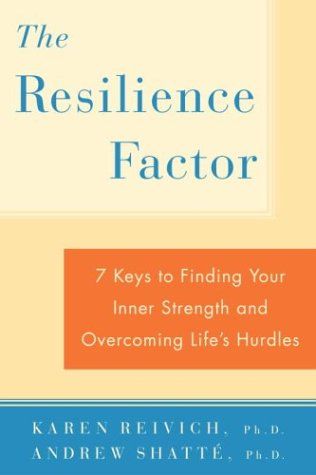
The resilience factor
7 Keys to Finding Your Inner Strength and Overcoming Life's Hurdles
Introduction: The Myth of Innate Toughness
Introduction: The Myth of Innate Toughness
Nova: Welcome to Mindset Mastery, the show where we dissect the science of success. Today, we are diving deep into a concept we all desperately need: resilience. Forget the idea that some people are just born tough. We’re talking about Karen Reivich and Andrew Shatte’s groundbreaking book, The Resilience Factor.
Nova: : That’s a fantastic premise, Nova. Because when life throws a curveball—and it always does—most people feel helpless, like they lack some secret genetic code for bouncing back. What’s the big reveal from Reivich and Shatte right out of the gate?
Nova: The reveal is that resilience is not a trait; it’s a skill set. They argue that resilience is a set of learnable, measurable skills that anyone can master. They built this work on the foundation of decades of research, particularly linking back to Martin Seligman’s work on Learned Optimism. It’s about training your brain to interpret setbacks differently.
Nova: : So, this isn't just motivational fluff. This is applied cognitive science for handling the inevitable bad stuff. If it’s a skill set, what are the tools? I’m guessing they break it down into manageable chunks, right?
Nova: Exactly. They distill this complex science into what they call the Seven Keys to Finding Your Inner Strength. We’re going to unpack the most powerful ones today, starting with the absolute bedrock of their entire system: the ABCs.
Nova: : The ABCs? That sounds almost too simple for something that determines how we handle a major career setback or personal crisis. I’m ready to be proven wrong. Let’s get into Key Number One.
The Cognitive Chain Reaction
Key 1: Mastering the ABCDE Model of Adversity
Nova: Key One is Learning Your ABCs. This model, adapted from Albert Ellis, is the engine of resilience. A stands for Adversity—the event itself. B stands for Beliefs—your automatic interpretation of that event. And C stands for Consequences—the emotional and behavioral results of those beliefs.
Nova: : Okay, A is the bad thing that happened, say, missing a major deadline. B is what I immediately tell myself, like, I’m incompetent. And C is the consequence: I feel depressed, I procrastinate on the next task, and I spiral. Is that the mechanism?
Nova: Precisely. Most people stop there, feeling like C is an unavoidable outcome of A. But Reivich and Shatte add two crucial steps that turn this model into a tool for resilience: D for Disputation and E for Energization.
Nova: : Disputation. That sounds like arguing with yourself. How do you dispute a belief that feels absolutely true in the moment, like 'I am incompetent'?
Nova: That’s the hard part, but it’s where the training kicks in. Disputation means actively challenging the evidence for your negative belief. You ask: Is this 100% true? Are there other explanations? Did I succeed on that project last month? You are treating your negative belief not as a fact, but as a hypothesis that needs testing.
Nova: : So, if my belief is 'I always fail presentations,' Disputation forces me to pull up the data. 'Wait, I got excellent feedback on the Q3 strategy pitch.' It’s about finding the counter-evidence.
Nova: Exactly. And when you successfully dispute that B, you change C. The consequence shifts from depression to perhaps mild disappointment, followed by E: Energization. You feel motivated to fix the actual problem, not wallow in the perceived catastrophe.
Nova: : That’s powerful. So, the goal isn't to stop adversity, but to shorten the time between A and C by intervening at B with D, which leads to E. It’s about creating distance between the event and your reaction.
Nova: It is. And they emphasize that the stronger your Disputation skills, the more resilient you become. It’s the mental equivalent of building strong core muscles. You’re not avoiding the weightlifting, you’re just getting stronger while you lift it.
Identifying Cognitive Distortions
Key 2 & 3: Avoiding Thinking Traps and Detecting Icebergs
Nova: Moving on to the next set of skills, which are closely related to mastering the ABCs: Avoiding Thinking Traps and Detecting Icebergs. These are essentially the specific, common errors in our B—our Beliefs—that we need to spot.
Nova: : Thinking Traps sounds like a great term for those moments when your brain goes rogue. What are some of the classic traps they identify that derail resilience?
Nova: They detail several, but two are particularly destructive. The first is 'Catastrophizing,' which is closely tied to what they call 'Icebergs.' An Iceberg is a belief so huge and overwhelming that it sinks your motivation, but you only see the tip of it—the immediate negative feeling.
Nova: : I love that metaphor. The tip of the iceberg is the panic attack or the overwhelming dread, but underneath the water is the massive, unexamined belief: 'This one failure means my entire career is over.'
Nova: Precisely. The Iceberg belief is often an extreme generalization. Other traps include 'Personalization'—believing everything negative that happens is somehow your fault—and 'Filtering,' where you only pay attention to the negative data points and filter out all the positive ones.
Nova: : So, if I’m filtering, I might get nine positive comments on a report and one critical note, and I’ll spend the entire day obsessing over that one note, letting it define the whole experience. That’s a classic resilience killer.
Nova: It is. The practice here is to become a detective of your own thoughts. When you feel a strong negative consequence, you must immediately look for the underlying belief and ask: Is this belief a Thinking Trap? Is this an Iceberg moment where I’m letting a small negative detail represent my entire reality?
Nova: : It requires a level of self-awareness that feels like it takes constant effort. Is there a way to make spotting these traps automatic?
Nova: Reivich and Shatte suggest labeling them. When you catch yourself saying, 'I mess this up,' you mentally label it: 'Ah, that’s an Overgeneralization Trap.' Just naming the trap takes away some of its power, making it easier to move into the Disputation phase from the ABC model.
The Proactive Side of Bouncing Back
Key 4 & 5: Cultivating Optimism and Practical Problem Solving
Nova: While the first few keys focus on defense—stopping negative thought spirals—Keys Four and Five shift us into offense. They focus on building the positive mental framework that makes you less susceptible to those spirals in the first place.
Nova: : This is where the optimism angle comes in, right? How do they define optimism in a way that’s actionable, not just wishful thinking?
Nova: They define optimistic explanatory style as believing that negative events are temporary, specific, and external, while positive events are permanent, pervasive, and internal. It’s the inverse of the pessimistic style.
Nova: : That’s a fantastic, concrete way to put it. If I get a promotion, I attribute it to my hard work and skill—internal, pervasive. If I get passed over for a raise, I attribute it to the company budget being tight this quarter—external, temporary.
Nova: Exactly. And the book gives practical exercises to shift that default setting. One surprising element they stress is the active practice of Gratitude. It’s not just a nice thing to do; it’s a direct countermeasure to the Filtering trap we just discussed. By deliberately listing things you appreciate daily, you train your brain to scan the environment for positive data.
Nova: : So, we’re actively building up the positive side of the ledger. What about the fifth key, which seems to be about action? I recall a snippet mentioning problem-solving as a key component.
Nova: Yes, Key Five often centers on effective problem-solving. Resilience isn't just about feeling better; it’s about better after a setback. If you’ve successfully disputed your belief that you’re incompetent, you can now move to concrete action.
Nova: : So, the sequence is: Adversity happens. I catch my catastrophic belief. I dispute it. I feel energized. Now, I use that energy to solve the actual problem, rather than just dwelling on the feeling.
Nova: That’s the full loop. The resilient person doesn't waste energy fighting an internal battle against a distorted belief; they channel that energy into fixing the external issue. It’s efficiency in the face of crisis. They emphasize breaking down the problem into small, solvable steps, which combats the feeling of being overwhelmed by the Iceberg.
Nova: : It sounds like the entire system is designed to keep you moving forward, even if it’s just a tiny step at a time. It shifts the focus from 'Why me?' to 'What now?'
Building a Resilient Lifestyle
The Remaining Keys and Real-World Application
Nova: We’ve covered the foundational cognitive tools—ABCs, Traps, Optimism, and Problem Solving. While the book details seven keys, the remaining ones often focus on integrating these skills into a lifestyle, focusing on areas like building strong social support and developing a sense of purpose.
Nova: : That makes sense. Resilience isn't just a one-time fix; it’s a lifestyle of mental maintenance. How do they frame the importance of social connection within this framework?
Nova: They treat social support as a crucial external buffer. When you face a major adversity, having people you trust allows you to test your negative beliefs against reality. A supportive friend can often provide the external challenge needed for your Disputation to work when you’re too close to the situation.
Nova: : That’s a great point. Sometimes, you need someone else to point out the tip of your Iceberg because you’re swimming right under it. It’s about leveraging your network to test your internal narrative.
Nova: Absolutely. And when you look at the whole package—the ABCDE model, the trap avoidance, the proactive optimism, and the support network—the message is clear: Resilience is robust because it’s multi-faceted. It’s not just one trick; it’s an integrated defense system.
Nova: : I’m struck by how practical this is. It’s not about being happy all the time, which is impossible. It’s about reducing the and of negative emotional fallout from setbacks. If I can cut my recovery time from a failure by half, that’s a massive competitive advantage in life.
Nova: It is. And the beauty is that every time you successfully dispute a belief or solve a problem, you are literally strengthening the neural pathways associated with resilience. You are making the next challenge easier to handle. It’s a compounding return on mental investment.
Conclusion: Your Resilience Toolkit
Conclusion: Your Resilience Toolkit
Nova: So, as we wrap up our deep dive into The Resilience Factor, the biggest takeaway is empowerment. Karen Reivich and Andrew Shatte give us the blueprint to stop being victims of our own thoughts.
Nova: : If listeners take away just one thing, it should be to stop accepting their initial negative reaction as the final word. That immediate belief after an adversity is not gospel; it’s a hypothesis ripe for Disputation.
Nova: Precisely. Start small. The next time something minor goes wrong—you spill your coffee, you get a slightly critical email—don't just react. Pause. Write down A, B, and C. Then, force yourself to write down D: What is the evidence against my belief? And finally, what action can I take now that I’m energized?
Nova: : It’s about building that mental muscle memory. By practicing these cognitive interventions, we move from being reactive to being responsive. We don't eliminate pain, but we eliminate unnecessary suffering.
Nova: That’s the essence of true mental toughness. It’s not about never falling down; it’s about how quickly and intelligently you get back up. Thank you for joining us for this exploration of building inner strength.
Nova: : Indeed. We hope you’ve gained a powerful new toolkit for navigating life’s inevitable hurdles. This is Aibrary. Congratulations on your growth!