

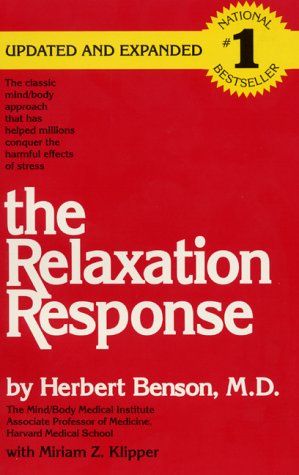
The relaxation response
Introduction
Nova: Think about the last time you felt truly, deeply stressed. Maybe your heart was racing, your breath was shallow, and your mind was spinning at a hundred miles an hour. We usually think of that as just a mental state, but it is actually a full-body biological emergency called the fight or flight response.
Atlas: Oh, I know that feeling well. It is like my body is preparing to fight a tiger, even though I am just looking at a crowded inbox. It feels like there is no off switch once that engine starts running.
Nova: That is exactly what most people think. But back in 1975, a Harvard cardiologist named Dr. Herbert Benson published a book that changed everything. He discovered that we actually have a built-in biological off switch. He called it the Relaxation Response.
Atlas: Wait, so you are saying there is a literal physical mechanism in our bodies that can just shut down the stress response? Like, a counter-program?
Nova: Precisely. And the best part is that it does not require expensive equipment or years of training. Benson took the ancient wisdom of meditation, stripped away the mysticism, and proved in a lab that we can trigger this response ourselves. Today, we are diving into his groundbreaking work to see how a simple word or a quiet moment can actually rewrite your biology.
Key Insight 1
The Harvard Rebel
Nova: To understand why this book was such a big deal, you have to look at the medical world in the late 1960s. At that time, mind-body medicine was basically considered science fiction. Doctors focused on pills and surgery, not thoughts and feelings.
Atlas: I can imagine. A Harvard doctor talking about meditation back then must have raised some serious eyebrows. Did he get a lot of pushback?
Nova: Huge amounts. Benson was a cardiologist studying high blood pressure, and he started noticing that his patients' stress levels were directly impacting their physical health. But when he wanted to study meditation, he had to do it almost in secret. He actually had practitioners of Transcendental Meditation sneak into Harvard Medical School through the back stairs at night so his colleagues wouldn't see them.
Atlas: That is wild. It sounds like a spy movie but for monks. Why were they so secretive?
Nova: Because at the time, meditation was seen as something purely religious or cult-like. Benson wanted to know if there was a physiological basis for what these people were experiencing. He hooked them up to sensors and measured their oxygen consumption, heart rate, and brain waves.
Atlas: And what did the sensors say? Was it all just in their heads?
Nova: Not at all. The results were staggering. He found that during meditation, these people could decrease their oxygen consumption by about 17 percent in just minutes. To put that in perspective, when you sleep, your oxygen consumption only drops by about 8 percent over several hours.
Atlas: So they were reaching a state of rest that was twice as deep as actual sleep, while they were still awake? That is incredible.
Nova: It really was. He realized that this was not just a relaxation of the mind, but a distinct physiological state. He saw blood pressure drop and heart rates slow down significantly. He realized he had found the polar opposite of the fight or flight response, which had been discovered by Walter Cannon decades earlier.
Atlas: So Cannon found the gas pedal for stress, and Benson found the brakes.
Nova: Exactly. And Benson knew that if he could prove this was a biological reflex, he could bring it into mainstream medicine. He just had to find a way to explain it without the spiritual baggage that made other doctors so uncomfortable.
Key Insight 2
The Biology of Calm
Nova: Benson's core argument is that our bodies are essentially stuck in an outdated survival mode. The fight or flight response was great when we were dodging predators, but in the modern world, it is being triggered by traffic, emails, and news cycles.
Atlas: Right, and because we are not actually fighting or fleeing, all those stress hormones like cortisol and adrenaline just sit there and simmer in our systems. That is where the damage happens, right?
Nova: Spot on. Chronic stress leads to hypertension, heart disease, and a weakened immune system. Benson called the Relaxation Response the natural antidote. When you trigger it, your body shifts from the sympathetic nervous system, which is the gas pedal, to the parasympathetic nervous system, which is the rest and digest mode.
Atlas: I have heard those terms before, but how does it actually feel different in the body? Is it just feeling sleepy?
Nova: It is different from sleep. In sleep, your brain waves change in a specific pattern, but in the Relaxation Response, you remain alert while your metabolism drops. Your heart doesn't have to work as hard, and your muscles lose that chronic tension we often don't even realize we are carrying.
Atlas: It is like rebooting a computer that has too many background apps running. You are clearing the cache.
Nova: That is a perfect analogy. Benson found that by regularly triggering this response, you could actually lower your baseline blood pressure over time. He wasn't just talking about feeling better in the moment; he was talking about long-term physical changes.
Atlas: Did he find that everyone could do this? Or were those monks just special cases because they had practiced for years?
Nova: That was his biggest discovery. He realized that the monks weren't special because of their religion or their specific mantras. They were just using a technique to trigger a reflex that every single human being possesses. He stripped away the specific mantras and found that you could get the exact same physiological results using any neutral word.
Atlas: So it is a universal human hardware feature, not a software update you have to buy from a specific guru.
Nova: Exactly. It is a biological gift we all have, but most of us have forgotten how to use it.
Key Insight 3
The Four Pillars of the Technique
Nova: Since Benson wanted to make this accessible to everyone, he distilled the practice down to four essential components. If you have these four things, you can trigger the response anywhere.
Atlas: Okay, I am taking notes. What is the first one?
Nova: The first is a quiet environment. Now, it doesn't have to be a silent mountain top, but you need a place with minimal distractions so you can turn your attention inward.
Atlas: Fair enough. I can find a quiet corner. What is next?
Nova: The second is a mental device. This is something to shift your mind away from logical, externally oriented thoughts. Benson suggested a sound, a phrase, or a single word repeated silently. His go-to suggestion was the word one.
Atlas: Just the word one? Why that word specifically?
Nova: Because it is neutral. It doesn't carry emotional weight or religious baggage. The goal isn't to think about the meaning of the word, but to use it as an anchor. Every time you breathe out, you silently say one.
Atlas: That seems almost too simple. Does it really work?
Nova: It does, because of the third and most important component: a passive attitude. This is the one people struggle with the most. You have to let go of the need to do it right. When distracting thoughts come into your mind, and they will, you just say, oh well, and go back to the word.
Atlas: Oh well. I like that. It is like you are giving yourself permission to be imperfect.
Nova: Exactly. Benson said that the more you try to force relaxation, the less likely it is to happen. You have to be a passive observer of your own mind. And finally, the fourth component is a comfortable position. You want to be relaxed so you don't have unnecessary muscle tension, but you don't want to be so comfortable that you fall asleep.
Atlas: So, sitting in a chair with my back supported, repeating one on every exhale, and not worrying if my mind wanders to my grocery list.
Nova: That is it. He recommended doing this for ten to twenty minutes, twice a day. He found that this specific combination was the most effective way to reliably flip that biological switch.
Key Insight 4
The Genetic Frontier
Nova: Now, if you think the 1975 findings were impressive, wait until you hear what Benson and his team at the Benson-Henry Institute found more recently. They started looking at the Relaxation Response on a genetic level.
Atlas: Wait, you can change your genes just by sitting quietly and saying the word one?
Nova: Not changing the genes themselves, but changing their expression. This is the field of epigenetics. In a study from 2008, they found that people who practiced the Relaxation Response actually changed the expression of genes involved in inflammation, programmed cell death, and how the body handles oxidative stress.
Atlas: That is mind-blowing. So we are talking about actual molecular changes. It is not just a feeling of calm; it is a cellular repair mission.
Nova: Precisely. They found that long-term practitioners had significantly different genetic expressions than the control group. But even more interestingly, they took people who had never meditated before, put them through an eight-week program, and saw those same genetic changes start to happen.
Atlas: So it doesn't take a lifetime of practice to start seeing the benefits at the DNA level. That is a huge motivator.
Nova: It really is. They also found that it affects the mitochondria, which are the power plants of our cells. The Relaxation Response seems to make them more resilient and efficient. It is like you are upgrading the battery life of your entire body.
Atlas: It makes sense why this is used for so many different conditions now. It is not just for heart health anymore, right?
Nova: Not at all. It is used for chronic pain, insomnia, infertility, and even the side effects of cancer treatments. By reducing that baseline of systemic inflammation and stress, you are giving the body the resources it needs to heal itself. Benson always said that medicine is like a three-legged stool: one leg is drugs, one is surgery, and the third is self-care through the Relaxation Response. Without that third leg, the stool is always going to be unstable.
Conclusion
Nova: We have covered a lot of ground today, from the secret hallways of Harvard in the seventies to the cutting-edge world of epigenetics. The legacy of Herbert Benson's work is the realization that we are not helpless victims of our stress.
Atlas: It is empowering to know that we have this built-in tool. It is not about escaping reality or becoming a monk; it is just about taking ten minutes to let our biology do what it was designed to do: find balance.
Nova: Exactly. Benson's book, The Relaxation Response, remains a classic because it took something that seemed mystical and made it a matter of public health. It proved that the mind and body are not separate entities, but a single, integrated system.
Atlas: I think the biggest takeaway for me is the passive attitude. Just saying oh well to the stress and the distractions. It makes the whole idea of meditation feel much less intimidating.
Nova: That is the heart of it. So, the next time you feel that fight or flight response kicking in, remember that you have the brakes. Find a quiet spot, pick a word, and give your body the rest it deserves.
Nova: This is Aibrary. Congratulations on your growth!