

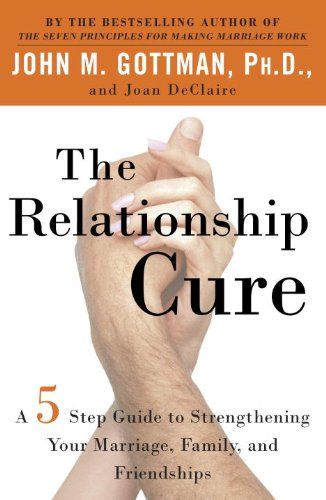
The relationship cure
Introduction: The Science of Staying Together
Introduction: The Science of Staying Together
Nova: Welcome to The Deep Dive, the show where we dissect the blueprints of human connection. Today, we are opening up a book that claims to hold the cure for relationship ailments, not just for romance, but for every bond we cherish: John Gottman’s "The Relationship Cure."
Nova: : That sounds incredibly ambitious, Nova. Gottman is famous for predicting divorce with near-perfect accuracy based on just a few minutes of observation. So, what makes this book different from his other work? Is this the secret sauce he’s been hiding?
Nova: That’s the perfect entry point. While his earlier work, like "The Seven Principles for Making Marriage Work," focused heavily on married couples, "The Relationship Cure" broadens the scope. Gottman argues that the fundamental mechanics of connection are universal. He says the core issue isn't communication style, but something much smaller, much more frequent, and far more subtle: the 'bid' for connection.
Nova: : A 'bid'? That sounds almost too simple for something that determines the fate of our closest relationships. Are we talking about asking someone out on a date, or is it more granular than that?
Nova: It is incredibly granular. Think of it as the emotional equivalent of a stock market transaction. Every interaction is either an investment or a withdrawal. Gottman’s research, spanning decades and involving thousands of couples, boils down to this: relationships thrive or die based on how we respond to these tiny, everyday requests for attention, affirmation, or affection. If we ignore them, we bankrupt the account. If we honor them, we build an empire of trust. Today, we’re breaking down his five-step prescription for financial solvency in your emotional bank.
Nova: : I’m ready to audit my own accounts. Let’s start with the basics. What exactly constitutes a 'bid' and why is responding to them so critical?
Key Insight 1: Turning Toward vs. Turning Away
The Fundamental Unit: Bids for Connection
Nova: The first major concept we have to internalize from "The Relationship Cure" is the Bid for Connection. A bid is any attempt by one person to get attention, affirmation, affection, or any positive connection from another. It can be a question, a comment, a gesture, even just a sigh.
Nova: : Give me an example of a really subtle bid. Something I might miss if I’m just scrolling through my phone.
Nova: Absolutely. Imagine you’re sitting on the couch, and your partner says, "Wow, look at that sunset." That’s not a request for a deep philosophical discussion. It’s a bid. They are essentially saying, 'I see something beautiful, and I want to share that moment with you.' If you grunt, keep scrolling, or say, 'Uh-huh,' you’ve made what Gottman calls a 'Turn Away.' You’ve missed the deposit.
Nova: : So, 'Turning Toward' is acknowledging the bid—maybe saying, 'That is stunning, the colors are incredible.' And 'Turning Away' is ignoring it or dismissing it. What happens when we consistently turn away?
Nova: The research is stark. Couples who eventually divorced, during conflict, turned toward each other’s bids only 33% of the time. That’s a one-in-three success rate. In contrast, couples who were still happily married at follow-ups turned toward bids 86% of the time. That 86% versus 33% gap is the chasm between connection and disconnection.
Nova: : Eighty-six percent! That’s almost every time. It makes you realize how much emotional labor goes into maintaining a strong bond, even in the mundane moments. It’s not just the big gestures; it’s the thousands of tiny acknowledgments.
Nova: Precisely. Gottman emphasizes that these bids are the building blocks. If you miss 10 bids a day, that’s 300 missed deposits a month. Your emotional bank account is running a massive deficit, and when a real crisis hits, there’s no reserve to draw from. The book stresses that we need to become hyper-aware of these bids, not just in our partners, but in our children, our friends, and even our colleagues. It’s about tuning into the emotional frequency of the people around us.
Nova: : And I assume Step One of the cure is learning to recognize our own bids, right? Because sometimes I probably make a bid so weakly that I don't even realize I’m asking for something.
Nova: You hit on a key part of Step One: Self-Awareness. We have to identify what we are actually asking for. Are you asking for help, or are you asking for validation that you’re not incompetent? Are you complaining about the dishes, or are you asking for partnership? The book forces you to translate the surface-level statement into the underlying emotional need. That clarity helps the other person know how to 'Turn Toward' effectively.
Nova: : That’s a huge shift. It moves the focus from 'Are they listening to my words?' to 'Are they responding to my underlying need for connection?' What’s the next step in this five-step cure? Does it move from the positive foundation to addressing the negatives?
Key Insight 2: Identifying and Countering Toxic Communication
Neutralizing the Destroyers: The Four Horsemen
Nova: Yes, once you understand how to build up positive deposits, the next crucial step is stopping the catastrophic withdrawals. This is where Gottman’s most famous findings come into play: The Four Horsemen of the Apocalypse. These are the communication styles that predict relationship failure with terrifying accuracy.
Nova: : I know the names, but I always forget which one is the worst. Is it Contempt?
Nova: Contempt is widely considered the single greatest predictor of divorce. It’s toxic because it communicates moral superiority. It’s not just disagreement; it’s disgust. It manifests as sarcasm, name-calling, eye-rolling, or hostile humor. Gottman found that when contempt is present, the relationship is in serious, immediate danger.
Nova: : Eye-rolling. That’s so common, yet so corrosive. It’s a non-verbal way of saying, 'You are beneath me.' What are the other three?
Nova: Criticism, Defensiveness, and Stonewalling. Criticism attacks your partner’s character—'You are so selfish.' The antidote here is a Gentle Startup: complaining about the situation without attacking the person—'I feel overwhelmed when I see the trash overflowing.'
Nova: : And Defensiveness? That feels like a natural reaction when you’re criticized.
Nova: It is, but it’s a trap. Defensiveness is essentially saying, 'The problem isn't me; it's you, or the situation you created.' It escalates conflict instantly. The antidote is taking responsibility, even for a small part of the problem. Saying, 'You know what, you’re right, I could have handled that better,' immediately de-escalates the situation.
Nova: : That requires a level of humility that’s hard to access when you’re already feeling attacked. And Stonewalling—that’s the silent treatment, right?
Nova: Exactly. Stonewalling is shutting down completely—physically withdrawing, looking away, refusing to engage. It’s often a response to feeling emotionally flooded by the conflict. The antidote isn't to force engagement, but to take a structured break. Gottman suggests a 20-minute self-soothing break where both partners agree to step away, calm their physiological arousal—their heart rate, their stress hormones—and then agree to return to the discussion.
Nova: : So, the cure for the Horsemen isn't just stopping them, but actively replacing them with their specific antidotes. It sounds like a targeted behavioral therapy plan.
Nova: It is. And this is where the 5:1 ratio we mentioned earlier becomes the background music to all this. You can use the antidotes perfectly, but if you’re only having one positive interaction for every ten negative ones, you’re still sinking. The Horsemen are the torpedoes, but the low ratio is the slow leak. We need both solutions to keep the ship afloat.
Key Insight 3: Mastering Positive Interactions and Repair Attempts
Building Resilience: The 5:1 Ratio and Repair
Nova: Let's dive into the positive side of the ledger, which is where the 5:1 Magic Ratio truly shines. This ratio isn't just about avoiding fights; it’s about actively cultivating positive sentiment override. When you have a high ratio of positive interactions, you develop a buffer zone.
Nova: : A buffer zone. I like that term. So, if I have a strong 5:1 ratio, when a conflict does happen, my partner is more likely to interpret my actions charitably?
Nova: Precisely. Gottman’s research shows that couples with a high ratio view each other’s negative actions as situational—'They’re stressed today'—rather than character flaws—'They are inherently inconsiderate.' The positive deposits create a reservoir of goodwill.
Nova: : What counts as a positive interaction that counts toward that five? Is it just saying 'I love you'?
Nova: It’s much broader, tying back to those bids. Positive interactions include: expressing appreciation, showing affection, offering support, validating feelings, sharing a joke, or even just making eye contact and smiling. The book gives examples of what they call 'Positive Exchanges' that are crucial: things like expressing admiration, showing interest in their day, or offering a small favor without being asked.
Nova: : I remember reading that in healthy couples, even during arguments, the ratio stays relatively high. How is that possible if they are actively fighting?
Nova: That’s the genius of the final two steps of the cure: Repair Attempts. A Repair Attempt is any statement or action—silly or otherwise—that prevents negativity from escalating out of control. It’s the emergency brake. It could be saying, 'Whoa, let’s pause, I’m getting too worked up,' or even using humor to break the tension, like saying, 'I’m sorry, I sound like a broken record.'
Nova: : So, a successful repair attempt counts as a positive interaction, even if it happens in the middle of a negative exchange?
Nova: It absolutely does. A successful repair attempt can instantly neutralize a negative interaction. If you are in a fight and you manage to make a successful repair, you can effectively turn a negative interaction into a neutral or even positive one in the ledger. This is why the ratio is so dynamic. It’s not a static score; it’s a constant negotiation.
Nova: : It sounds like the entire system—Bids, Horsemen, Ratio, and Repairs—is designed to teach us emotional agility. It’s not about being perfect; it’s about being resilient enough to recover quickly from inevitable mistakes.
Nova: That’s the ultimate takeaway. The Relationship Cure isn't about finding a perfect partner; it’s about mastering the skill of emotional repair. The five steps, synthesized, are: 1. Become aware of your bids. 2. Learn to turn toward them. 3. Identify and stop the Four Horsemen. 4. Actively build up positive interactions to reach the 5:1 ratio. And 5. Master the art of the Repair Attempt. It’s a comprehensive toolkit for any relationship, whether it’s a marriage, a parent-child dynamic, or a professional partnership.
Conclusion: The Prescription for Lasting Connection
Conclusion: The Prescription for Lasting Connection
Nova: We’ve covered a lot of ground today, moving from the subtle glance across the room to the catastrophic eye-roll. The core message from Gottman’s "The Relationship Cure" is that connection is an active, moment-to-moment process, not a passive state of being.
Nova: : It’s humbling, really. I always thought relationship success was about finding the right person. Now I see it’s about mastering the right micro-behaviors. The idea that 86% of successful couples turn toward bids, while divorced couples only manage 33%, is a staggering statistic that should motivate everyone to pay closer attention to the small stuff.
Nova: It should. And the actionable takeaway is to start practicing awareness today. Don't wait for a major conflict. Start tracking your bids. When someone speaks to you, pause for one second and ask yourself: Is this a bid? And if it is, how can I turn toward it, even in a small way? That small acknowledgment is the down payment on future stability.
Nova: : And for those moments when we inevitably slip up and deploy a Horseman—Criticism or Defensiveness—the key is the Repair Attempt. Knowing how to hit the emergency brake and genuinely apologize for the escalation is what separates the stable relationships from the doomed ones.
Nova: Exactly. The cure isn't perfection; it's recovery. It’s about building that positive sentiment override so that when the inevitable negative interaction occurs, the foundation of goodwill is strong enough to absorb the shock. It’s a science-backed prescription for emotional fitness.
Nova: : So, if you’re looking to strengthen any bond in your life—romantic, familial, or professional—the cure is in the details, in the daily deposits, and in the courage to repair. A powerful lesson from the Gottman lab.
Nova: Indeed. Thank you for diving deep into the mechanics of connection with us today. This is Aibrary. Congratulations on your growth!