

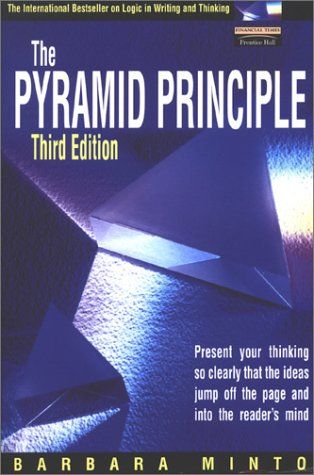
The pyramid principle
logic in writing and thinking
Introduction: The Universal Pain of Poor Communication
Introduction: The Universal Pain of Poor Communication
Nova: Welcome to the show. Imagine this: you're an executive, you have 100 emails waiting, and you open one that starts with three paragraphs of background, two pages of methodology, and finally, buried on page four, the actual recommendation. How do you feel?
Nova: : I feel like I need a time machine to go back and delete the email before I even opened it. It’s the communication equivalent of a slow, painful crawl through molasses. We’ve all been there, suffering through the bottom-up approach.
Nova: Exactly. That universal pain point is precisely what Barbara Minto, a legend from McKinsey & Company, decided to solve. She didn't just write a book; she codified the operating system for executive thought. Today, we are dissecting the framework that has sold millions of copies and arguably changed how the world's top firms communicate: The Pyramid Principle.
Nova: : The Pyramid Principle. It sounds so simple, almost too simple for something that supposedly organizes complex thought. Is this just another management buzzword, or is there real structural genius here?
Nova: It is structural genius. Minto realized that the human mind naturally organizes information into pyramids. The problem is, most people communicate in the reverse order of how they think. The Pyramid Principle forces you to communicate in the way the needs to receive it: top-down. It’s about respecting the reader’s time and cognitive load.
Nova: : So, we're not just talking about better writing; we're talking about better thinking, delivered efficiently. That sounds like a massive upgrade for anyone dealing with complexity. Where did this revolutionary idea even come from?
Nova: That’s our first deep dive. Let’s talk about the genesis of this idea, rooted deep within the halls of the world's most demanding consulting firm.
The Birth of Top-Down Communication
The Genesis: Minto at McKinsey and the Executive Mindset
Nova: The story of the Pyramid Principle is fascinating because it wasn't born in an academic ivory tower; it was forged in the fire of McKinsey & Company in the 1960s. Barbara Minto was the firm's very first female post-MBA hire, and her initial job was editing reports from consultants.
Nova: : Editing reports from the sharpest minds in business? That sounds like a high-stakes proofreading gig.
Nova: It was. And Minto noticed a pattern. The consultants were brilliant, but their reports were often disorganized. They would present their data, their analysis, their findings, and only then, perhaps, the conclusion. Minto recognized that this was a fundamental disconnect with the audience: the busy executive.
Nova: : The executive doesn't have time for the journey; they need the destination immediately. I see the logic. They are thinking about the answer first, the 'so what?'
Nova: Precisely. Minto observed that executives think 'top-down.' They hold a single governing idea in their mind, and everything else they hear or read must support or explain that idea. If you don't give them the answer first, their brain struggles to categorize the subsequent details.
Nova: : So, the principle is essentially mirroring the executive's preferred cognitive structure. It’s about empathy for the reader’s brain architecture. How did she formalize this into a structure?
Nova: She formalized the structure based on two primary modes of thinking: deductive and inductive reasoning. Most people default to inductive—building up from facts to a conclusion. Minto mandated the deductive approach for communication: state the conclusion, then provide the supporting arguments.
Nova: : Deductive communication. So, if I'm presenting a new marketing strategy, I don't start with the market research data, I start with: 'We must pivot to digital advertising because it offers the highest ROI.' That’s the apex.
Nova: That’s the apex! And that apex must be a single, clear statement. The research showed that when communication followed this top-down structure, comprehension increased dramatically, and the time taken to convey complex ideas plummeted. It became the unwritten standard for how McKinsey communicated internally and externally.
Nova: : It’s incredible that one person’s observation while editing could become the bedrock for an entire industry’s communication style. It sounds like the ultimate efficiency hack for the C-suite.
Nova: It is. But the structure itself is only half the battle. To make that pyramid stable, the supporting arguments need to be logically sound. And that brings us to the structural rules that hold the whole thing up.
The Rule of Summarization and Logical Grouping
The Shape of Thought: Building the Pyramid
Nova: Let’s visualize the pyramid. At the very top, you have your main answer, your key takeaway. Underneath that, you have your primary supporting arguments—usually three or four distinct ideas. Each of those primary arguments then has its own set of supporting facts or details beneath it.
Nova: : Okay, I'm picturing a classic organizational chart, but inverted. What is the absolute, non-negotiable rule for what goes into those supporting layers?
Nova: The core rule is this: Ideas at any level in the pyramid must always be summaries of the ideas grouped directly below them. Think of it like a hierarchy of abstraction. The lower level provides the evidence; the level above it synthesizes that evidence into a conclusion.
Nova: : So, if my primary argument is 'Digital advertising offers the highest ROI,' the layer beneath it can't just be random data points. It has to be grouped data points that prove the ROI claim.
Nova: Exactly. For example, Level 2 might have three points: 'Digital channels have lower CPA,' 'Digital channels offer superior targeting,' and 'Digital channels provide real-time attribution.' Each of those three points must then be supported by hard data in Level 3.
Nova: : This forces a level of discipline. You can’t just throw in a point because it sounds good; it must logically flow from the evidence below it, or the pyramid collapses. It’s a self-checking mechanism for your own thinking.
Nova: That’s the beauty of it. It forces you to synthesize. You can’t just list facts; you must group them into meaningful statements. Minto emphasizes that you must group ideas that answer the same question or address the same issue. This grouping is what creates the logical flow upwards.
Nova: : And I recall reading something about how this structure relates to how we process information naturally. It’s not just about being persuasive; it’s about being.
Nova: Absolutely. The research suggests the human mind can only hold about five to seven items in short-term memory at once. By grouping your supporting arguments into three or four main buckets at Level 2, you are respecting those cognitive limits. You give the executive a manageable set of concepts to absorb before they ask for the details.
Nova: : It’s like giving them a table of contents for your brain. If they are satisfied with the summary at Level 2, they move on. If they need more, they ask, and you drill down into the specific supporting evidence. It’s interactive clarity.
Nova: Precisely. And that drill-down capability is crucial. It’s why the principle works so well in Q&A sessions or consulting interviews. You deliver the top, they ask for one branch, and you deliver that branch, perfectly structured, before returning to the main trunk. It’s controlled disclosure.
Ensuring Completeness and Clarity
The Logic Engine: MECE and Setting the Stage with SCQ
Nova: Now we have to talk about the two most famous acronyms associated with Minto’s work, which are the quality control checks for your pyramid. First, MECE.
Nova: : Mutually Exclusive, Collectively Exhaustive. This is the holy grail of consulting logic, right? I always struggle to apply it perfectly.
Nova: It is the bedrock. Mutually Exclusive means there is no overlap between your supporting arguments. If you have three reasons why X is true, those three reasons cannot overlap in meaning. If one point is 'It saves money' and another is 'It reduces operational expenditure,' those are not MECE; they overlap significantly.
Nova: : That’s a perfect example of the trap. You think you have three distinct points, but two of them are just different ways of saying the same thing. How do you enforce the 'Collectively Exhaustive' part?
Nova: Collectively Exhaustive means that your set of arguments, when taken together, covers the entire scope of the issue you are addressing. If you are asked to analyze the reasons for declining sales, and you only list marketing and product issues, but ignore distribution and pricing, you are not collectively exhaustive. You’ve left a hole in the pyramid’s base.
Nova: : So, MECE ensures that your supporting arguments are both distinct complete relative to the question posed at the apex. It’s rigorous. But before we even build the pyramid, Minto suggests a framework to introduce the problem itself. That’s the SCQ framework, correct?
Nova: Yes, the SCQ—Situation, Complication, Question—is the perfect preamble to launching your pyramid. It’s how you hook the executive. The Situation sets the context—the undisputed facts everyone agrees on. For example, 'Our company has maintained 15% market share for five years.'
Nova: : Then comes the Complication, the disruption that creates the need for action. 'However, a new competitor entered the market last quarter, and our share dropped to 12%.' That creates tension.
Nova: And that tension immediately generates the Question, which is what your entire pyramid is designed to answer. 'How do we regain our lost market share and stabilize our position?' Once you state that question, you immediately launch into your top-down pyramid answer.
Nova: : Situation, Complication, Question, then the Answer Pyramid. That’s a narrative arc in just four steps! It moves the audience from agreement to tension to a clear mandate for your solution. It’s incredibly powerful because it validates their current reality before presenting a new path.
Nova: It transforms communication from a data dump into a guided narrative. The SCQ frames the problem, and the Pyramid delivers the solution, all while adhering to the strict logic of MECE at every supporting level. It’s a complete system for clarity.
Overcoming the Bottom-Up Habit
The Mindset Shift: Synthesis vs. Delivery
Nova: We’ve covered the structure, but the biggest hurdle people face when adopting the Pyramid Principle isn't drawing the shape; it's the mental shift required to the content. Minto emphasizes that there are two distinct phases: synthesis and communication.
Nova: : I suspect most people try to do both simultaneously, which leads to the rambling emails we discussed earlier. They write the facts as they discover them.
Nova: Exactly. The synthesis phase must be done 'bottom-up.' You gather all your raw data, you analyze it, you group it, you test it against MECE, and you build your pyramid structure on paper or in your notes. This is where the hard thinking happens.
Nova: : So, the research and analysis phase is messy, inductive, and bottom-up. You are building the foundation and stacking the stones until you have a solid structure ready to be presented.
Nova: Precisely. You don't show anyone that messy foundation. Once the pyramid is logically sound—the top point is the answer, and the layers below summarize the layer beneath them— you switch to the communication phase, which is strictly top-down delivery.
Nova: : That separation is key. It means you can be a thorough researcher without being a confusing communicator. But I imagine the critique often leveled against this is that it feels unnatural or even overly rigid for creative or collaborative work.
Nova: That’s a fair point. Some argue it stifles creativity or makes communication sound too much like a consultant’s memo. However, Minto’s framework is not about you think, but you present it. If your creative idea is truly groundbreaking, the Pyramid Principle ensures that the executive grasps the core value proposition instantly, making them more receptive to the details later.
Nova: : It’s a tool for clarity, not a straitjacket for ideas. I’ve seen it applied successfully in everything from structuring software requirements documents to pitching investment theses. The common thread is that the audience is time-constrained and needs the bottom line first.
Nova: And the principle scales. Whether you are writing a two-sentence summary for a Slack message or a 50-page strategic plan, the underlying logic remains the same: governing thought supported by summarized arguments, supported by detailed facts. It’s a universal key to unlocking executive attention.
Nova: : It forces you to know your answer before you open your mouth. That’s a powerful discipline, even if the initial effort to build the pyramid feels like extra work. It saves ten times the effort in follow-up questions and clarifications later.
Conclusion: Mastering the Art of Efficient Impact
Conclusion: Mastering the Art of Efficient Impact
Nova: We’ve journeyed from the chaotic world of unstructured reports to the elegant, logical architecture of Barbara Minto’s Pyramid Principle. The core takeaway is that effective communication is not about presenting information in the order you discovered it, but in the order your audience needs to receive it.
Nova: : We saw the origin story—Minto recognizing the executive's top-down cognitive preference at McKinsey. We learned the structure: the apex being the answer, supported by logically grouped arguments.
Nova: And critically, we explored the quality control mechanisms: MECE ensuring your arguments are distinct and complete, and the SCQ framework setting the stage perfectly by framing the Situation, Complication, and the Question your pyramid answers.
Nova: : The actionable step for our listeners today is to stop writing emails or preparing presentations by starting with the first fact they found. Instead, force yourself to write the answer first. Then, ask: What are the three main reasons this answer is true? And then, what facts support those three reasons?
Nova: Practice that synthesis first, then deliver it top-down. It’s a shift from being a reporter of data to being a strategic communicator of insight. It’s about maximizing your impact with minimal cognitive friction for your audience.
Nova: : It’s the difference between being heard and being understood. A powerful distinction that Barbara Minto gifted the business world.
Nova: Indeed. Mastering this principle means mastering the art of efficient impact. This is Aibrary. Congratulations on your growth!