

The Professional Consulting Toolkit
Golden Hook & Introduction
SECTION
Nova: Atlas, five words. "The Professional Consulting Toolkit." Go.
Atlas: Clarity, leverage, growth, structure, impact.
Nova: Ooh, you hit all the high notes right there. That's almost like a mission statement for anyone trying to navigate the modern business world.
Atlas: Honestly, it’s what came to mind when I thought about what these books promise. They’re not just about consulting; they’re about a way of thinking.
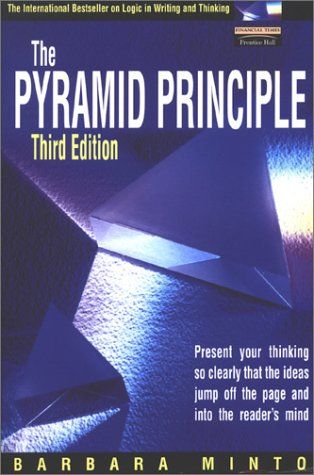
Nova: Absolutely. And today, we’re unpacking two foundational texts that codify that thinking: Barbara Minto’s "The Pyramid Principle" and Ethan Rasiel’s "The McKinsey Way." What’s fascinating about these works is they didn't come from abstract academic theory. Minto, for instance, developed her Pyramid Principle while she was at McKinsey, teaching consultants how to structure their arguments for maximum impact. She literally wrote the playbook for clear, persuasive business communication because she saw a need for it in the highest stakes environments.
Atlas: So this isn’t just some lofty idea, it’s battle-tested advice from the trenches of high-level problem-solving. It makes me wonder what kind of problems they were facing that demanded such rigorous logical frameworks.
Nova: Exactly. These aren't just books; they're distilled wisdom from decades of advising Fortune 500 companies. They’re about how to dissect complex problems and present solutions with undeniable logic. It’s about thinking like the best in the business.
Atlas: For anyone who analyzes business models or builds efficient systems, that's like finding a treasure map to scalable success.
The Power of Structured Thinking (MECE & Pyramid Principle)
SECTION
Nova: And that brings us to our first core idea: the power of structured thinking, largely thanks to Barbara Minto and her MECE framework. That’s M-E-C-E: Mutually Exclusive, Collectively Exhaustive.
Atlas: Hold on. "Mutually Exclusive, Collectively Exhaustive." That sounds like something I’d hear in a philosophy class, not a boardroom. What exactly does that mean in practice?
Nova: That’s a great question, and it’s simpler than it sounds. Imagine you're trying to understand why a company's sales are down. If you break down the problem using MECE, you might look at "internal factors" and "external factors." Those are mutually exclusive—they don't overlap. And together, they're collectively exhaustive—they cover all possibilities. You're not missing anything, and you're not double-counting.
Atlas: So it’s like categorizing your laundry: darks, lights, and delicates. They don’t overlap, and together they cover all your clothes.
Nova: Exactly! Or thinking about customer segments: existing customers, new customers, and churned customers. Each group is distinct, and combined, they represent your entire customer base. The magic is, once you’ve broken down a problem into these neat, non-overlapping, complete categories, it becomes incredibly clear where to focus your analysis.
Atlas: That makes sense. For someone who’s always building systems, I can see how MECE would be crucial for preventing gaps or redundancies. You’re ensuring every component has a place and nothing falls through the cracks.
Nova: Precisely. And MECE is the bedrock for Minto's "Pyramid Principle." This isn't just about organizing your thoughts; it's about them. Instead of building up to your conclusion like a detective story, you start with your core conclusion, your main answer, right at the top. That's your pyramid's apex.
Atlas: So, you lead with the punchline? That feels counterintuitive to how most people present. We’re taught to build suspense.
Nova: That’s the genius of it. In high-stakes environments, people are busy. They want the answer. You state your main point, then you support it with three, sometimes four, distinct, MECE arguments. Each of those arguments then has its own set of supporting data or facts. It's a top-down approach.
Atlas: So basically, "Here's what we need to do, and here are the three big reasons why, and here's the evidence for each reason."
Nova: You've got it. Imagine a company that's facing declining profits. A traditional presentation might walk you through all the data, then finally reveal the solution. A Minto-style presentation would open with: "To restore profitability, we recommend divesting the underperforming European division." Then, they’d present three pillars: "First, the European division is consistently unprofitable due to market saturation. Second, it diverts resources from our high-growth Asian markets. Third, divesting would free up capital for strategic acquisitions." Each of those pillars would then have data supporting it.
Atlas: I can see how that would cut through a lot of noise. No more guessing what the presenter is trying to say. For a visionary trying to get buy-in on a new business model, clarity and persuasion are everything. It eliminates ambiguity.
Nova: It does. It forces you to be brutally clear and logical. If your core conclusion doesn't stand up to those three distinct pillars, or if those pillars overlap, your argument is weak. It's a self-correcting mechanism for fuzzy thinking.
Focusing on What Truly Matters (80/20 & Key Drivers)
SECTION
Nova: Now, once you can break down any problem with MECE and present it clearly with the Pyramid Principle, the next challenge for any strategist is knowing to apply your effort. You can analyze everything, but you can't everything. And that naturally leads us to our second core idea, deeply explored in Ethan Rasiel’s "The McKinsey Way": the 80/20 rule and identifying "key drivers."
Atlas: Ah, the Pareto Principle. The idea that 80% of effects come from 20% of causes. It’s a classic, but how does it specifically apply in a consulting context, especially for someone focused on growth and financial acumen?
Nova: It’s absolutely critical. Consultants don't get paid to solve the client's problems; they get paid to solve the ones. The 80/20 rule, in this context, means identifying the 20% of factors or activities that will drive 80% of the desired results. It's about finding the leverage points.
Atlas: So, it's not about being exhaustive in problem-solving, but about being surgically precise. But how do you those key drivers? It sounds like magic. For an analytical mind, I need a process.
Nova: It’s definitely not magic, and it ties back to MECE thinking. You break down the problem, identify all potential contributing factors – let’s say, for a company wanting to increase customer retention. You list everything: product features, customer service, pricing, onboarding experience, marketing, competitor actions. Then, through data analysis, interviews, and market research, you start to quantify the impact of each. You look for the few levers that, if pulled, will move the needle the most.
Atlas: So you're filtering your MECE breakdown through an impact lens. Instead of fixing every little thing, you're saying, "Our data shows that 80% of customer churn is actually due to a poor onboarding experience, not product features or pricing."
Nova: Precisely. Or perhaps 80% of a company's revenue comes from 20% of its product lines. A smart strategist wouldn't try to optimize all product lines equally. They'd pour resources into that top 20%, or understand why the other 80% is underperforming. It’s about resource allocation and maximizing return on effort.
Atlas: I can see how that would be a game-changer for scalable success. Instead of spreading your efforts thin, you’re concentrating your resources where they’ll have the biggest bang for the buck. But what if you misidentify a key driver? What if the 80% you ignore becomes a problem later?
Nova: That’s a valid concern, and it’s why the initial analysis has to be robust. It’s not about permanent neglect, but about. You focus on the key drivers first because they offer the greatest immediate leverage. Once those are addressed, you can re-evaluate. It’s an iterative process. The biggest trap people fall into is trying to boil the ocean, tackling every perceived problem with equal intensity. The 80/20 rule forces discipline and focus.
Atlas: That makes perfect sense. For building resilient organizations, you need to be able to quickly identify and address critical vulnerabilities or opportunities, not get bogged down in minor issues. It’s about strategic agility.
Synthesis & Takeaways
SECTION
Nova: So, when you bring these two ideas together – Barbara Minto's structured thinking with MECE and the Pyramid Principle, combined with Ethan Rasiel’s focus on key drivers and the 80/20 rule – you get an incredibly powerful toolkit. It’s not just about consulting; it’s about a universal approach to problem-solving.
Atlas: It’s about bringing clarity to chaos and then focusing your energy on what truly matters. It’s the difference between being busy and being effective.
Nova: Exactly. These aren't just academic concepts; they are fundamental principles for clarity, impact, and achieving true scalable success in any complex environment. It's about thinking smarter, not just harder, and ensuring your efforts yield disproportionate results.
Atlas: Which is exactly what any strategist, builder, or visionary needs to thrive. So, before your next presentation, map your argument using a pyramid structure. Start with that core conclusion.
Nova: And before you start your next big project, take 30 minutes for deep work. Don't just dive in. Identify your key drivers. Where will you get the most leverage? Where can you get 80% of the impact from 20% of the effort?
Atlas: That’s a powerful challenge for our listeners. Embrace that iterative learning, and make every step forward count.
Nova: This is Aibrary. Congratulations on your growth!