

Structuring Your Thoughts: Clarity for Confident Expression
Golden Hook & Introduction
SECTION
Nova: You know, Atlas, I was today years old when I realized that most of my communication struggles weren't about I was trying to say, but I was trying to say it. It’s like trying to build a skyscraper without a blueprint.
Atlas: Oh, I like that! So, basically, we’re all just… verbal architects, constantly trying to construct ideas, but often without the right tools. I can definitely relate to that feeling of having a brilliant thought in your head that just crumbles when you try to speak it.
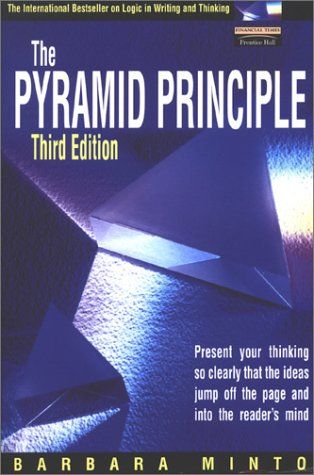
Nova: Exactly! And that’s why today, we’re diving into a concept that’s less about what you say, and more about how you structure your thoughts to ensure clarity for confident expression. We're getting into the foundational work of "The Pyramid Principle: Logic in Writing and Thinking" by the brilliant Barbara Minto.
Atlas: Ah, Minto! I’ve heard whispers of this. It’s almost legendary in consulting circles, isn’t it? I mean, what’s fascinating is that Minto herself started her career at McKinsey & Company, essentially codifying the firm's approach to structured thinking and communication. It’s not just an academic theory; it’s a methodology forged in the fires of high-stakes problem-solving.
Nova: Absolutely. And that’s the magic. It’s not just for consultants or executives. It's for anyone who wants to be understood, anyone who wants their message to land with impact. The book itself, first published in the 1970s, has become a timeless classic because it addresses a universal human challenge: how do you take a messy, complex idea and present it in a way that is immediately clear, compelling, and persuasive?
Atlas: So, you’re saying it’s like a secret weapon for anyone who’s ever tried to explain a complex idea and just watched people’s eyes glaze over? Because, honestly, that's going to resonate with anyone who's ever tried to articulate a nuanced point in a meeting or even just explain their weekend plans to a tired spouse.
Nova: Precisely. Before you can articulate with impact, you must first think with clarity. And the Pyramid Principle offers a powerful method to organize your thoughts so they flow logically and persuasively. It’s about building your argument from the top down.
Atlas: Top down, huh? My gut reaction is always to start with all the details and build up to the conclusion. That sounds a bit counterintuitive.
Nova: It does, doesn't it? But that’s where the genius lies. Think of it like this: when you read a newspaper article, what’s the first thing you see? The headline, right? And then the lead paragraph summarizes the most important information. Only after that do you get into the supporting details. That’s essentially the Pyramid Principle in action.
Atlas: So basically you’re saying, don’t bury the lead. Get to the point first, and then back it up.
Nova: Exactly. The main point, the single idea you want your audience to take away, goes at the very top of your "pyramid." Everything below it then supports that main idea. It’s a logical structure that mirrors how the human mind naturally processes information. When you present your conclusion first, your audience immediately knows what you’re talking about and why they should care.
Atlas: Okay, so the main point is the tip of the pyramid. What about the layers underneath? How does that work?
Nova: Underneath that main point, you have a layer of key supporting arguments or ideas. These are the main reasons why your top-level message is true or why your recommendation should be adopted. And each of supporting arguments then has its own set of details, data, or examples that prove. You keep going down, from general to specific, until you've fully supported your initial main point.
Atlas: That makes sense. So, it’s not just a random collection of thoughts, but a hierarchy. Each level answers a question posed by the level above it. Like, "What's your main point?" "My main point is X." "Why should I believe X?" "Because of A, B, and C." "Why should I believe A?" "Because of data point 1, 2, and 3."
Nova: You've got it! It forces you to pre-organize your thoughts so that when you communicate, you're not just rambling, you're guiding your audience effortlessly through your logic. Minto argued that this structure is so powerful because it taps into how our short-term memory works. We can only hold about seven items in our short-term memory at a time. If you present a jumble of ideas, your audience gets overwhelmed. But if you present one main idea, then three supporting ideas, and then three details for each—that’s manageable.
Atlas: That’s actually really inspiring. I can instantly see how that would prevent information overload. I still struggle with that myself, especially when I get excited about a topic. I just want to dump all the knowledge on people.
Nova: And that's a common trap! Minto's work, which has been praised for its clarity and practicality by countless business leaders and writers, really highlights that. It’s not about dumbing down your ideas; it’s about presenting them in their most digestible form. It’s about respecting your audience’s cognitive load.
Atlas: So, how does this apply to, say, someone who’s preparing a presentation, or even just writing an important email? I imagine a lot of our listeners struggle with getting their point across quickly and effectively in those situations.
Nova: It’s transformative. For a presentation, instead of starting with your research, you start with the one thing you want your audience to remember. Then you build slides that support that. For an email, your subject line and first sentence should be your main point, not a meandering introduction. It forces discipline and ensures that your communication is always purposeful.
Atlas: That’s a great way to put it. It’s like, instead of letting your thoughts wander and hoping your audience follows, you’re building a clear, illuminated path for them. But wait, what if your idea is genuinely complex? What if there isn't one single "main point" that covers everything?
Nova: That’s where the beauty of the structure comes in. Even with complex ideas, there's always a core message you want to convey. The Pyramid Principle helps you that core message. It forces you to clarify your own thinking first. If you can't articulate your main point simply, it's often a sign that haven't fully understood or organized your own thoughts yet. It's a tool for self-clarification as much as it is for communication.
Atlas: So, it's not just a communication technique, it's a thinking technique. You’re saying that by trying to fit your thoughts into this pyramid structure, you actually refine your understanding of the topic itself? That's kind of mind-blowing.
Nova: Absolutely. And that’s where the "Logic in Writing and Thinking" part of the title comes in. It helps you identify gaps in your logic, ensures your arguments are sound, and prevents you from making unsupported claims. Critics of the method sometimes argue it can stifle creativity or oversimplify complex issues, but Minto's proponents would counter that it merely provides a framework for presenting those complex ideas with utmost clarity, not for reducing their inherent complexity. It’s about making the complexity.
Atlas: I can see how that would be a game-changer for people who feel like their voice isn't heard, or their ideas aren't valued. Because if you can articulate your thoughts clearly, concisely, and persuasively, you naturally gain influence.
Nova: Precisely. It empowers you to speak your truth, to own your power, because you've done the intellectual work to make your message undeniable. It’s about clarity, impact, and ultimately, confidence. It’s a tool for confident communication.
Atlas: That’s a perfect example of how structure can actually free you, rather than constrain you. By giving your thoughts a logical home, you make them more powerful.
Nova: It’s like a conductor leading an orchestra. Each instrument plays its part, but it’s the conductor’s structure that brings it all into a harmonious, impactful symphony. Your main point is the melody, and your supporting arguments are the harmony and rhythm.
Atlas: What a fantastic analogy! So, for anyone out there who's ever felt unheard, or struggled to convey the brilliance in their mind, this isn't just about sounding smarter. It's about being understood, connecting deeply, and making your voice truly count.
Nova: It’s about making your thoughts so clear, so confidently expressed, that they can’t be ignored. It’s about structuring your thoughts to unlock your true intellectual potential.
Atlas: That’s actually really inspiring. It frames clear communication not as a luxury, but as a foundational skill for making an impact.
Nova: And that impact starts with the clarity within your own mind.
Atlas: This is Aibrary. Congratulations on your growth!