The Wealthy Mindset: Unlocking Financial Success Beyond the Numbers
12 minGolden Hook & Introduction
SECTION
Nova: What if I told you that a janitor who patiently saved his modest income could die a multi-millionaire philanthropist, while a Harvard-educated, top finance executive, who made millions, could end up completely bankrupt? It sounds impossible, but it’s a true story, and it reveals the single most important secret about money: that financial success is not a hard science. It’s a soft skill, where how you behave is so much more important than what you know.
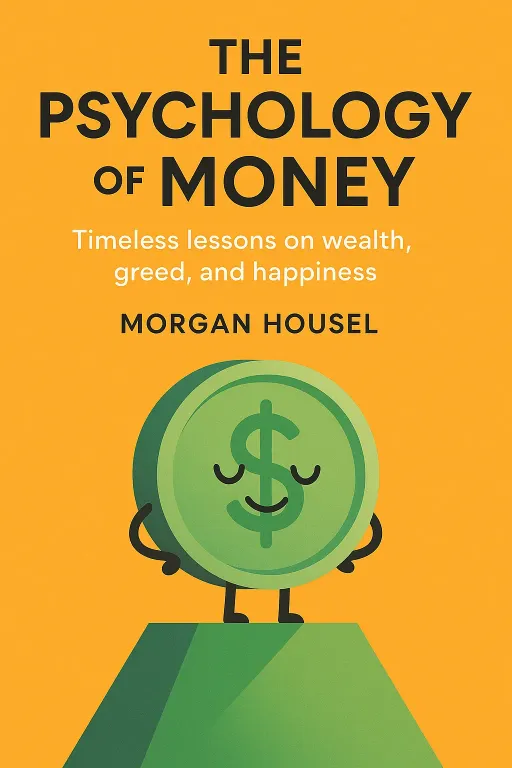
Nova: And that’s what we’re exploring today through Morgan Housel’s incredible book,. We’re joined by Binh, who’s at the very start of her journey in the finance world. Today we'll dive deep into this from two powerful perspectives. First, we'll explore the 'Enough' Paradox and why even billionaires risk it all for more. Then, we'll uncover the true secret to long-term wealth, which isn't about being the smartest person in the room, but the one who can stick around the longest. Binh, it’s so great to have you here.
Binh: Thanks for having me, Nova! I'm so excited for this. That opening contrast you shared is exactly why I found this book so compelling. In finance, we're so focused on models, data, and intelligence. The idea that a janitor could outperform a finance exec just by having a better mindset is, honestly, a little terrifying but also incredibly empowering.
Nova: It really is! It democratizes the whole idea of wealth. Housel’s argument is that we treat finance like physics, with rules and laws, but it’s really more like psychology, driven by emotions and individual quirks. And that’s a perfect place to start. What drives someone who has everything, like that finance executive, to risk it all? This brings us to our first big idea: the danger of 'Never Enough'.
Deep Dive into Core Topic 1: The 'Enough' Paradox
SECTION
Nova: The book tells this absolutely chilling story about a man named Rajat Gupta. And Binh, this story is like a cautionary tale written specifically for the world of high finance. Gupta’s story is, on the surface, the ultimate dream. He was born in Kolkata, orphaned as a teenager, and through sheer brilliance and hard work, he rises to become the CEO of McKinsey, the world's most prestigious consulting firm. By his retirement, he's worth an estimated one hundred million dollars.
Binh: Wow. So by any objective measure, he's already won. He has achieved a level of success and wealth that 99.9% of the world can only dream of.
Nova: Exactly. He had won the game. But here's the twist. He wasn't content. He was on the board of directors for companies like Goldman Sachs, surrounded by people like Warren Buffett. And he saw their wealth, which was in the billions, not millions. And he wanted that. He wanted to be a billionaire. His goalpost had moved.
Binh: I can almost understand that impulse, especially in that environment. When your peer group includes literal billionaires, your own $100 million can start to feel... inadequate. It’s the social comparison trap on an extreme scale.
Nova: It's the ultimate trap. And it led him to do something catastrophic. In 2008, at the height of the financial crisis, he was on a Goldman Sachs board call. He learned, seconds before the public, that Warren Buffett was about to make a five-billion-dollar investment to save the company. This was massive, market-moving news. The call ended. Sixteen seconds later, Gupta, from his phone, called a hedge fund manager named Raj Rajaratnam.
Binh: Oh no. I know where this is going. Insider trading.
Nova: The most blatant case you can imagine. Rajaratnam immediately bought 175,000 shares of Goldman. When the news of Buffett's investment broke, the stock surged, and he made a quick one-million-dollar profit. But of course, it didn't end there. The SEC investigated, and both Gupta and Rajaratnam were convicted. Rajat Gupta, the man who had everything—reputation, freedom, family, and a hundred million dollars—threw it all away for a shot at getting. He went to prison.
Binh: That story is just devastating. He risked what he had and needed for something he absolutely did not have and did not need. It perfectly illustrates Housel's point that the hardest financial skill is getting the goalpost to stop moving. In finance, we're trained to always chase growth, to beat the benchmark, to move to the next level. The entire incentive structure is about 'more'.
Nova: You're so right. And Housel points out that this social comparison is a battle that can't be won. As he puts it, the ceiling of what other people have is so high that virtually no one will ever hit it. You mentioned Mike Trout's salary earlier. He makes $36 million a year, which is incredible. But in 2018, the top hedge fund managers made at least $340 million. And Warren Buffett's net worth went up by $3.5 billion that year. It never ends.
Binh: So it's not a ladder, it's a hamster wheel.
Nova: Precisely! Which brings me to one of my favorite anecdotes from the book. The author Kurt Vonnegut was at a party with his friend, the novelist Joseph Heller. Vonnegut pointed out that their host, a hedge fund manager, had made more money in that single day than Heller's classic novel,, had made in its entire history.
Binh: That's a brutal comparison. How did Heller respond?
Nova: His response was perfect. He said, "Yes, but I have something he will never have… enough."
Binh: Chills. That's it, isn't it? 'Enough' isn't a number. It's a feeling. It's a decision. And it's a form of wealth in itself. The actionable advice here isn't just a vague 'be content.' It's to actively define what 'enough' means for you, personally, before you even get on that treadmill. Otherwise, you're just running towards someone else's finish line, and you might run right off a cliff like Rajat Gupta.
Nova: That is so well put. And that idea of defining your own finish line is the perfect bridge to our second topic. Because if you're not constantly chasing 'more,' what should you be focusing on? Housel's answer is surprising, and he uses a figure you're very interested in, Binh, Warren Buffett, to explain it.
Deep Dive into Core Topic 2: The Twin Engines of Wealth: Time and Survival
SECTION
Nova: So, when people in finance study Warren Buffett, what are they usually looking at?
Binh: His returns, absolutely. His stock picks, his valuation models. We analyze how he achieved his average annual return of around 22%, which is just legendary. We're trying to figure out how to replicate his genius.
Nova: Right. But Housel argues we're looking at the wrong variable. He says Buffett's genius is only half the story. The other, more important half? He's been a phenomenal investor for three-quarters of a century. He started when he was 10 years old. Housel reframes Buffett's success not as an investing story, but as a story about the mind-bending power of compounding over time.
Binh: The power of longevity.
Nova: Exactly. Of Buffett's $85 billion net worth, something like $84.5 billion of it was accumulated his 50th birthday. Housel runs this amazing thought experiment: if Buffett started investing at age 30 with a respectable $25,000 and still earned his incredible 22% annual returns, but then retired at age 60 to play golf, what would his net worth be?
Binh: I'm guessing a lot less than $85 billion.
Nova: Try $11.9 million. Which is a fantastic amount of money! But it's 99.9% less than his actual net worth. The takeaway is staggering. His skill is investing, but his secret is time.
Binh: That's a complete paradigm shift. In my classes, we study 'alpha'—the excess return above a benchmark. It's all about how smart you are. But we rarely, if ever, try to quantify the impact of sheer, uninterrupted longevity. Housel is basically saying that a 'good' return sustained for an incredibly long time will always beat a 'genius' return that gets interrupted.
Nova: You've hit on the key word: interrupted. You can't get the benefit of time if you get wiped out along the way. This is where Housel's second engine of wealth comes in: survival. He says getting wealthy and staying wealthy are two completely different skills. Getting wealthy often requires taking risks, being optimistic. But staying wealthy? That requires the opposite. It requires humility, frugality, and a dose of paranoia that you could lose it all.
Binh: It's the difference between offense and defense.
Nova: A perfect analogy. And he uses the story of a trader named Jesse Livermore to illustrate this. Livermore was a legend in the early 20th century. During the 1929 stock market crash, when everyone else was being ruined, he made the equivalent of $3 billion today by shorting the market. He was a genius at getting wealthy.
Binh: So he was set for life.
Nova: You'd think so. But he kept making bigger and bigger bets, fueled by overconfidence. By 1933, he had lost everything. He was wiped out. He was brilliant at getting money, but terrible at keeping it. Housel's point is that survival is the single most important skill. More than big returns, you want to be financially unbreakable.
Binh: That resonates so much, especially for my generation. We've seen the 2008 crisis, we've seen the volatility of crypto, we're entering a world that feels less certain. The idea of being 'unbreakable' is so much more appealing than just 'getting rich.' It's about building what Housel calls a 'margin for error.' It means you're not optimizing your life for the best-case scenario; you're structuring it to ensure you can survive the worst-case scenario. You can endure the inevitable downturns and stick around long enough for your career and your investments to compound.
Nova: And when you do that, you give yourself the greatest asset of all: time. You allow compounding to work its quiet, slow, but unstoppable magic.
Synthesis & Takeaways
SECTION
Nova: So it all comes together in this beautiful, holistic way. We have these two powerful, almost counter-intuitive ideas from. First, you have to actively fight the modern world's siren song of 'more' by defining what 'enough' means for you. You have to get off the social comparison hamster wheel.
Binh: And once you've done that, you can shift your focus. Instead of chasing the highest possible short-term returns, which is what Rajat Gupta was doing, you focus on a different game entirely.
Nova: The game of survival. You focus on building a plan that is reasonable and sustainable for you, one that helps you sleep at night. You build in a margin for error, you save consistently, and you simply aim to stay in the game, year after year, decade after decade.
Binh: It's a less glamorous path, for sure. It's not about the thrill of a huge win. It's about the quiet confidence of being unbreakable. It's about playing the long game.
Nova: Beautifully said. So, Binh, as someone just starting out in this world, what's the big, final takeaway for you and your peers?
Binh: I think for anyone my age, just starting their career, the most powerful question this book leaves us with is this: Are you building a financial plan to get rich, or are you building one to wealthy? Because, as we've discussed, they are not the same thing. They require different skills and a different mindset. And focusing on the second one, on being unbreakable, might just be the surest and most peaceful path to achieving the first.
Nova: A perfect place to end. Binh, thank you so much for sharing your insights today.
Binh: This was fantastic, Nova. Thank you.