

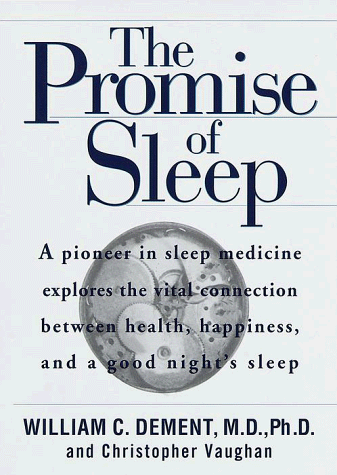
The promise of sleep
Introduction
Nova: Imagine you're a medical student sitting in a lecture hall, fighting to keep your eyes open. Your head droops, you snap it back up, but it's no use — you fall asleep. The professor spots you and points to the door. Humiliating, right? Well, that student was William C. Dement, and that moment of shame launched a career that would change the way the entire world thinks about sleep.
Nova: : Nova, that's quite the origin story. Being kicked out of class for dozing off? That would be mortifying.
Nova: It absolutely was. And Dement never forgot it. He went on to become known as the father of sleep medicine — the man who co-discovered REM sleep, founded the world's first sleep disorders clinic, and wrote the book we're diving into today: The Promise of Sleep. Published in 1999, it's part memoir, part science primer, and part urgent wake-up call — pun fully intended. Dement argues that healthy sleep is arguably the single most important factor in predicting how long you'll live — more than diet, more than exercise, more than genetics.
Nova: : More than diet and exercise? That's a bold claim. What makes him so confident?
Nova: Decades of research at Stanford, thousands of patients, and a career that spanned from the 1950s until his passing in 2020 at age 91. His book condenses all of that into a message he spent his entire life broadcasting: sleep is dangerously undervalued, and the consequences are costing lives every single day. Today we're unpacking The Promise of Sleep — what Dement discovered, why it matters, and how to claim the promise for yourself.
Nova: : I'm already intrigued. Let's get into it.
How Bill Dement Discovered the Architecture of Sleep
The Accidental Pioneer
Nova: Let's rewind to 1953 at the University of Chicago. Dement was a young medical student who had become fascinated by Freud's theories about dreams. He heard a lecture by a physiologist named Nathaniel Kleitman and basically banged on the guy's door begging to join his lab.
Nova: : I love that kind of boldness. Just knock on the door and say, let me in?
Nova: Exactly. Kleitman said yes, and assigned him to assist a graduate student named Eugene Aserinsky, who had noticed something strange: people's eyes seemed to dart back and forth rapidly during certain periods of sleep. Nobody had named it yet. Nobody understood it. Dement would sit awake all night in a dark lab while a volunteer slept in the next room, electrodes glued to their scalp and near their eyes, watching an EEG machine scratch out lines on long reams of paper.
Nova: : That sounds incredibly tedious. Just watching paper scroll by for hours?
Nova: Tedious but transformative. Dement noticed that about every 90 minutes, the brainwave patterns would flip from slow, synchronized waves into something that looked almost like wakefulness. The eyes would start shuttling back and forth beneath closed lids. And here's the kicker: when he woke people up during these episodes, they almost always recounted vivid, dramatic dreams. Before this, most scientists thought dreams were instantaneous flashes. Dement proved they lasted much longer — up to two hours per night across multiple cycles. He coined the term REM sleep, for rapid eye movement, and mapped out the entire 90-minute sleep cycle we now take for granted: four stages of increasingly deep non-REM sleep followed by REM.
Nova: : So one restless medical student basically drew the architecture of human sleep that every textbook now teaches?
Nova: Pretty much. But here's what I find fascinating: the scientific establishment at the time considered sleep a fundamentally boring topic. Sleep was just the off switch. Dement showed it was an entirely distinct biological state — one where the brain is intensely active, your heart rate and breathing fluctuate dramatically, and your body becomes temporarily paralyzed during REM to prevent you from physically acting out your dreams.
Nova: : Wait, paralyzed? That's actually a little unsettling.
Nova: It's a brilliant evolutionary safety mechanism. And when that paralysis fails — which we'll get to later — the consequences can be severe. But Dement didn't stop at mapping sleep cycles. In the 1960s, he moved to Stanford, and in 1970 founded the world's very first sleep disorders clinic. He also pioneered polysomnography — the comprehensive sleep study that tracks brain waves, eye movements, heart rate, breathing, blood oxygen, and leg movements all at once. It's still the gold standard for diagnosing sleep disorders today.
Nova: : He essentially invented an entire medical specialty from scratch.
Nova: He did. And he knew it was unusual. He once joked that he had to sign his own certification diploma in sleep medicine because there was nobody else qualified to do it.
How Sleep Loss Accumulates and Why It's More Dangerous Than You Think
The Invisible Debt
Nova: Here's one of the biggest concepts Dement introduces in The Promise of Sleep: sleep debt. Every hour of sleep you miss, your body keeps a tab. If you need eight hours and get six, you've accrued two hours of debt. Do that for a full work week and by Friday you're carrying a ten-hour sleep debt — the equivalent of having pulled an all-nighter.
Nova: : So you're saying if I sleep six hours a night Monday through Friday, by Friday I'm walking around like I haven't slept at all?
Nova: That's exactly what the research shows. Dement and his graduate student Mary Carskadon proved this at the Stanford Summer Sleep Camp — an actual summer camp they ran between 1976 and 1985 on the shores of Lake Lagunita at Stanford. Adolescents would play volleyball and go bowling by day, and at night the researchers would monitor their sleep and test their alertness. What they discovered was that sleep debt accumulates hour for hour, and the effects on alertness, reaction time, and mood compound relentlessly. There's no adaptation. You don't get used to sleeping less.
Nova: : That contradicts what a lot of people tell themselves. I know people who brag about functioning on five hours.
Nova: Dement was ruthless about this. He investigated dozens of people who claimed to thrive on short sleep, and he was never convinced by any of them. His rule of thumb: if you feel drowsy at any point during the day, you're carrying a sleep debt. If you lie down in a dark, quiet room and fall asleep within five minutes, you probably have a serious problem. A well-rested person should take fifteen to twenty minutes to drift off.
Nova: : That's a really tangible test. What happens when the debt gets really large?
Nova: Dement said about fifty hours is the maximum anyone can stand before the brain essentially forces sleep. But long before that, the impairment is severe. Take driving: a person with significant sleep debt has reaction times comparable to someone who's legally drunk. Dement cited research showing that being awake for 17 hours straight produces impairment equivalent to a blood alcohol level of 0.05 percent — and 24 hours without sleep is like 0.10 percent, which is above the legal limit.
Nova: : And we regulate drunk driving heavily but nobody stops you from getting behind the wheel exhausted.
Nova: That was Dement's constant frustration. He tracked news stories about mysterious crashes and disasters and found that fatigue was almost never investigated as a cause. The Three Mile Island nuclear meltdown happened at 4 a. m. when workers on the night shift made critical errors. The official investigation of the Exxon Valdez oil spill blamed the third mate's poor judgment — he had slept only four hours in the previous 48. The Challenger space shuttle disaster: key NASA managers had been awake for over 24 hours making launch decisions.
Nova: : These aren't minor incidents. These are history-changing catastrophes.
Nova: And Dement estimated that drowsy driving alone causes about 50,000 deaths per year in the United States. He called sleep deprivation the most common brain impairment in the world, and he couldn't understand why we weren't treating it like a public health emergency.
Sleep Apnea, Narcolepsy, and the Disorders Nobody Was Diagnosing
The Hidden Epidemic
Nova: In The Promise of Sleep, Dement makes a staggering claim: ninety-five to ninety-nine percent of sleep disorders remain undiagnosed or untreated. And the biggest culprit? Sleep apnea.
Nova: : That percentage can't be right. How is that possible?
Nova: Because for decades, nobody was looking. Dement and his colleague Christian Guilleminault essentially discovered sleep apnea as a widespread condition when patients started flooding their new Stanford clinic in the 1970s. These people were incredibly tired during the day — not from narcolepsy or insomnia, but because their airways were collapsing repeatedly during sleep. Picture this: your throat closes, you stop breathing, carbon dioxide builds up, your brain panics and jolts you awake with an explosive gasp — and then you fall back asleep and it happens again. Forty-five to a hundred times per hour, all night long.
Nova: : A hundred times an hour? That means every minute or so you're being yanked out of sleep. How does anyone survive that?
Nova: They suffer tremendously, and often don't know why. Dement presented early data suggesting sleep apnea affected nearly a quarter of adult men. His colleagues thought he was crazy — at the time, conventional wisdom said maybe two percent. But Dement was right. We now know sleep apnea is one of the most common chronic conditions in America, strongly linked to high blood pressure, type 2 diabetes, stroke, and heart attack. Dement's research suggested that in 1992 alone, apnea caused roughly 38,000 fatal heart attacks and strokes.
Nova: : And the symptoms people might notice?
Nova: Loud snoring — which Dement insisted is never normal and always deserves investigation — plus daytime exhaustion, morning headaches, personality changes like irritability, and frequent nighttime urination. The good news is treatment exists. The CPAP machine, which pumps air through a mask to keep the airway open, was a breakthrough largely developed at Stanford.
Nova: : What about narcolepsy? That one's more famous, at least from movies and TV.
Nova: Dement made a key discovery here too. He found that narcolepsy involves the brain plunging directly into REM sleep during waking hours — those sudden sleep attacks people experience. Imagine being in the middle of a conversation and your body just switches into dream sleep, complete with muscle paralysis. It's terrifying and dangerous. Dement found it can be effectively managed with medications like modafinil.
Nova: : And there's one more disorder you hinted at earlier — the one where the paralysis during dreaming fails?
Nova: REM Behavior Disorder. During normal REM sleep, your body is paralyzed so you don't act out your dreams. In this condition, the paralysis fails, and people physically enact their dreams — which are often violent or frightening. Dement notes that ninety percent of sufferers are male, usually over fifty. There have been criminal cases where the disorder has been invoked as a defense. But in most cases it's treatable with medication. The fact that Dement even identified and characterized these conditions shows how much of sleep medicine he personally mapped out.
Dement's Lifelong Public Health Crusade
Drowsiness Is Red Alert
Nova: Every student who took Dement's legendary Sleep and Dreams course at Stanford — and there were about 20,000 of them — learned one phrase above all: drowsiness is red alert.
Nova: : I've heard that phrase. He actually had students shout it in class, didn't he?
Nova: He did more than that. Dement designated a special sleeping section in his classroom for students who were too exhausted to stay awake. But if he caught someone dozing off outside that section, he'd wake them with a squirt gun and make them stand up and shout, drowsiness is red alert! It sounds playful, but he was dead serious. His message was: when your body signals that it needs sleep, especially in a hazardous situation, you must treat that signal with the same urgency as a fire alarm.
Nova: : A squirt gun professor who changed national policy. That's quite a combination.
Nova: It really was. In the late 1980s, Dement got frustrated with the slow pace of change and basically started walking the halls of Congress, knocking on every door. He'd schedule a meeting with one representative, and then just go down the hallway and talk to whoever would listen. His persistence led to the creation of the National Commission on Sleep Disorders Research, which he chaired.
Nova: : And what did the commission find?
Nova: Their 1992 report, called Wake Up America: A National Sleep Alert, was a bombshell. It estimated that Americans were sleeping twenty percent less than they had a century earlier. Forty million Americans suffered from chronic sleep disorders. Sleepiness had become a major hazard on highways, in schools, and in workplaces. The report directly led to the creation of the National Center on Sleep Disorders Research at the National Institutes of Health, which funds and coordinates sleep research across the country.
Nova: : Forty million people with sleep disorders in 1992 — that number must be even higher now.
Nova: Almost certainly. And Dement was especially concerned about one group: teenagers. He argued that contrary to popular belief, teens need about ten hours of sleep — roughly the same as younger children. But most teens are biologically programmed as owls — their internal clocks shift so they feel alert late at night and groggy in the early morning. Meanwhile, high schools typically start at the crack of dawn. The result is a population that is almost universally sleep-deprived. Dement believed this wasn't just a health issue; he thought it might contribute to teen moodiness, lack of motivation, and even behavioral problems.
Nova: : So the system is basically working against adolescent biology.
Nova: Exactly. And Dement spent years advocating for later school start times — a fight that's still ongoing in many communities today. He also pushed for reduced working hours for medical residents. In 2003, new rules finally capped resident hours at 80 per week, which was actually considered a victory — though Dement would probably say even that is far too many.
Practical Wisdom for Better Sleep
Claiming the Promise
Nova: So with all this alarming information, what does Dement actually recommend? The Promise of Sleep is not just a warning — it offers a practical program.
Nova: : Alright, let's hear it. How do you fix your sleep?
Nova: Step one is awareness. Dement recommends keeping a sleep diary for a week — track when you go to bed, when you wake up, how you feel during the day. His simple self-test: in the middle of the day, could you fall asleep in a quiet, darkened room? If the answer is yes, you're carrying debt.
Nova: : And then you pay it off?
Nova: Exactly. Step two: spend a week aggressively reducing your sleep debt. Go to bed earlier, take naps when possible — Dement was a big fan of naps. He often said, sleep until you can't sleep anymore. Let your body tell you how much it needs. Then step three: maintain good sleep hygiene. That means a consistent schedule, a dark and quiet bedroom — Dement recommended about 65 degrees Fahrenheit as the ideal sleeping temperature — and avoiding the obvious saboteurs.
Nova: : Like late-night coffee and scrolling through your phone in bed?
Nova: Those are the big ones, yes. But Dement also highlighted something less obvious: your evening wind-down. He recommended setting aside thirty minutes earlier in the evening as designated worry time — get all your anxious thoughts out then, so they're not climbing into bed with you. He was also cautious about alcohol, which might help you fall asleep but severely disrupts the quality of your sleep, especially REM.
Nova: : What about sleeping pills?
Nova: Dement was pragmatic. He acknowledged that medications like Ambien could be useful short-term tools, particularly because they're short-acting and non-addictive when used properly. But his real emphasis was on fixing the underlying causes of poor sleep rather than medicating the symptoms.
Nova: : And did he have specific advice for the apnea problem?
Nova: First and foremost: take snoring seriously. Dement's position was that snoring is never normal and always warrants investigation. If you snore and feel tired during the day, get a sleep study. CPAP therapy is remarkably effective. He also highlighted newer treatments that were emerging, including surgical options and radiofrequency procedures to reduce excess tissue in the throat.
Nova: : It strikes me that Dement's approach is both high-tech — all the lab studies and monitoring — and remarkably simple. Go to bed earlier, sleep in the dark, take naps, listen to your body.
Nova: That's a great observation. For all his scientific sophistication, his core message was almost primal: sleep is not optional, it's not a luxury, and when your body says it's tired, you need to listen.
Conclusion
Nova: Let's step back and look at what William Dement accomplished. In the 1950s, sleep was considered so uninteresting that studying it was a career dead end. By the time he died in 2020 — fittingly, in his sleep — he had co-discovered REM sleep, mapped the human sleep cycle, founded the world's first sleep disorders clinic, created the field of sleep medicine, established the American Academy of Sleep Medicine, co-developed the Multiple Sleep Latency Test, pioneered polysomnography, taught 20,000 students, chaired the national commission that transformed sleep policy in America, and wrote The Promise of Sleep to bring all of this knowledge directly to the public.
Nova: : When you lay it out like that, it's staggering. One person built an entire field.
Nova: And here's the thing: Dement would be the first to say that his work is unfinished. His colleague Emmanuel Mignot at Stanford said that even at 91, Dement felt drowsiness and sleep disorders were still a major threat, and he would have kept fighting if he could. But he also trained an army of students and researchers to carry on.
Nova: : Let's distill it. If someone listening wants to take one thing from The Promise of Sleep, what should it be?
Nova: I'd say it's this: the world has convinced you that sleep is negotiable. That you can cut corners, power through, and catch up later. Dement's entire career proves that's a dangerous illusion. Sleep debt is real, it accumulates, and it impairs your judgment so subtly that you stop noticing how impaired you actually are. The promise of sleep is that if you give your body the rest it needs, you gain everything: sharper thinking, better health, longer life, and a fundamentally happier existence.
Nova: : And if you feel drowsy?
Nova: Red alert. Get off the road. Get out of harm's way. And go to bed.
Nova: : Wise words from a man who spent sixty years stalking the sleeping self — and in doing so, woke up the rest of us.
Nova: This is Aibrary. Congratulations on your growth!