

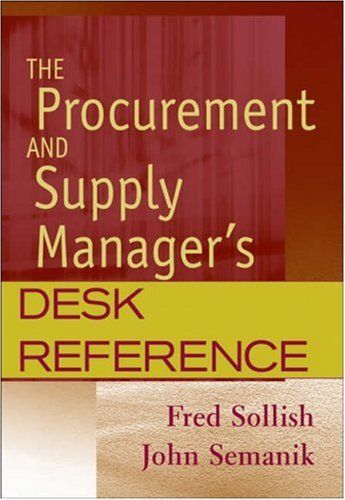
The procurement and supply manager's desk reference
Introduction: The Hidden Powerhouse of Business
Introduction: The Hidden Powerhouse of Business
Nova: Welcome to the show. We often talk about innovation, marketing, and finance, but today we are diving deep into the engine room of every successful company: Procurement and Supply Management. Here is a startling fact: for many large organizations, the cost of goods sold—which procurement directly influences—can account for 60 to 80 percent of their total revenue. That is where the real margin lives, yet it remains one of the most misunderstood departments.
Nova: That is exactly the problem this week's deep dive addresses. We are examining the definitive guide for that shift: "The Procurement and Supply Manager's Desk Reference," specifically the Second Edition by Fred Sollish and John Semanik. This isn't a light read; it's positioned as the essential road map for the modern supply professional.
Nova: It’s the depth and the practicality. It promises to cover everything from the foundational roles to advanced risk management. We’re going to break down what makes this book a cornerstone text for anyone serious about mastering the art and science of getting what a business needs, when it needs it, and at the right strategic value. Let's start by looking at the architects behind this massive compilation of knowledge.
Authoritative Foundations
The Architects of Strategy: Credibility Behind the Cover
Nova: Our first core insight revolves around the authors themselves, Fred Sollish and John Semanik. When you pick up a reference guide, you need to trust the source, and Sollish brings serious credentials to the table. Research shows he has over 30 years of experience in supply management and procurement.
Nova: He is definitely a practitioner who has moved into thought leadership. Sollish holds the MS and CPM designations, which are serious markers of expertise in the field. More importantly, he’s the Managing Director of eParagon, LLC, a consulting firm specifically focused on providing training and working tools for procurement professionals. He’s literally in the business of teaching this stuff.
Nova: Precisely. When you have someone who has been at the helm of the professional body, they have a panoramic view of the challenges facing the entire profession, not just one company's silo. Semanik, his co-author, shares this respected expertise. This isn't just a textbook; it’s distilled wisdom from people who have lived and breathed supply chain strategy for decades.
Nova: Absolutely. And this authority is what allows them to tackle the breadth of topics they cover. They aren't afraid to get into the nitty-gritty, which brings us to the actual substance of the reference guide.
Nova: We’ll explore that in the next chapter, but just know that the credibility of the authors is the bedrock upon which they build their comprehensive structure, covering everything from the tactical to the strategic.
Key Insight 1: From Purchasing to Strategic Sourcing
The Strategic Blueprint: Core Pillars of the Reference
Nova: The second major theme we uncovered is how the book clearly delineates the modern procurement function. It moves far beyond the old-school idea of 'purchasing'—which is transactional—into strategic sourcing and supply management. The reference covers key roles and responsibilities in detail.
Nova: He emphasizes the entire lifecycle, which includes robust sections on Sourcing Management and Supplier Selection. It’s not just about finding the cheapest supplier; it’s about finding the supplier based on total cost of ownership, risk profile, and strategic alignment. The book details how to measure supplier performance, which is a huge component of modern supply management.
Nova: It goes deep. We’re talking about metrics that tie directly back to business outcomes. If you are sourcing raw materials, the reference guides you on setting up scorecards that track quality consistency, innovation contribution, and even sustainability compliance, not just the invoice price. It’s about partnership management, not just vendor management.
Nova: Yes, Contract Administration is a dedicated area. In an era where supply chain disruptions can lead to massive litigation, understanding how to structure, negotiate, and enforce contracts is non-negotiable. The reference provides frameworks for this, ensuring that the negotiated value actually materializes.
Nova: Exactly. It’s a crucial bridge. Procurement professionals must be fluent in financial language to justify their strategic sourcing decisions. They need to show how a slightly higher initial investment in a strategic supplier leads to massive savings down the line through reduced inventory holding costs or fewer quality failures. The book provides the language and the tools to make that financial case.
Nova: That is the perfect analogy. It’s teaching them to think like a CEO of the supply function. It covers the entire spectrum, from the initial strategic planning of to buy, all the way through to the tactical execution of and managing the resulting budget impact. It’s comprehensive, covering the full lifecycle that many practitioners only see in fragments.
Key Insight 2: Practicality in a Transforming Landscape
Navigating the New Millennium: Tools and Modern Challenges
Nova: That’s where the emphasis on 'essential tools and strategies' comes into play. While the book won't detail the latest generative AI procurement bot, it focuses on the that underpin successful technology adoption. For instance, it covers how to drive continuous improvement—a concept that remains vital whether you are using spreadsheets or machine learning.
Nova: It is. Outsourcing requires a level of proficiency that many companies underestimate. The reference provides guidance on managing complex external relationships, which is essentially what modern outsourcing is. It helps managers avoid the pitfalls of simply handing off a process without retaining control over quality or intellectual property.
Nova: Exactly. It’s about governance at a distance. Furthermore, the book addresses the changing role itself. Procurement is no longer just about cost reduction; it’s about value creation and risk mitigation. Consider the recent global shocks—the pandemic, trade wars. A reference that covers risk management thoroughly becomes invaluable in these volatile times.
Nova: Absolutely. The book provides a framework for resilience. It’s about building supply chains that can bend without breaking. And this ties into the idea of making procurement a strategic partner. When you can demonstrate that your sourcing strategy actively mitigates existential business risk, you move from being a cost center to a value driver.
Nova: That’s the goal. It’s a comprehensive guide that equips you not just for today’s immediate purchasing needs, but for the strategic challenges of the next decade. It’s about building a robust, defensible supply base.
Key Insight 3: Foundational Knowledge in a Fast-Moving World
The Enduring Value: Why Reference Matters Over Trends
Nova: We’ve covered the authors’ deep expertise and the book’s comprehensive structure covering sourcing, contracts, and risk. Let’s pivot to the final, crucial question: In 2024 and beyond, why should a busy professional rely on a printed reference guide when they have instant access to every trend article online?
Nova: That cohesion is its superpower. Procurement is a complex ecosystem. If you pull one lever—say, aggressively driving down supplier costs—you might inadvertently break another, like supplier innovation or long-term quality. Sollish and Semanik structure the knowledge so you see the interdependencies. You can’t optimize supplier selection without understanding contract terms, and you can’t manage contracts without understanding internal controls.
Nova: Precisely. Think of it this way: Technology changes every six months. The principles of negotiation, the legal requirements of a sound contract, the methodology for calculating total cost of ownership—those are enduring. This book codifies those enduring principles. It’s the foundation upon which you build your tactical responses to the latest trends, whether that trend is AI integration or near-shoring.
Nova: It is. It’s designed to be used, not just read once. It’s the go-to resource when you’re facing a novel problem—a supplier bankruptcy, a sudden regulatory change—and you need a proven, structured methodology immediately. It prevents you from reinventing the wheel under pressure.
Nova: A perfect summary, Alex. It’s the architectural plan for strategic supply management.
Conclusion: Mastering the Supply Chain Mandate
Conclusion: Mastering the Supply Chain Mandate
Nova: We’ve spent this episode unpacking "The Procurement and Supply Manager's Desk Reference" by Fred Sollish and John Semanik. We established that the authors bring decades of frontline, executive, and teaching experience, lending immense credibility to the material.
Nova: Most importantly, we concluded that in an age of constant digital disruption, this reference remains vital because it codifies the enduring principles of value creation in supply management. It provides the strategic blueprint so that when new technologies emerge, you know exactly how to apply them effectively.
Nova: It elevates the entire function. It’s about moving from being a necessary expense to being a strategic asset that protects and grows the enterprise. It’s a mandate for excellence in the supply chain.
Nova: That’s what we aim for. This is Aibrary. Congratulations on your growth!