

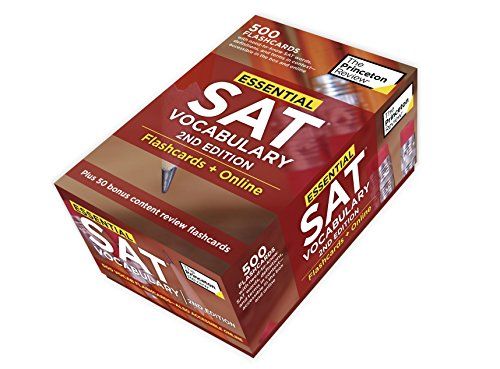
The Princeton Review Essential SAT Vocabulary
500 Essential Vocabulary Words to Help You Boost Your SAT Score!
Introduction
Nova: Picture this: it's 11 PM the night before the SAT, and a student is frantically trying to cram 500 vocabulary words into their brain. We've all been there, or known someone who has. But here's the thing: vocabulary still matters on the SAT, even in 2026 with the digital format, and one little box of flashcards has been a quiet bestseller for years helping students crack it. I'm talking about The Princeton Review Essential SAT Vocabulary, a 500-card deck that's been on Amazon since 2017 and still has SAT tutors raving about it.
Nova: : Wait, flashcards? In the age of apps and AI tutors and digital everything, we're talking about a cardboard box of paper cards?
Nova: We absolutely are. And there's a reason this unassuming little box, priced around seventeen to twenty-five dollars, has outlasted so many digital tools. It's not just nostalgia. It's about what's inside those 550 pages of cardstock: the words that actually show up on the SAT, curated by a company that's been analyzing the test since 1981.
Nova: : Okay, I'm intrigued. But before we go deep, let's address the elephant in the room. Didn't the SAT change? Like, dramatically? I thought they got rid of all those obscure vocabulary words.
Nova: They did change. And that's exactly what makes this conversation so interesting. The old SAT had those infamous sentence completion questions where you had to know words like "sesquipedalian." The new digital SAT has replaced those with "words in context" questions. Up to eight questions on the Reading and Writing section ask you to choose the most precise word for a given context. And here's the twist: the words tested are often familiar, but with meanings that shift depending on how they're used.
Nova: : So you might know the word "conduct" as in behavior, but the SAT might use it as in "to conduct an experiment." Got it. Still, why a physical flashcard set? Why not just an app?
Nova: That's exactly what we're going to unpack today. Welcome to Aibrary. I'm Nova.
Nova: : And I'm. Let's dive into The Princeton Review Essential SAT Vocabulary.
Unboxing the 500-Card Arsenal
What's Actually in the Box
Nova: So let's open this box. The Princeton Review Essential SAT Vocabulary, second edition, published in April 2017. It contains 500 vocabulary flashcards, and they are not randomly chosen words pulled from a dictionary. These are words from what Princeton Review calls the "Hit Parade" — the vocabulary that appears most frequently on the actual SAT.
Nova: : The "Hit Parade" — that sounds like a radio countdown. So these are the chart-toppers of SAT vocabulary?
Nova: Exactly. And here's why that matters. The Princeton Review has been analyzing SAT tests for over four decades. They have the data, the computer power, and the connections to identify which words show up again and again. A tutor from eSAT Prep Tips, who reviewed this set extensively, said something that stuck with me: every time he pulls a card from this box, it's "solid gold" — a word he would want every student to learn, and a word most students don't already know.
Nova: : That's a strong endorsement. But what's actually on each card? Walk me through the anatomy.
Nova: The front of each card has the vocabulary word, its part of speech, and the pronunciation. Flip it over, and you get three things: a clear definition, a sentence using the word in context, and a list of synonyms. The synonyms are sneaky genius because many of them are also SAT-level words, so you're effectively learning two or three words for the price of one.
Nova: : So every time you study "expedient," you might also pick up "advantageous" or "prudent." That's efficient.
Nova: Very. But there's more. The box includes 50 bonus cards that cover important terms, formulas, and practice question prompts for the Math, Essay, and Reading and Writing sections. There are also 50 blank cards, pre-formatted with the same layout, so you can add your own words — maybe ones you encounter in practice tests that aren't already in the deck.
Nova: : Customizable flashcards. I like that. What about tracking progress? Because 500 cards is a lot.
Nova: Great question. Under the cover, there's a color-coded scale printed on the inside of the box. You can use it to track how many words you've memorized. The review on Rainbow Resource also mentions that you can register your purchase online and access the entire deck digitally. So it's a hybrid product: physical cards plus a digital version.
Nova: : Physical cards for when you're offline, digital for when you're on the go. That actually makes a lot of sense for today's students.
The Science of Active Recall and Spaced Repetition
Why Flashcards Still Work
Nova: Let's talk about why flashcards — even paper ones — remain one of the most effective ways to learn vocabulary. It comes down to two concepts from cognitive science: active recall and spaced repetition.
Nova: : Active recall — that's when you force your brain to retrieve information rather than just passively reading it, right?
Nova: Exactly. When you look at the front of a card that says "abstemious" and you have to actively remember what it means before flipping it over, you're strengthening that neural pathway. It's way more effective than just reading a word list over and over.
Nova: : And spaced repetition?
Nova: Spaced repetition is the practice of reviewing information at gradually increasing intervals. A 2019 study in the Journal of Educational Psychology found that students using spaced repetition retained 20 to 30 percent more information after one month compared to students who crammed. Other research has shown retention rates as high as 85 to 90 percent after four weeks when using spaced repetition tools.
Nova: : So instead of studying 50 cards the night before the test and forgetting most of them by morning, you study five cards today, review them tomorrow, then again in three days, then a week later, and so on.
Nova: That's the method. And the Princeton Review flashcard set, while it doesn't have a built-in spaced repetition algorithm like Anki, is perfectly suited for this approach. The reviewer from eSAT Prep Tips recommended using the cardboard divider that comes in the box to separate learned words from unlearned ones. You can create your own system: a pile for words you know cold, a pile for words you're shaky on, and a pile for words you haven't touched yet.
Nova: : It's analog spaced repetition. There's something almost meditative about physically sorting cards into piles.
Nova: There really is. And the Princeton Review itself, on their website, emphasizes a strategy they call "use it or lose it." Think of your vocabulary as a muscle. You have to keep working it out. They recommend defining words in your own words, writing them down, and — here's the key — using new words in conversation whenever possible.
Nova: : I can imagine a high school student at dinner telling their parents, "This meatloaf is quite palatable" and getting some strange looks.
Nova: Strange looks, but a better SAT score. Worth it.
How Vocabulary Testing Has Evolved and Why This Book Still Matters
The Digital SAT Shift
Nova: Let's address the big question: the SAT has changed dramatically. The old paper-based SAT had those sentence completion questions that directly tested obscure vocabulary. The new digital SAT, rolled out in 2024, has a completely different approach.
Nova: : This is what confuses a lot of students. They hear "the SAT doesn't test vocabulary anymore" and they think they can skip vocab prep entirely.
Nova: And that is a dangerous misconception. The Princeton Review's own website puts it bluntly: "SAT words still matter." The digital SAT now tests vocabulary through "words in context" questions. You'll encounter up to eight questions that require you to choose the most precise word or phrase for a given passage. The words themselves might look familiar — words like "claim," "significant," "conduct" — but they shift in meaning depending on how they're used.
Nova: : So it's less about knowing that "loquacious" means talkative, and more about knowing that "charge" can mean a fee, an accusation, a responsibility, or an electrical property, depending on context.
Nova: Perfect example. And this is where the Princeton Review flashcard set actually shines. Remember, on the back of every card, there's a sentence using the word in context. That is exactly the skill the digital SAT tests: can you understand a word based on how it's used in a real sentence?
Nova: : So even though the test format changed, the fundamental skill hasn't. You still need a strong vocabulary. You just need it in a more applied, contextual way.
Nova: Right. And Princeton Review's broader advice for building SAT vocabulary reinforces this. They recommend reading widely — magazines like Forbes, National Geographic, and The New Yorker. They suggest using a dictionary strategically, looking at all definitions of a word, not just the first one. And they emphasize writing things down, because the physical act of writing helps cement information.
Nova: : That advice about reading widely is underrated. You can't cram a sophisticated vocabulary in two weeks by grinding flashcards alone. The flashcards are a supplement to a broader reading habit.
Nova: Exactly. The flashcards give you the targeted, high-frequency words. But the reading habit gives you the contextual intuition — the ability to sense what a word means even when you've never seen it before.
Honest Assessment of the Product
The Good, the Nitpicks, and the Bottom Line
Nova: Let's do an honest assessment. What makes this product great, and what are the nitpicks?
Nova: : I'll start with the obvious strength: curation. These aren't random words. The Princeton Review has the resources to analyze actual SAT exams and identify which words appear most frequently. That data-driven curation is something an individual student or tutor simply cannot replicate on their own.
Nova: Absolutely. Another strength is the price point. At roughly seventeen to twenty-five dollars for 500 curated words plus 50 bonus cards and 50 blank cards, plus online access, it's remarkably affordable compared to SAT prep courses that can cost hundreds or thousands of dollars.
Nova: : Portability is another win. The box is about five and a half inches by four inches by two and three-quarter inches. You can throw it in a backpack, leave it in the car, study a few cards between classes. The reviewer from eSAT Prep Tips said he throws it in his backpack frequently and the box holds up well.
Nova: Now for the nitpicks. The cards themselves are relatively thin paper, not heavy cardstock. They're not going to survive being spilled on or crumpled. You need to treat them with some care and keep them in the box.
Nova: : Also, there's no built-in organizational system beyond that cardboard divider and the color-coded scale inside the box. You have to create your own system for tracking which words you've mastered. Digital apps like Anki and Quizlet handle that automatically.
Nova: That's fair. Though some students actually prefer the tactile, analog experience. Another thing worth noting: because the set was published in 2017, before the digital SAT was fully rolled out, some of the vocabulary might feel slightly more aligned with the old format. However, the core words remain highly relevant because they're common academic vocabulary — the kind of words you encounter in college-level reading.
Nova: : So the bottom line: who is this for?
Nova: It's for the student who wants a structured, curated, no-nonsense vocabulary resource. It's for someone who likes physical flashcards and the satisfaction of physically sorting cards into "mastered" and "not yet" piles. It's for the student who doesn't want to spend time making their own flashcards and wants to trust that every word they study has a decent chance of actually appearing on the test.
Nova: : And who might want something else?
Nova: If you're fully digital-native and prefer adaptive algorithms, Anki or Quizlet might suit you better. If you need a deeper dive into etymology and word roots, Princeton Review's own SAT Power Vocab book is a more comprehensive text. But for pure, efficient flashcard-based vocabulary drilling, this box set has been a top recommendation from SAT tutors for years.
Vocabulary as a Life Skill
Beyond the Test
Nova: Here's something that often gets lost in the SAT prep conversation: these words are useful far beyond test day.
Nova: : This is what I was hoping we'd get to. Because once the SAT is over, you don't just delete these words from your brain, right?
Nova: Exactly. The eSAT Prep Tips reviewer made a point that resonated with me: learning SAT vocabulary has "rewarding benefits beyond the SAT like improving your college and scholarship applications as well as simply making reading more fun and enjoyable." When you know more words, you comprehend more of what you read. Reading becomes less of a chore and more of a pleasure.
Nova: : And in college, you're going to encounter these words everywhere — in textbooks, in lectures, in academic papers. Words like "ambiguous," "corroborate," "mitigate," "pragmatic" — these are the building blocks of academic discourse.
Nova: The Princeton Review's own philosophy reflects this. Their website says they help students "become more than their test score." The vocabulary you build for the SAT becomes part of your permanent intellectual toolkit.
Nova: : That's a much more motivating framing than "memorize these 500 words or else." It's more like "here are 500 words that will make you a better reader, writer, and thinker for the rest of your life."
Nova: And that's the real value proposition of a resource like this. Yes, it's designed to boost your SAT score. But the words stick with you. When you know what "ubiquitous" means, you start noticing it in articles. When you learn "ephemeral," you recognize it in a novel. It's like putting on a pair of glasses — suddenly the world of language comes into sharper focus.
Nova: : Plus, there's a confidence factor. Walking into the SAT knowing you have 500 high-frequency words in your back pocket — that has to reduce test anxiety.
Nova: Absolutely. Vocabulary is one of the few parts of SAT prep where the preparation is finite and measurable. You either know the word or you don't. With 500 cards, you can literally track your progress: 100 down, 400 to go. There's something psychologically satisfying about watching that "learned" pile grow taller.
Conclusion
Nova: Let's bring it all together. The Princeton Review Essential SAT Vocabulary is a 500-card flashcard set that has earned its reputation through smart curation. These aren't just any 500 words — they're the "Hit Parade," the words that actually appear most frequently on SAT exams, backed by decades of test analysis.
Nova: : Each card gives you the word, pronunciation, part of speech, a clear definition, a contextual sentence, and synonyms. The box includes 50 bonus cards for other SAT sections and 50 blanks for customization. And you can access the whole deck online too.
Nova: Even though the SAT has shifted to a digital, words-in-context format, this resource remains highly relevant because it teaches words through contextual sentences — exactly the skill now tested. And the underlying cognitive science — active recall and spaced repetition — makes flashcards one of the most effective study methods available.
Nova: : The bottom line: it's affordable, portable, data-backed, and filled with words that matter both for the test and for life beyond it. The cards are a bit thin, and you'll need your own organizational system, but those are small trade-offs for a product that SAT tutors consistently recommend as their top vocabulary tool.
Nova: If you're preparing for the SAT, or know someone who is, don't buy into the myth that vocabulary doesn't matter anymore. It does. It just matters in a smarter, more contextual way. And the right tool — whether it's a box of 500 flashcards, a digital app, or a combination of both — can make all the difference.
Nova: : Build the habit. Read widely. Use the words you learn. Your SAT score will thank you, and so will your future self when you're cruising through college readings with confidence.
Nova: This is Aibrary. Congratulations on your growth!