

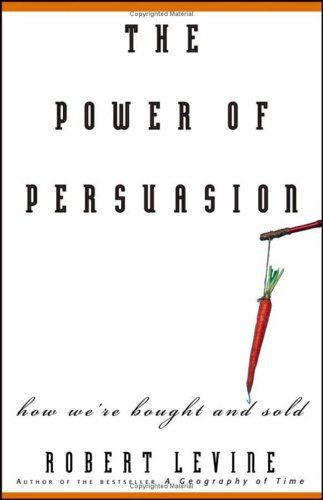
The Power of Persuasion
Introduction: The Invisible Chains of Influence
Introduction: The Invisible Chains of Influence
Nova: Welcome back to Mind Over Matter, the podcast dedicated to dissecting the hidden forces that shape our decisions. Today, we are diving deep into a book that pulls back the curtain on influence itself: Robert V. Levine’s "The Power of Persuasion: How We're Bought and Sold."
Nova: : I'm ready, Nova. The title alone sounds like a warning label for modern life. What makes Levine’s take on persuasion so essential right now?
Nova: Because, Alex, Levine argues that persuasion isn't just about slick salespeople or political ads. It’s so sophisticated that, and this is a quote from reviews, "even the best-educated cynics among us can be victimized." He takes us from the mundane—that impulse buy at the checkout—to the terrifyingly extreme.
Nova: : Extreme? You’ve got my attention. We usually talk about Cialdini’s six principles, the classic stuff. Where does Levine take the conversation that warrants such a stark warning?
Nova: He maps the entire spectrum. He shows how the same psychological levers that make you buy a slightly overpriced gadget are the ones that can, in the wrong hands, lead to mass self-deception. We’re talking about everything from telemarketing scams to, and this is chilling, the psychological architecture behind suicide cults and radicalization.
Nova: : Wow. That’s a massive scope. So, this isn't just about getting a better deal; it’s about understanding the very nature of compliance and belief formation. Why should our listeners care about this deep dive into social psychology?
Nova: Because awareness is the first line of defense. Levine, a Professor of Psychology, doesn't just list the tactics; he dissects the where they become most potent. By the end of this episode, you’ll be able to spot the invisible chains being wrapped around your decision-making process. Ready to start dismantling them?
Nova: : Absolutely. Let’s see what kind of sophisticated methods Levine says are being used against us every single day.
Key Insight 1: The Sophistication of Modern Influence
The Illusion of Immunity: Why Cynics Fall Hardest
Nova: Let’s start with that idea of the educated cynic. We often think, 'I’m too smart for that. I see the sales pitch coming a mile away.' Levine suggests that’s exactly what the persuaders are counting on.
Nova: : That’s frustratingly true. If I know the tactic, I feel immune. What’s the mechanism he identifies that bypasses that intellectual guardrail?
Nova: It’s the subtlety of the and the. Levine emphasizes that persuasion is often less about the message itself and more about the environment in which the message is delivered. He points out that we are constantly exposed to sophisticated methods in everyday life—television, targeted advertising, even workplace dynamics.
Nova: : So, it’s the sheer volume and the professional packaging that wears us down, not just a single, obvious trick?
Nova: Precisely. Think about testimonials. We know they can be bought, but when a testimonial is delivered by someone we perceive as highly credible—an expert, or someone just like us—our critical filter often lowers automatically. Levine stresses the importance of establishing credibility and demonstrating expertise as a fundamental persuasive tool.
Nova: : That makes sense. If a doctor recommends a supplement, I might pause, even if I know the doctor is paid by the manufacturer. It’s the authority cue kicking in before the logic centers can fully engage.
Nova: Exactly. And he goes deeper than just authority. He looks at popularity cues—the bandwagon effect. If everyone else is doing it, or if a product is presented as the 'best-selling' or 'most popular,' our brain defaults to the path of least resistance, which is conformity.
Nova: : So, the sophisticated persuader doesn't just tell you to believe; they engineer a situation where believing it feels like the safest, most normal, or most expert-approved choice.
Nova: That’s the core of his survey. He’s showing that these aren't isolated incidents; they are systematic applications of psychological principles designed to elicit compliance without conscious, critical evaluation. It’s about moving from conscious processing to automatic response.
Nova: : It sounds like Levine is mapping out the psychological terrain that Cialdini mapped, but perhaps with a more cynical or perhaps more realistic view of how often we fall for it in the wild.
Nova: That’s a fair assessment. While Cialdini gave us the foundational principles, Levine seems focused on demonstrating their relentless, almost inescapable application across consumerism and social control. It’s less about the theory and more about the pervasive reality of being bought and sold daily.
Key Insight 2: The Extreme Applications of Influence
The Spectrum of Control: From Sales to Suicide Cults
Nova: Now we have to talk about the chapters that truly separate this book. We mentioned the extreme examples earlier. Levine doesn't shy away from the darkest corners of human influence.
Nova: : I recall seeing references to the Jonestown Incident. That’s a textbook case of total control through psychological manipulation, isn't it?
Nova: It is. Levine uses Jonestown as a case study to show what can be achieved when persuasion techniques—like isolation, manufactured crisis, and absolute reliance on a charismatic leader—are pushed to their absolute limit. It’s persuasion weaponized.
Nova: : When you look at something like that, it seems like pure coercion, not persuasion. Where does Levine draw the line, if he does at all?
Nova: He explores the gradual erosion of autonomy. It’s not one moment of coercion; it’s a slow, steady process where the target internalizes the persuader’s reality. He examines how rituals and group conformity—powerful forms of social proof—can override individual survival instincts.
Nova: : And the reference to suicide bombers? That’s an even more terrifying application, moving from self-destruction within a cult to targeted, external destruction.
Nova: Yes. He observes how radicalization often relies on a highly structured persuasive environment. This environment typically features an in-group/out-group dynamic, absolute authority, and a powerful narrative that reframes self-sacrifice as the ultimate act of compliance or virtue. The persuader has successfully made the desired action seem not only right but inevitable.
Nova: : So, the common thread between selling a used car and recruiting a terrorist is the successful manipulation of social proof and authority, just scaled up and tied to existential stakes.
Nova: Exactly. The underlying psychological mechanisms—the desire to belong, the deference to perceived expertise, the need for consistency in our beliefs—remain the same. The difference is the cost of non-compliance. In sales, you lose a few hundred dollars. In a cult, you lose your life and the lives of others.
Nova: : It forces you to confront how powerful these automatic responses are. If we can be persuaded to buy a slightly better brand of coffee, we can certainly be persuaded to accept a radically different worldview if the delivery system is robust enough.
Nova: Levine’s point is that the system is always robust. He’s essentially saying: 'Look at the full range of human behavior—the trivial and the tragic—and you will see the same persuasive tools at work, just calibrated differently.'
Key Insight 3: Persuading Ourselves
The Internal Battlefield: Self-Deception and Cognitive Traps
Nova: One of the most fascinating aspects of Levine’s work, which often gets overlooked when we focus on external manipulation, is the role of self-persuasion. We are often our own most effective victims.
Nova: : That’s the part that hits home hardest. How does Levine frame self-deception in the context of persuasion?
Nova: He links it directly to the principle of commitment and consistency, which, while often associated with Cialdini, Levine explores through the lens of cognitive dissonance. Once we make a small commitment—say, agreeing with a minor point in a negotiation, or buying a low-cost introductory product—we are psychologically driven to maintain consistency with that initial action.
Nova: : Right. We don't want to look foolish to ourselves, so we rationalize the next, bigger step. It’s like digging a small hole and then feeling obligated to keep digging until you’ve built a basement.
Nova: A perfect analogy. Levine details how this internal pressure is leveraged. For instance, in sales, getting you to agree to a small, seemingly harmless request first—the 'foot-in-the-door' technique—is not just about getting a 'yes'; it’s about priming your mind to be consistent with the identity of someone who says 'yes' to that persuader.
Nova: : So, the persuader is actually helping us persuade ourselves by setting up the initial commitment?
Nova: Precisely. And he also covers the sunk cost fallacy, which is a form of self-persuasion. We continue investing time, money, or effort into something not because it’s currently beneficial, but because we’ve already invested so much. Admitting failure would mean admitting our past decisions were flawed, which is a painful cognitive inconsistency.
Nova: : That explains why people stay in bad investments or toxic relationships long after the warning signs are flashing red. It’s easier to believe the next small effort will fix it than to accept the total loss.
Nova: Levine shows that the most effective persuasion doesn't just change your behavior; it changes your so that the desired behavior becomes the only logical extension of who you now believe yourself to be. You become the agent of your own compliance.
Nova: : It’s a much more insidious model than just being tricked by a clever line. It implies a deep, almost unavoidable human tendency toward self-justification that persuaders exploit masterfully.
Key Insight 4: Resistance and Awareness
Building Your Psychological Armor
Nova: After laying out this comprehensive map of manipulation, from the subtle to the catastrophic, Levine pivots to the crucial final goal: equipping the reader to resist.
Nova: : This is where the book transitions from being a fascinating study to being a necessary survival guide. What is the primary tool for resistance according to Levine?
Nova: It circles back to awareness, but with a specific focus on source evaluation. If you know that testimonials are powerful, you must constantly ask: Who is giving this testimonial? What is their incentive? Are they a true peer, or are they an actor paid to look like a peer?
Nova: : So, it’s about deconstructing the source credibility, not just dismissing the message outright.
Nova: Exactly. When confronted with an appeal to authority, you must immediately audit the authority. Does this person have genuine, relevant expertise, or are they simply wearing a uniform or using jargon to expertise? Levine encourages us to look for the gap between perceived authority and actual competence.
Nova: : That’s a great practical step. For social proof, instead of just looking at the number of people doing something, we need to look at they are doing it. Are they genuinely convinced, or are they conforming out of social pressure?
Nova: Yes. And for self-persuasion traps like sunk costs, the resistance strategy is to mentally separate your past actions from your future decisions. You have to give yourself permission to cut your losses without feeling like a failure. The failure was the initial bad decision, not the current, rational decision to stop.
Nova: : It requires a constant, low-level vigilance, doesn't it? A kind of mental friction against the path of least resistance.
Nova: It does. Levine’s ultimate takeaway is that you cannot eliminate persuasion from society—it’s fundamental to how we communicate and organize. But you can inoculate yourself by understanding the mechanisms. He wants you to move from being a passive recipient of influence to an active, critical evaluator of the context surrounding every request.
Nova: : So, we stop being victims of the situation and start analyzing the situation itself. That’s empowering. It shifts the burden of proof back onto the persuader.
Conclusion: The Informed Citizen
Conclusion: The Informed Citizen
Nova: We’ve covered a lot of ground today, from the subtle nudges of telemarketing to the terrifying power displayed in cult dynamics. Robert V. Levine’s "The Power of Persuasion" serves as a vital, if sometimes unsettling, manual for modern citizenship.
Nova: : Unsettling, yes, but necessary. The key takeaway for me is the spectrum. Persuasion isn't inherently good or bad; it’s the and the that define its morality. Levine forces us to look at the full range of outcomes.
Nova: Absolutely. We learned that our cynicism can be a weakness if we aren't vigilant about and. We must constantly audit credibility, question popularity cues, and be wary of our own internal drive for consistency that leads to self-deception.
Nova: : So, the actionable step for our listeners today is simple but difficult: Slow down. Before you agree, before you buy, before you conform, ask: Who benefits from my automatic 'yes,' and what psychological lever are they pulling to get it?
Nova: That constant, critical pause is the armor Levine provides. Understanding how we are bought and sold is the first step to owning our own decisions again. It’s about moving from being a subject of influence to being an informed participant in your own life.
Nova: : A powerful lesson from a book that truly spans the breadth of human influence. Thank you for guiding us through Levine's essential work, Nova.
Nova: My pleasure, Alex. Keep questioning the context, keep auditing the source, and keep challenging those invisible chains. This is Aibrary. Congratulations on your growth!