The Overwhelm Trap: Why You Need Mindful Awareness for Joy.
Golden Hook & Introduction
SECTION
Nova: What if I told you that the very thing you're chasing – more productivity, more achievements, more "doing" – is precisely what's stealing your joy?
Atlas: Oh man, that's a bold claim, Nova. Because in our world, busyness often feels like a badge of honor, doesn't it? Like, if you're not overwhelmed, you're not trying hard enough.
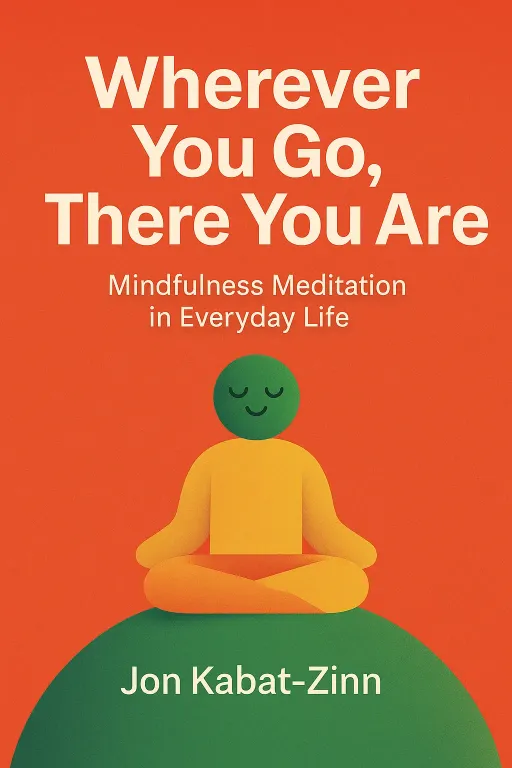
Nova: Absolutely, Atlas. It's a pervasive myth, and it’s one we’re diving deep into today. We’re exploring what we call "The Overwhelm Trap," and how to escape it, drawing profound insights from two transformative works: Jon Kabat-Zinn's seminal "Wherever You Go, There You Are" and Eckhart Tolle's powerful "The Power of Now."
Atlas: Two absolute cornerstones of modern mindfulness. Kabat-Zinn, I remember, was a molecular biologist who took ancient meditative practices and brought them into mainstream medicine, literally founding the Stress Reduction Clinic at UMass. And Tolle, of course, had that incredible personal journey from deep despair to a profound spiritual awakening that shaped his entire philosophy.
Nova: Exactly. Their unique paths give their work such a rich, interdisciplinary quality, perfect for anyone seeking deeper understanding. And their core message? It’s a powerful counter to that feeling of being pulled in a million directions.
Atlas: I can definitely relate to that feeling. It's like my mind is a dozen open tabs at once. So, let's unpack this "overwhelm trap." What is it, really?
The Overwhelm Trap: Unpacking the Paradox of Busyness
SECTION
Nova: Well, the feeling itself is universal: that constant rush, the relentless tug from every direction, leaving us perpetually exhausted. But here’s the paradox: this very overwhelm, this constant "doing," actually hides the joy that's already present. It’s like driving a car with a perpetually foggy windshield, always moving forward but never truly seeing the landscape you’re in.
Atlas: That’s a great analogy. It sounds rough, but isn't a certain level of overwhelm just... modern life? For our listeners managing high-pressure teams or navigating complex projects, slowing down can feel like a recipe for falling behind. What's the real insidious part of this trap?
Nova: The insidious part is that we often more productivity or more achievements will lead us to joy. We chase it like a distant horizon. Yet, the constant pursuit detaches us from the present moment, which is the only place joy actually resides. Imagine someone spending all their time planning the future vacation, meticulously researching every detail, so consumed by the planning that they completely miss the beauty of their current evening, the sunset outside their window, or the quiet comfort of their home.
Atlas: That’s a perfect example. We’re so focused on the destination that we forget the journey is all there is. But wait, how do Kabat-Zinn and Tolle address the practical reality of our demanding lives? It's not like we can just abandon our responsibilities.
Nova: They don't advocate abandoning responsibilities at all. Quite the opposite. Kabat-Zinn, for instance, emphasizes that mindfulness isn't about escaping reality; it's about fully embracing the present moment, even its difficulties, to find calm amidst chaos. It’s not about, but about with whatever it is you're doing. The trap isn't the busyness itself, but our to it – the constant mental chatter about what's next, what went wrong, what needs to be fixed.
Atlas: I see. So the trap isn't the workload, but the. The constant mental gymnastics. That makes me wonder, what’s the immediate impact when we’re caught in this trap? Beyond just feeling tired, what are we actually losing?
Nova: We're losing the richness of life itself. We're on autopilot. We eat without tasting, listen without hearing, look without seeing. The vibrancy drains out of our experience. Tolle reinforces this by arguing that most human suffering comes from dwelling on the past or worrying about the future, completely bypassing the only moment we ever truly have: now. It's like we're constantly waiting for life to begin, instead of realizing it's happening right here, right now.
Atlas: That's actually really profound. It’s easy to intellectualize, but when you put it like that, it makes you realize how much we miss. It sounds like a fundamental disconnect from our own lives. So, if the trap is this constant mental future-tripping or past-dwelling, what’s the key to unlocking the present?
Mindful Awareness: The Path to Unlocking Present Joy
SECTION
Nova: This brings us perfectly to the antidote to this overwhelm, the key that both Kabat-Zinn and Tolle champion: mindful awareness. It's about learning to pause and truly notice, Nova’s Take suggests, that cultivating presence is the fundamental step.
Atlas: What exactly mindful awareness in a practical sense? It sounds a bit abstract. Is it just... thinking happy thoughts? Or meditating for hours every day? For our curious explorers who want to grasp the 'how,' what's the simplest way to explain it?
Nova: The simplest way is to think of it as bringing gentle, non-judgmental attention to the present moment. It's not about emptying your mind, but about observing what's already there. It could be simply noticing your breath, the sensations in your body, the sounds around you, or the taste of your coffee. It's breaking the autopilot. Tolle often says that true peace and joy reside in the present because the past is gone and the future hasn't arrived. Our suffering largely comes from resisting that reality.
Atlas: So, it's about being in the 'now.' But our minds race, especially when deadlines are looming or life feels chaotic. How do you 'force' yourself into the present when your brain wants to solve a hundred problems? It sounds impossible for someone deeply driven by growth and achievement.
Nova: You don't force it, Atlas; you invite it. It’s a practice, a gentle redirection. And for anyone listening who feels that pull, let's try a tiny "healing moment" right now. Just for a minute.
Nova: Take a minute. Notice your breath. Feel your feet on the ground. Just be here, fully. No need to change anything, just observe.
Atlas: Wow. Even just that small pause felt... different. Like my brain just took a tiny breath too. But it's hard to hold onto that feeling; my mind already wants to jump to what's next.
Nova: And that's perfectly normal! That's the practice. That's the muscle you're building. Kabat-Zinn talks about how mindfulness isn't about achieving a state of perfect calm, but about fully embracing the present, its difficulties. It’s a radical acceptance of. This consistent practice builds your capacity for presence, gradually leading to deeper peace and joy. Think of it like learning an instrument; you don't master it instantly, but every gentle practice session strengthens the skill.
Atlas: That's a great analogy. It sounds like a fundamental shift, not just a quick fix. What's the biggest misconception people have about mindful awareness? What prevents them from even starting?
Nova: I think the biggest misconception is that it’s about thinking or problems. People believe it’s a form of denial. But it's actually the opposite: it's about your thoughts and problems clearly, without getting swept away by them. It's about creating a space between you and your reactions, giving you choice. This ability to pause, to notice, that's where genuine freedom and joy begin to emerge, even amidst the chaos of life.
Synthesis & Takeaways
SECTION
Nova: So, ultimately, the overwhelm trap isn't about having too much to do, but about losing touch with the present moment. And mindful awareness is the simple, yet profound, path back. It's not an external destination for joy; it's an internal state accessed through presence, counteracting that trap. Imagine your life not as a frantic race to a distant finish line, but as a series of profoundly rich moments to be experienced, one after the other.
Atlas: That's incredibly powerful. For anyone who's a resilient seeker or a joyful cultivator, this isn't just about managing stress; it's about truly and finding that genuine joy that’s been hidden in plain sight. That moment of simply noticing your breath could be the most revolutionary act of your day, a tiny rebellion against the constant pull of the future.
Nova: Exactly. And for our listeners, we have a simple, actionable recommendation: dedicate just 10 minutes each day for quiet reflection. Just notice. No judgment, no agenda. See what emerges.
Atlas: And trust your inner wisdom on this journey. Your path is unfolding beautifully, especially when you choose to be present for it.
Nova: Thank you for joining us on this insightful journey today.
Atlas: This is Aibrary. Congratulations on your growth!