The Hidden Cost of Busyness: Why Presence Trumps Productivity.
Golden Hook & Introduction
SECTION
Nova: What if the very thing you're told will bring you success—constant busyness, chasing the next big win—is actually the biggest obstacle to your peace and true potential?
Atlas: Whoa. That feels counterintuitive, Nova. Most of us are taught to hustle, to always be on, to fill every minute. Are you suggesting our entire playbook for achievement might be… flawed?
Nova: Flawed, perhaps, or at least incomplete. Because today, Atlas, we're diving into a concept that challenges that relentless drive, inspired by two profound thinkers: Jon Kabat-Zinn, the pioneer who brought mindfulness into mainstream medicine and society, and Eckhart Tolle, whose work has helped millions find inner peace by focusing on the 'now.'
Atlas: Okay, so we're talking about mindfulness and presence. Sounds good in theory, but how do these ideas challenge our modern addiction to productivity, especially for those of us who genuinely love building and growing things?
Nova: Exactly. Because the core of our podcast today is really an exploration of why our relentless pursuit of productivity often blinds us to the very peace and effectiveness we crave, and how embracing presence can redefine our understanding of progress.
The Blind Spot of Busyness (Kabat-Zinn's Perspective)
SECTION
Nova: So, let's start with what we call 'the blind spot.' We're all in this constant pursuit of growth and achievement, right? But somewhere along the line, we start to mistake constant busyness for meaningful progress. It’s like we’re on a treadmill, running faster and faster, but not necessarily getting anywhere truly fulfilling.
Atlas: I see that. It's almost a badge of honor now to say you're 'swamped' or 'slammed.' It implies importance, right? But I’ve felt that disconnection you mentioned, where you’re moving at a million miles an hour and suddenly realize you haven't actually anything deeply in days.
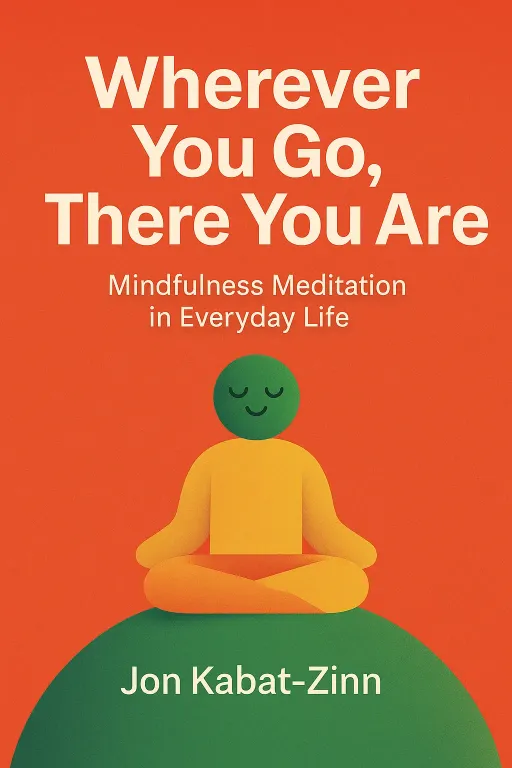
Nova: Precisely. And Jon Kabat-Zinn, through his work like "Wherever You Go, There You Are," really shines a light on this. He introduces mindfulness not as another item to squeeze onto your already overflowing schedule, but as a fundamental shift in you engage with every moment.
Atlas: So you’re saying it’s not about adding 'meditate for 20 minutes' to the calendar? Because honestly, for someone juggling multiple ventures, that just feels like another task to fail at. How do you even to practice 'being' present when your mind is always five steps ahead, strategizing, planning, problem-solving?
Nova: That’s a fantastic point, and it’s where Kabat-Zinn’s genius lies. He emphasizes mindfulness as "paying attention, on purpose, without judgment, to the present moment." Think of it this way: imagine you're eating a meal. The busy mindset is already planning the next meeting, checking emails between bites, or replaying a conversation from earlier. You're physically there, but mentally, you're everywhere but the plate in front of you.
Atlas: Oh, I know that feeling. Sometimes I finish a meal and can barely recall what it tasted like. My brain is just churning.
Nova: Right? Kabat-Zinn would say that’s a lost opportunity for presence. Instead, mindfulness is about consciously bringing your attention back to the sensation of the food, the flavors, the textures, the act of chewing. It’s not about your thoughts about the meeting, but about noticing them, acknowledging them, and then gently redirecting your focus to the present experience without self-reproach. It's a way of being what you're doing, rather than just it.
Atlas: So, it's not about stopping the doing, but changing the quality of the doing. That's a subtle but significant difference. It’s about being fully immersed, even if it’s just for a few breaths between calls.
Embracing the Present Moment (Tolle's Perspective)
SECTION
Nova: Exactly. And building on that idea of being, Eckhart Tolle takes us even deeper into the singular reality of the present moment with "The Power of Now." He argues that most human suffering actually stems from dwelling on the past or worrying about the future.
Atlas: That sounds incredibly peaceful, but for people who are driven by growth—business, family, self—isn't planning for the future essential? Are we saying ambition is the enemy of presence? Because that sounds a bit out there for someone who values building a life and not just running a business.
Nova: Not at all! Tolle isn't advocating for a lack of ambition or planning. He’s highlighting where our resides. Think of it like this: you can plan for your business, your family's future, or your personal growth from a place of presence, or from a place of anxiety and attachment to outcomes.
Atlas: What do you mean by that? Give me an example.
Nova: Consider a visionary, a natural integrator, deeply invested in their work and family. The 'busy' mindset might be constantly replaying a past mistake in a business deal or obsessively forecasting every potential future challenge. This creates mental noise, stress, and robs energy from the actual task at hand, or from truly connecting with loved ones.
Atlas: Oh, I've been there. The mental loop of "what if I had done this differently?" or "what if this goes wrong?" can be exhausting. It's like a constant low hum of worry.
Nova: Tolle suggests that liberation and peace come from fully embracing this present moment, because it's the only reality we ever truly have. The past is memory, the future is imagination. When you bring your full attention to, that mental noise starts to dissipate. You act more effectively because your energy isn't fragmented. You connect more deeply because you're actually. It's not about abandoning planning, but about while you plan.
Atlas: So, it’s not about ignoring challenges or not learning from the past, but about not letting them consume your present. It's about being grounded in the now, even when you're strategizing for tomorrow. That makes sense. It’s like the difference between driving while looking only in the rearview mirror versus driving with full attention on the road ahead, but still glancing at the mirrors when needed.
Synthesis & Takeaways
SECTION
Nova: Exactly! Both Kabat-Zinn and Tolle, in their own powerful ways, show us that true peace and effectiveness come not from doing more, but from being more present in what we do. It’s about shifting our perception of what 'progress' truly means. It's the profound insight that the external success we chase will be hollow without internal peace, and that internal peace is found in the present.
Atlas: That's actually really inspiring. It redefines productivity not as a measure of how many tasks you check off, but how fully you show up for each one. It's about bringing that 'heartfelt harmonizer' energy to every moment, not just the big wins.
Nova: Absolutely. It's about recognizing that constant busyness, while appearing productive, can be our biggest blind spot, preventing us from truly seeing, feeling, and connecting. When we pause, even for a moment, we gain clarity, make better decisions, and foster deeper relationships—with our work, our loved ones, and ourselves.
Atlas: So, for all our listeners out there, especially those who are juggling multiple ventures and striving for a holistic life—business, family, faith, and self—we want to leave you with this deep question: Where in your day could you intentionally pause for just one minute to simply present, without judgment or agenda?
Nova: Find that one minute. Make it non-negotiable. And we'd love to hear about it. Share your insights and experiences with us.
Atlas: This is Aibrary. Congratulations on your growth!