

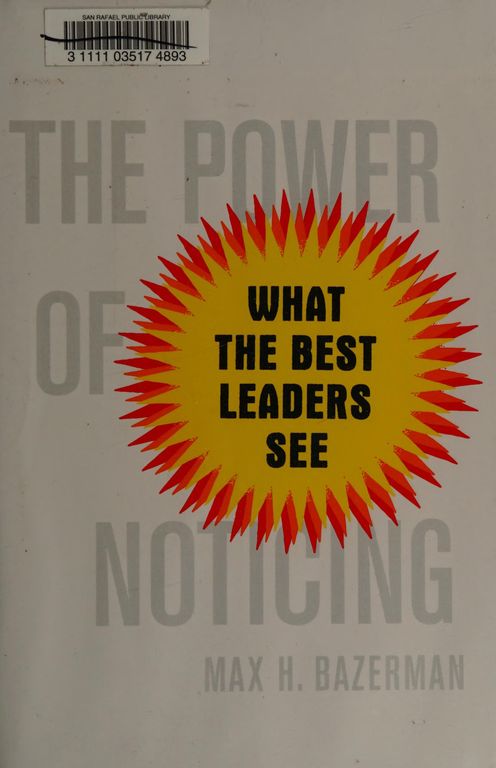
The power of noticing
What the Best Leaders See
Introduction
Nova: Imagine you're watching a video. People in black shirts and white shirts are passing basketballs back and forth. Your job is simple: count how many passes the white-shirted players make. You focus, you count, you nail it. Seventeen passes. But here's the thing — while you were counting, a woman in a gorilla suit walked right through the middle of the screen, stopped, beat her chest, and walked off. And you never saw her. Not even a flicker.
Nova: : Wait, I know this experiment. It's the famous invisible gorilla study, right? But what does a gorilla suit have to do with leadership and decision-making?
Nova: Everything. That experiment, by psychologists Christopher Chabris and Daniel Simons, is the perfect doorway into Max Bazerman's book The Power of Noticing: What the Best Leaders See. Bazerman is the Jesse Isidor Straus Professor of Business Administration at Harvard Business School, and his core argument is startling: the biggest disasters in business, government, and life don't happen because people make bad decisions with the information they have. They happen because people fail to notice critical information that's right in front of them.
Nova: : So it's not about being stupid or incompetent. It's about being blind to what's there.
Nova: Exactly. And Bazerman has spent three decades researching this. He calls it "bounded awareness" — the systematic, predictable ways we fail to see or seek out information that's readily available. The gorilla experiment is funny. But when NASA engineers missed the connection between cold temperatures and O-ring failures before the Challenger launch? That killed seven astronauts. When regulators missed Bernie Madoff's impossibly consistent returns? That wiped out billions. This book is about why we miss these things and how we can stop.
Nova: : I'm already thinking about all the gorillas I've probably missed in my own life. Let's dig in.
Bounded Awareness and Inattentional Blindness
The Blinders We All Wear
Nova: Let's start with the core concept Bazerman introduces: bounded awareness. This is different from bounded rationality, which is about how we process information we already have. Bounded awareness is about never even registering that the information exists in the first place. It's the gorilla you never saw.
Nova: : So it's not that I'm bad at analyzing data. It's that I never even looked at the data that mattered.
Nova: Precisely. And Bazerman illustrates this with the Challenger disaster in devastating detail. The night before the launch in January 1986, engineers at Morton Thiokol, the contractor that built the shuttle's solid rocket boosters, raised concerns about the cold weather. They had data from 24 previous launches. In seven of those, O-rings had shown some degree of failure. NASA focused narrowly on those seven failures and asked, "Is there a pattern here?" They didn't see one strong enough to delay the launch.
Nova: : But they were looking at the wrong data set.
Nova: They were. If they had widened their frame and looked at all 24 launches — including the 17 successful ones — they would have noticed something unmistakable. Every single successful launch had occurred at temperatures above 65 degrees Fahrenheit. On the morning of the Challenger launch, it was about 40 degrees. Bazerman points out that if they had analyzed the full data set, they would have predicted a greater than 99 percent chance of failure. Instead, they only looked at the data in the room.
Nova: : That phrase — "the data in the room" — that's chilling. They had all the information they needed. They just didn't think to look at it.
Nova: And that's Bazerman's key insight. He inverts Daniel Kahneman's famous acronym WYSIATI — What You See Is All There Is — into WYSINATI: What You See Is Not All There Is. The best decision-makers constantly ask themselves, "What information am I missing? What data would I want if I had it?"
Nova: : This reminds me of Sherlock Holmes. Bazerman references that, doesn't he?
Nova: He does. In the story "Silver Blaze," Holmes solves the case by noticing something that didn't happen — the dog didn't bark in the night. If the dog didn't bark, the intruder must have been someone the dog knew. Bazerman calls this "noticing the dog that didn't bark." In business and leadership, we need to pay attention to what didn't happen, not just what did. Which deals didn't close? Which candidates didn't apply? Which complaints were never made?
Nova: : So bounded awareness isn't just about missing gorillas. It's about never asking what gorillas might be there.
Nova: Right. And Bazerman says this is a System 2 activity — it requires slow, deliberate, effortful thinking. Our fast, intuitive System 1 is great for routine decisions, but it wears blinders. Noticing requires us to slow down and deliberately expand our frame.
Motivated Blindness and Ethical Fading
When Winning Makes You Blind
Nova: Now let's talk about something even more uncomfortable: motivated blindness. This is when we fail to notice something because it's not in our interest to notice it. Bazerman defines it as "the systematic failure to notice others' unethical behavior when it is not in our best interest to do so."
Nova: : So it's not that I can't see the problem. It's that I have a reason not to see it.
Nova: Exactly. And Bazerman gives a powerful example from Major League Baseball. Between 1998 and 2001, the home run records were being shattered year after year. In 1991, the average top slugger hit about 44 home runs. By 1998, ten players beat that. In 1999, eight more. In 2001, another nine. The statistical anomaly was screaming at everyone. But managers, coaches, and league officials looked the other way. Why? Because the home run race between Mark McGwire and Sammy Sosa in 1998 had brought fans back to baseball after the 1994 strike. Everyone was winning — the players, the teams, the league, the broadcasters. So nobody wanted to notice the steroid use.
Nova: : That's a perfect example. But it also makes me think about the financial world. Bazerman writes about Bernie Madoff, doesn't he?
Nova: He does, and it's a masterclass in motivated blindness. Madoff reported annual returns of around 10 to 12 percent, year after year, with almost no volatility. In finance, that's statistically nearly impossible. Harry Markopolos, a financial analyst, figured out Madoff was running a Ponzi scheme in about five minutes of looking at the numbers. He tried to warn the SEC repeatedly for nearly a decade. But investors were making money, the SEC had no incentive to investigate a respected Wall Street figure, and everyone who benefited from Madoff's returns had a reason not to look too closely.
Nova: : And then there's Enron. Auditors at Arthur Andersen were supposed to be independent watchdogs, but they were also collecting massive consulting fees from Enron. They had every incentive not to notice the accounting fraud.
Nova: Right. And Bazerman extends this to JPMorgan's "London Whale" trading scandal in 2012. CEO Jamie Dimon hired Ina Drew as chief investment officer, and she generated enormous profits through increasingly risky trades. Dimon later admitted he knew about the risks but ignored them because the profits were so high. When the trades finally blew up, they cost the bank $6.2 billion in a single month.
Nova: : So how do you protect yourself against motivated blindness? Because this feels like it could happen to anyone.
Nova: Bazerman offers several strategies. First, establish clear rules for yourself before you're in the situation — the way auditing firms are supposed to have independence standards. Second, ask yourself: "Would I see this differently if I were an outsider?" Third, create accountability structures. Rotate people in oversight roles. Protect whistleblowers. And perhaps most importantly, notice when something seems too good to be true. Bazerman's rule: anytime you hear about something that seems too good to be true, you should be skeptical. That alone would have caught Madoff.
Nova: : It's almost like we need to be suspicious of our own success.
Nova: That's a great way to put it. When things are going really well, that's exactly when you should be asking the hardest questions.
Predictable Surprises and Indirect Harm
The Crisis Everyone Saw Coming
Nova: Let's move to one of Bazerman's most provocative concepts: the predictable surprise. He defines it as a situation where many key individuals are aware of a looming disaster, understand the risk is getting worse over time, and know conditions are likely to eventually explode into a crisis — yet they fail to act in time.
Nova: : Hurricane Katrina is the obvious example.
Nova: It's the textbook case. Four years before Katrina hit New Orleans in 2005, the Houston Chronicle reported that the city was sinking and that its main buffer — the wetlands — was eroding, leaving the city catastrophically vulnerable. In 2001, FEMA ranked potential damage to New Orleans as among the three likeliest, most catastrophic disasters facing the United States, alongside a massive earthquake in San Francisco and a terrorist attack in New York City. Simulations showed the government wasn't prepared. Journalists predicted the disaster. And yet, when Katrina struck on August 29, 2005, the response was a catastrophic failure.
Nova: : So everyone knew. But nobody acted.
Nova: And that's the defining feature of a predictable surprise. It's not a black swan — an unforeseeable event. It's something that was entirely foreseeable but was ignored because acting would have been expensive, politically difficult, or inconvenient. Bazerman argues that the 2008 financial crisis was also a predictable surprise. Rating agencies gave AAA ratings to mortgage-backed securities that were full of subprime loans. Regulators had the authority to intervene but didn't. Banks were making too much money.
Nova: : This connects to something else Bazerman writes about — indirect harm. Can you explain that?
Nova: This is one of the most powerful sections of the book. Bazerman argues that we're very good at noticing direct harm — someone punches someone, a factory owner locks the fire exits. But we're terrible at noticing indirect harm — harm that happens through a chain of decisions and incentives. He gives the example of Walmart and Blitz USA, once the largest manufacturer of gas cans in America, with about 80 percent of the market.
Nova: : What happened?
Nova: Blitz gas cans were connected to dozens of explosions, serious burn injuries, and deaths. The problem was that when gas was poured, vapors could connect with an ember and the flame would travel back into the can and explode. Blitz designed a fix — an arrestor device that would prevent this — costing between 80 cents and a dollar per can. But Walmart, driven by its "everyday low prices" mandate, rejected the safer design because of the price increase. Blitz couldn't launch a national product without Walmart's buy-in, so they shelved the safety improvement. The explosions continued. Blitz eventually went bankrupt from lawsuits.
Nova: : So Walmart never directly caused any injury. But their pricing pressure made the injuries inevitable.
Nova: Exactly. And Bazerman uses a counterfactual test: if Blitz didn't exist, would Walmart have sold safer gas cans? Probably not — another manufacturer would have faced the same price pressure. But if Walmart didn't exist, would Blitz have brought a safer gas can to market? Evidence suggests yes. Walmart was the driving force behind the unsafe product, but because the harm was indirect, they were harder to hold accountable.
Nova: : He also writes about the Bangladesh garment factory fire in 2012, right?
Nova: Yes. The Tazreen Fashions factory fire killed at least 117 people. A year and a half before the fire, more than a dozen Western retailers — including Walmart, Gap, Target, and JCPenney — met in Dhaka to discuss a legally enforceable agreement to pay factories prices high enough to cover safety improvements. Walmart and Gap refused. The factory failed to meet any reasonable safety standards. Again, the harm was indirect — no retailer set the fire — but the price pressure created the conditions for the disaster.
Nova: : This reframes how I think about corporate responsibility entirely. It's not just about what companies do. It's about what their incentives cause to happen.
Practical Strategies for Seeing What Others Miss
Becoming a First-Class Noticer
Nova: So after all these cautionary tales, Bazerman doesn't leave us hanging. He provides a practical blueprint for becoming what he calls a "first-class noticer." Let's walk through the key strategies.
Nova: : I'm ready. Where do I start?
Nova: Strategy one: widen your frame. Bazerman tells a personal story about attending a lecture where his colleague Richard Zeckhauser posed a problem. Your doctor prescribes a statin for high cholesterol. It works — your cholesterol drops from 260 to 195 — but you get sweaty palms as a side effect. The doctor asks if you can live with it. What do you say?
Nova: : I'd probably say yes. The drug is working.
Nova: That's exactly what Bazerman said. And Zeckhauser responded, "Why don't you try one of the other statins instead?" Bazerman, a Harvard professor who studies decision-making, had fallen into the trap of accepting the choice as it was presented. He failed to widen his frame. The lesson: when you're given two options, ask what the third, fourth, and fifth options are.
Nova: : So it's about rejecting the menu you're handed.
Nova: Exactly. Strategy two: ask "What do I wish I knew?" and "What information is missing?" Make this a habit. Before every major decision, explicitly list what you don't know but wish you did. Strategy three: pay attention to the dogs that don't bark. What didn't happen that should have? What complaints aren't being made? What questions isn't anyone asking?
Nova: : And Bazerman also recommends keeping a decision-making journal, right?
Nova: Yes, and this is deceptively powerful. Write down your important decisions, your reasoning, your confidence level, and then later record what actually happened. This does two things. First, it fights hindsight bias — we tend to rewrite our memories to make ourselves look smarter after the fact. Second, it helps you identify your systematic blind spots. Maybe you'll notice you're consistently overconfident about timelines, or you always underestimate competitive responses.
Nova: : What about organizations? How do leaders create cultures of noticing?
Nova: Bazerman introduces the concept of the "noticing architect." A leader's job isn't just to notice personally — it's to design systems that help everyone in the organization notice. This means creating psychological safety so people feel comfortable raising concerns. It means aligning incentives so that noticing problems is rewarded, not punished. It means bringing in outsiders regularly to review practices with fresh eyes. And it means conducting pre-mortems — before a project launches, imagine it has failed and work backward to identify what could have gone wrong.
Nova: : The Sears auto repair scandal is a perfect example of what happens when you design the wrong incentives.
Nova: It's a classic Bazerman case. In the 1990s, Sears management set a quota requiring auto repair employees to generate $147 per hour in sales. They probably thought they were just setting a performance target. But the incentive was perfectly designed to encourage mechanics to recommend unnecessary repairs. And that's exactly what happened — widespread fraud against customers. Sears management failed to notice what their incentive system would indirectly cause.
Nova: : So the question isn't just "what am I missing?" It's also "what are my systems causing that I'm not seeing?"
Nova: That's the heart of it. And Bazerman's final, most important recommendation: when you fail — and you will — focus on what you could have done differently, not on external excuses. First-class noticers have an internal locus of control. They ask, "What didn't I notice, and how can I make sure I notice it next time?"
Conclusion
Nova: So let's bring this together. Max Bazerman's The Power of Noticing makes a compelling case that the most consequential failures in leadership, business, and life come not from bad analysis of available information, but from never seeing the information in the first place. Bounded awareness, inattentional blindness, motivated blindness — these aren't just academic concepts. They explain the Challenger disaster, the Madoff scandal, the financial crisis, and countless smaller failures that happen in organizations every day.
Nova: : And the antidote isn't to try harder to pay attention. It's to build systems and habits that compensate for our natural blind spots.
Nova: Exactly. Widen your frame. Ask what information is missing. Notice the dogs that don't bark. Question anything that seems too good to be true. Keep a decision journal. Bring in outsiders. Design incentives that reward noticing, not ignoring. And when you fail, look inward first.
Nova: : What strikes me most is how practical this all is. Bazerman isn't saying you need to be a genius or have some special perceptual gift. He's saying you need to ask better questions and build better habits.
Nova: And that's the hopeful message of the book. Noticing is a skill. It can be learned. It can be practiced. It can be built into the architecture of organizations. The first step is simply recognizing that what you see is not all there is. There are gorillas walking through your field of vision every day. The question is whether you'll train yourself to see them.
Nova: : I'll never watch a basketball-passing video the same way again.
Nova: And hopefully, you'll never make a big decision the same way again either. This is Aibrary. Congratulations on your growth!