

The Digital Detox and Delight Protocol
Golden Hook & Introduction
SECTION
Nova: The average smartphone user touches their screen over two thousand times every single day. If you calculate the time spent swiping, scrolling, and tapping, that adds up to roughly four hours of our waking life, every single day, completely surrendered to the algorithm.
Atlas: Two thousand times? That number is staggering. It sounds like a full-time job that nobody applied for and nobody is getting paid to do.
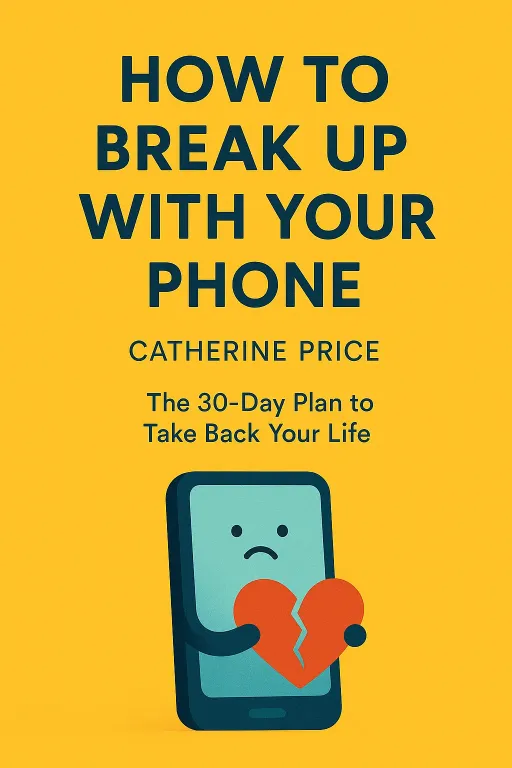
Nova: Exactly. And that is the central premise behind the work of Catherine Price. She is a science journalist who spent years investigating how our devices are engineered to hijack our dopamine systems. She wrote two essential books on this: How to Break Up with Your Phone and The Power of Fun. Her background as a science writer is crucial here because she doesn't approach this from a place of moralizing or Luddite philosophy. She approaches it like a researcher looking at the mechanics of our attention.
Atlas: I appreciate that angle. It feels like we are constantly told to just have more willpower, as if we are fighting a fair fight. But if the system is designed to win, willpower is not enough.
Nova: That is the key realization. Price argues that we need a protocol, not just a promise to do better. She views our relationship with technology as a relationship that has gone sour. We need to break up with the bad habits to make room for something much more vital, which she calls True Fun.
Atlas: I am curious about that jump. We go from breaking up with a screen to finding True Fun. That sounds like a massive shift in gears. How do we bridge the gap between clearing out the digital clutter and actually living a more joyful life?
The Hijacking of Attention
SECTION
Nova: The bridge starts by acknowledging the "slot machine" in your pocket. Think about why we check our phones. We are looking for a reward. It might be an email, a like, a news update, or a funny video. The device is designed to give us variable rewards, which is the exact same psychological mechanism that keeps people glued to slot machines in a casino.
Atlas: That analogy is uncomfortable, but it is accurate. I catch myself refreshing my feed even when I know there is nothing new. It is a reflex, not a choice.
Nova: That reflex is what Price calls the hijacking of our dopamine system. When we are constantly pinged by non-human notifications—those little red badges telling us an app updated or a game wants us back—we are essentially letting an algorithm dictate our emotional state. We are in a constant state of low-level distraction.
Atlas: But here is the pushback I imagine our listeners are feeling. If I turn off all these notifications, I am going to miss something important. I have a professional life, I have responsibilities. Is the answer to just go dark and become unreachable?
Nova: That is the common fear, but the reality is much more nuanced. Price suggests that we distinguish between human and non-human notifications. A text from your partner or a call from your boss is human communication. A notification telling you that a game has lives available or that a news site has a breaking headline you do not need to know about right this second? That is just noise.
Atlas: That is a simple, actionable distinction. It takes the decision-making process out of the moment. Instead of debating whether to check the phone, I have already decided that non-human alerts are not worth my time.
Nova: Exactly. It is about creating friction. When you disable those non-human notifications, you are not cutting yourself off from the world. You are reclaiming your sovereignty. You are deciding when to check your phone, rather than letting the phone decide when to interrupt your life.
Atlas: It sounds like we are shifting from a reactive state to a proactive state. I like that. But what happens in the void? If I am used to checking my phone every five minutes, and I suddenly stop, I am going to feel that anxiety, right? The itch to check?
Nova: You are absolutely going to feel that itch. Price describes this as a form of withdrawal. We are so accustomed to the constant drip of information that silence feels uncomfortable. But that discomfort is actually the first sign of healing. It is the moment where your brain starts to recalibrate.
Atlas: It is like cleaning a room you have neglected for years. It is dusty and messy at first, but once you clear the junk, you realize how much space you actually have.
The Architecture of True Fun
SECTION
Nova: That is the perfect segue to the second half of the equation. Once you clear that space, you have to fill it with something, or you will just drift back to the screen. And this is where Catherine Price’s other work comes in—The Power of Fun. She defines "True Fun" not as a luxury, but as a biological necessity.
Atlas: I have to stop you there. "Biological necessity"? That sounds like a stretch. Most people treat fun as something you do after you have finished all your "real" work. It is the reward, not the requirement.
Nova: That is exactly the mindset that leads to burnout. Price argues that True Fun is the intersection of three things: playfulness, connection, and flow. It is not just about having a good time. It is about engaging in activities where you lose track of time, where you feel genuinely connected to yourself or others, and where you are fully present.
Atlas: Playfulness, connection, and flow. I can see how those three things are often missing from our high-stress, screen-dominated days. We are connected to the internet, but we are not connected to people. We are busy, but we are not in a flow state.
Nova: Right. Think about the last time you were truly having fun. Maybe you were cooking a meal with friends, or solving a complex problem for a hobby, or even just playing a game with your kids. You were not thinking about your emails. You were not worried about your social media presence. You were fully immersed. That is the antidote to the digital drain.
Atlas: I am thinking about a time I was building a bookshelf. It was frustrating, but I was so locked into the process of measuring and cutting that I didn't check my phone for three hours. I felt energized afterward. Is that what you mean by flow?
Nova: That is a textbook example. You were utilizing your skills, you were focused, and you were creating something. That is the "flow" component. Now, add a friend to help you, and you have the "connection" component. That is the blueprint for True Fun. It is not about passive consumption. It is about active engagement.
Atlas: I see the contrast. A lot of our modern "fun" is passive. We watch a show, we scroll through a feed, we consume content. But that is not True Fun. That is just distraction.
Nova: That is a critical distinction. Passive consumption leaves us feeling drained, which makes us want to reach for our phones again to numb out. True Fun, on the other hand, leaves us feeling energized. It is a self-sustaining cycle.
The Practical Blueprint
SECTION
Atlas: So, let’s talk about the implementation. We have the theory—we need to reduce digital friction and increase active, playful engagement. But for someone who is busy, who has a demanding life, how do we actually schedule this?
Nova: Price suggests starting with a concept she calls "micro-dosing" joy. You do not need to take a vacation to have True Fun. You just need to carve out a micro-dose of it in your day.
Atlas: A micro-dose. That sounds manageable. How small are we talking?
Nova: We are talking about fifteen minutes. That is it. Fifteen minutes of uninterrupted, screen-free playtime. It sounds almost too simple, but the impact is profound. If you can protect fifteen minutes of your day to do something that is purely for you—something playful, something engaging—you are effectively training your brain to value that time over the digital slot machine.
Atlas: Fifteen minutes is a commitment anyone can make. But here is the challenge. If I tell myself I am going to have fifteen minutes of fun, I feel guilty. I feel like I should be doing something productive in those fifteen minutes. How do we overcome that guilt?
Nova: You have to reframe your understanding of productivity. If you are burned out, if you are constantly distracted, your productivity is already suffering. You are working with a depleted battery. True Fun is the charger. It is not a distraction from your work; it is the fuel for your work. You are not "wasting" time; you are investing in your own capacity to function at a high level.
Atlas: That is a powerful reframe. I am not taking time away from my goals; I am sharpening the tool I use to achieve them. My brain is the tool, and I need to keep it in good condition.
Nova: Exactly. And the beauty of this protocol is that it is self-reinforcing. The more you experience the vitality that comes from True Fun, the less appealing the screen becomes. You start to notice the difference in how you feel. You start to crave that clarity and that engagement.
Atlas: It sounds like we are talking about a fundamental shift in how we value our own attention. Our attention is our most valuable resource. We are essentially giving it away for free to apps that don't care about our well-being.
Nova: That is the core of the issue. We are the product. When you turn off those non-human notifications, you are taking your attention back. When you schedule that fifteen minutes of True Fun, you are deciding how to spend that reclaimed attention.
Synthesis & Takeaways
SECTION
Atlas: This has been a great conversation. We started with the idea of breaking up with the phone, which felt like a daunting task, and ended with the idea of reclaiming our joy. It is not just about what we are losing; it is about what we are gaining.
Nova: That is the takeaway. It is not about living in a cave or throwing your smartphone in the trash. It is about intentionality. It is about recognizing that your phone is a tool, not your master.
Atlas: I want to challenge our listeners today. We have the "Tiny Step" that Catherine Price recommends. Turn off all non-human notifications. Just do that. Right now. Go into your settings, find the apps that are constantly pinging you—the games, the news alerts, the social media updates—and silence them.
Nova: And once you have done that, protect those fifteen minutes. Don't leave it to chance. Put it on your calendar if you have to. Treat it with the same respect you would treat a high-stakes meeting. Because, in a way, it is. It is a meeting with your own well-being.
Atlas: I love that. It is a meeting with yourself. And if you do that, if you create that space, you might be surprised by what you find. You might find that you are more creative, more present, and frankly, a lot happier.
Nova: It is a small, consistent step, but as we have discussed, those are the ones that build the strongest foundations. You do not need to change your entire life overnight. You just need to change the next fifteen minutes.
Atlas: That feels like a challenge I can actually execute. I am going to turn off those notifications today.
Nova: And I am going to make sure I get my fifteen minutes of screen-free playtime. This journey toward digital freedom and genuine joy is not a sprint; it is a long-term practice. It is about sustainable growth, one micro-dose of fun at a time.
Atlas: I am ready to start that practice today. Thank you for this, Nova. It has been a pleasure unpacking this with you.
Nova: It has been a pleasure, Atlas. And to all our listeners, remember that you have the power to define your own relationship with your technology. This is Aibrary. Congratulations on your growth!









