

The 'Infinite To-Do List' Blind Spot: Mastering Your Energy, Not Just Your Time.
Golden Hook & Introduction
SECTION
Nova: What if I told you that the single biggest obstacle between you and your most productive, fulfilling self isn't a lack of time, but something far more fundamental that you're probably ignoring? And that by relentlessly chasing 'more time,' you're actually burning out faster?
Atlas: Whoa. Okay, that's a bold statement. My first thought is, "But everyone feels like they don't have enough time!" It's the universal complaint, right? We're constantly trying to squeeze more into our days.
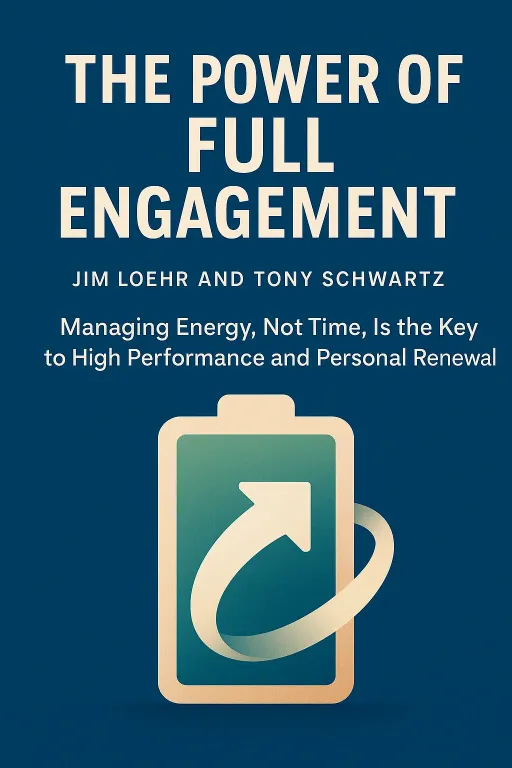
Nova: Exactly! And that's the blind spot. We're trapped in this illusion of the 'infinite to-do list,' believing that if we just manage our minutes better, we'll conquer it all. But our deep dive today, inspired by the groundbreaking work in by Jim Loehr and Tony Schwartz, suggests a radical alternative.
Atlas: . I've heard that title. What makes their approach so unique?
Nova: Well, what's fascinating is that Jim Loehr is a renowned performance psychologist who spent decades working with elite athletes, and Tony Schwartz is a former journalist and CEO. Their collaboration brought the rigorous principles of athletic training – think peak performance, recovery, and resilience – straight into the corporate world and our daily lives. They argue that humans are not machines designed to run continuously, but rather like athletes, requiring systematic energy expenditure renewal.
Atlas: So, they're taking lessons from Olympic athletes and applying them to, say, a startup founder or someone leading a demanding team? That’s compelling.
Nova: Precisely. And the core of their revelation is this: the real bottleneck isn't time. It's our finite energy.
Atlas: Okay, but in a world of endless deadlines and ambitious goals, especially for someone trying to grow a product or build a new team, doesn't 'more time' still feel like the ultimate goal? We're always trying to cram more in, especially in those early, high-stakes stages.
The Energy Management Paradigm Shift & The Myth of the Infinite To-Do List
SECTION
Nova: I can definitely relate to that feeling, Atlas. It's the default setting for so many ambitious people. We see time as this fixed, linear container, and our goal is to stuff as much into it as humanly possible. We buy into the myth that if we just work harder, longer, faster, we’ll eventually get ahead.
Atlas: Right? It feels like if I could just add another two hours to my workday, I could finally get through that backlog, or push that feature live.
Nova: And that's where the blind spot kicks in. Imagine your phone battery. You can't magically add more hours to the day, just like you can't add more capacity to your phone battery. What you do, what truly matters, is how you manage the charge you have. Are you constantly running it down to zero, or are you strategically topping it up throughout the day?
Atlas: So, the problem isn't the clock, it's the internal fuel gauge. That makes sense. But what happens when we ignore that fuel gauge?
Nova: What happens is chronic energy depletion. We mistake exhaustion for productivity. We push ourselves into a state where we're technically 'working,' but our focus is fractured, our creativity is stifled, and our decision-making is compromised. It's like a sprinter trying to run a marathon at their top speed – it’s unsustainable, and ultimately, damaging.
Atlas: That resonates with anyone who’s ever felt that creeping sense of burnout, even when they’re ticking off tasks. You’re busy, but not necessarily effective. It’s like you’re doing the motions, but the spark is gone.
Nova: Exactly. They argue that this constant 'on' culture, this relentless pursuit of time efficiency without regard for our energy, leads to a fundamental misunderstanding of human physiology and psychology. We aren't machines; we have natural rhythms, limits, and needs for renewal. Ignoring that leads to diminishing returns, not sustainable high performance.
Atlas: So, it's not just about physical energy, then, if we're talking about focus and creativity. What exactly do they mean by "energy" in this context?
The Four Dimensions of Energy & Intentional Oscillation
SECTION
Nova: That’s a great question, because it’s much broader than just our physical get-up-and-go. Loehr and Schwartz break energy down into four core, interconnected dimensions: Physical, Emotional, Mental, and Spiritual.
Atlas: Okay, physical energy I get – sleep, nutrition, exercise. That's pretty straightforward.
Nova: Absolutely. That’s the foundational layer. If your physical energy is low, everything else becomes a struggle. Then we have. This is about the quality of your feelings – your mood, your self-confidence, your resilience, your ability to experience positive emotions like joy, gratitude, and appreciation.
Atlas: Hmm. Emotional energy. For someone leading a team, managing product launches, that sounds like... a lot. How do you 'manage' your emotions in a way that fuels performance?
Nova: It's about cultivating positive emotions and learning to regulate negative ones, not suppressing them. Think about how much more productive and creative you are when you're feeling inspired versus frustrated. Next is, which is your ability to focus, concentrate, think strategically, and be creative. It’s about the bandwidth of your brain.
Atlas: That’s a huge one for problem-solving and innovation. I know I’ve felt that mental fog when I’m just trying to push through.
Nova: And finally, we have. This isn't necessarily religious, but about your connection to your deepest values, your sense of purpose, and the meaning you find in your work and your life. It's what fuels your passion and provides a moral compass.
Atlas: Okay, so physical makes sense. Mental, absolutely. Emotional, I can see how that impacts everything. But spiritual energy? For someone trying to hit product milestones and build a successful company, that sounds... abstract. How does that translate to the daily grind, or even a Monday morning meeting?
Nova: I love that pushback, Atlas. It's often the most overlooked, yet it’s incredibly powerful. When your work aligns with your deepest values, when you feel a sense of purpose, you tap into a well of motivation that’s far more sustainable than external pressures. It’s the difference between doing a job and living your calling. And this leads us to their crucial concept:.
Atlas: Intentional oscillation. That sounds like a fancy term for taking a break.
Nova: It’s more than just 'taking a break,' though that's certainly part of it. It’s the deliberate movement between expending energy and renewing it, across all four dimensions. Like an athlete, you train intensely, but then you deliberately rest, nourish your body, and mentally prepare for the next challenge. You don't train 24/7.
Atlas: So it's not about being 'less busy,' but being about how we're busy? And intentionally stepping away to recharge, rather than just crashing?
Nova: Precisely. They emphasize that continuous expenditure without intermittent renewal leads to breakdown, not breakthrough. Think of a rubber band: if you keep it stretched constantly, it loses its elasticity and eventually snaps. But if you stretch it and release it, it maintains its snap, ready for the next pull. Our energy systems work the same way. Renewal isn't a luxury; it’s a performance imperative.
Atlas: That’s a great way to put it. It’s like a battery that needs recharging, not just running on fumes. I can see how that applies to physical and mental, but how do we actually that for all four dimensions? Build these 'recharge' moments into a demanding day?
Building Energy Renewal Rituals
SECTION
Nova: That brings us to the deep question from the book: where in your day could you intentionally build in a small ritual to renew one of your four energy dimensions? The key word here is "small." We're not talking about a week-long meditation retreat every month, though that's lovely if you can do it. We're talking about micro-interventions.
Atlas: I really like that – micro-interventions. Because honestly, the idea of adding another hour-long "renewal" session to an already packed schedule feels impossible for many people.
Nova: Exactly. For, it could be a 5-minute walk around the block, a quick stretch, or opting for that healthy snack instead of sugary fuel. For, it might be a quick gratitude practice – just naming three things you're thankful for – or a positive affirmation. It could even be a meaningful, brief conversation with a colleague that generates connection.
Atlas: So, instead of just grabbing coffee, maybe taking that coffee break someone and having a genuine check-in.
Nova: Perfect example. For, it could be 10 minutes of focused work followed by a 2-minute brain break – stepping away from the screen, looking out a window. It could be a short burst of journaling to clear your thoughts. And for, it might be reflecting on your core purpose before you start a big project, asking yourself, "Why am I doing this? What values am I upholding?" Or even consciously helping someone, which often provides a profound sense of meaning.
Atlas: That’s actually really inspiring. It reframes 'taking a break' from being lazy to being strategic. For someone building a team, what's one immediate thing they could do to boost their collective energy, not just their own?
Nova: That's a fantastic application. You could start team meetings with a quick "win" sharing – letting everyone share one small success from the past week. That boosts collective emotional energy and connection. Or encourage short, mindful breaks throughout the day, normalizing the idea that stepping away for a few minutes actually productivity.
Atlas: That makes so much sense! It’s like, if the team leader models it, it becomes part of the culture.
Synthesis & Takeaways
SECTION
Nova: Absolutely. Ultimately, what Loehr and Schwartz are telling us is that sustainable high performance isn't about time scarcity; it's about energy mastery. It's about recognizing our human limits and oscillating strategically between intense energy expenditure and deliberate, multi-dimensional renewal.
Atlas: So basically you're saying, you can have all the time in the world, but if your energy tank is empty across these four dimensions, you're not going anywhere. The real competitive advantage, especially in demanding fields, is smart energy management.
Nova: It profoundly is. Elite performers across any field don't just work harder; they recover better. They understand that renewal isn't a passive activity; it's an active, essential component of their performance strategy. These aren't just "soft skills"; they are foundational to achieving ambitious goals without burning out, without sacrificing your well-being.
Atlas: That gives me chills. It’s about building a life that supports your ambition, rather than sacrificing yourself it. It makes me wonder, what small ritual could I build into my day, even for just five minutes, to recharge one of those dimensions? I bet our listeners are asking themselves the same thing right now.
Nova: I hope so! We’d love to hear what small energy renewal rituals you're going to try. Join the conversation and let us know.
Atlas: Definitely. Take a moment to think about that deep question. Where in your day could you intentionally build in a small ritual to renew one of your four energy dimensions? Even the smallest step can make a huge difference.
Nova: This is Aibrary. Congratulations on your growth!









