

** The Discipline of Wellness: A Researcher's Guide to Building Healthy Habits
Golden Hook & Introduction
SECTION
Nova: We've all been there. It's January 1st, and you're ready to transform your health. But by February, you're back to your old habits, wondering what went wrong. What if I told you it's not a failure of character, but a feature of your brain's design? Research shows less than 10% of New Year's resolutions are ever achieved, and today, we're going to find out why.
Simon Mungai Kinyanjui: That 10% figure is startling, but as a nutrition professional, I can tell you it doesn't surprise me. The gap between knowing what's healthy and consistently doing it is where most people get lost.
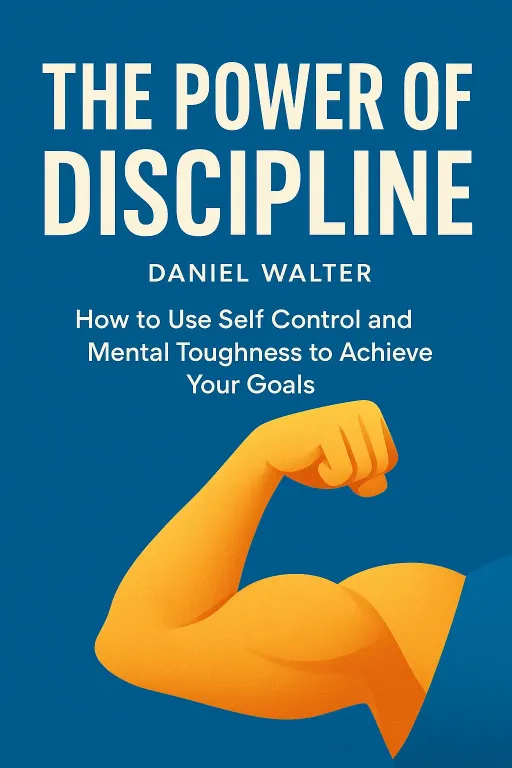
Nova: Exactly! And that's why we're so excited to have you here, Simon. We're diving into Daniel Walter's "The Power of Discipline," and with your background as a nutrition researcher, you're the perfect person to help us connect these powerful ideas to our health. Today, we'll tackle this from three angles. First, we'll explore the biology of our 'willpower battery.' Then, we'll uncover the psychological 'comfort trap' that keeps us stuck. And finally, we'll reveal a game-changing strategy: building 'systems over goals' for permanent health.
Simon Mungai Kinyanjui: I'm ready. These are the core challenges we face in public health every single day. Understanding the 'why' behind our behavior is the first step to changing it.
Deep Dive into Core Topic 1: The Willpower Battery
SECTION
Nova: So, Simon, let's start with that feeling of being drained at the end of the day, when the thought of cooking a healthy meal feels impossible. The book argues that self-discipline isn't some magical trait we're born with. It's a skill, and more importantly, it has a biological basis. It's like a muscle that gets tired.
Simon Mungai Kinyanjui: That's a great analogy. We often treat willpower as a moral issue—you're either 'strong' or 'weak'—but thinking of it as a finite resource, like energy in a battery, is much more accurate and, frankly, more compassionate.
Nova: It really is! And the book highlights a classic 1996 study by psychologist Will Baumeister that illustrates this perfectly. Imagine this: you're a hungry college student brought into a lab. The room is filled with the incredible smell of freshly baked chocolate chip cookies. You're put into one of two groups. The lucky group? They get to eat the cookies.
Simon Mungai Kinyanjui: I think I know where this is going. What about the unlucky group?
Nova: The unlucky group is told to eat... radishes. While staring at the cookies, smelling the cookies, knowing the cookies are right there. They had to use immense willpower to resist.
Simon Mungai Kinyanjui: That's psychological torture.
Nova: Right? But here's the brilliant part. After that, both groups were taken to another room and given an unsolvable puzzle to work on. The researchers wanted to see how long they'd persist. The cookie-eaters, who hadn't used up any willpower, worked on it for an average of 19 minutes. The radish-eaters? They gave up in just 8 minutes. Their willpower battery was completely drained.
Simon Mungai Kinyanjui: That's fascinating, Nova. From a research perspective, that's a perfect illustration of what we call 'ego depletion.' In nutrition, we see this constantly. A client might successfully resist the donuts in the office breakroom all morning, using up their 'willpower battery,' and then get home and find they have no mental energy left to resist overeating at dinner.
Nova: So it's not that they failed at dinner!
Simon Mungai Kinyanjui: Exactly. Their battery was drained hours before. This finding is critical. It implies that the best health advice isn't just 'eat this, not that.' It's about structuring your environment to reduce the number of decisions you have to make and the temptations you have to resist in the first place.
Nova: I love that. So it's less about being a superhero of self-control and more about being a smart architect of your own life.
Simon Mungai Kinyanjui: Precisely. Don't keep junk food in the house, so you don't have to spend precious mental energy fighting the urge to eat it. It's an engineering problem, not just a willpower problem. You're setting up your future self for success.
Deep Dive into Core Topic 2: The Comfort Trap
SECTION
Nova: And that idea of engineering your environment leads us perfectly to our second point. Even when we know what to do, and maybe we've even removed the temptations, why is it still so hard to just a new, healthy routine? The book explains this with a concept called the 'Status Quo Bias.'
Simon Mungai Kinyanjui: The idea that we prefer things to stay the same, even if the current situation isn't ideal.
Nova: Exactly. Our brains are wired to prefer the familiar, the predictable. The book gives the example of someone who wants to wake up early on a Saturday to exercise. They set their alarm, but when it goes off, they repeatedly hit the snooze button. The abstract idea of 'being healthier' in the future just can't compete with the immediate, familiar comfort of a warm bed.
Simon Mungai Kinyanjui: This is a huge barrier in community health. We can provide communities with all the information in the world about balanced diets, but we're fighting against decades of habit and cultural norms—the 'status quo' of how a family has always eaten. The book also mentions the 'Mere Exposure Effect,' which is so relevant here. The more you're exposed to certain foods, especially from childhood, the more you naturally prefer them.
Nova: So it's a double-whammy. We're comfortable with our old habits, and we've been conditioned to like them. How do we possibly break that cycle?
Simon Mungai Kinyanjui: Well, the book suggests a logical 'thought evaluation exercise,' but I think it has to be more than just logic. It has to be emotional. The author talks about using 'disgust' as a powerful motivator. In a clinical setting, this could be a patient seeing a troubling blood test result for the first time, or not being able to play with their kids without getting out of breath.
Nova: Ah, so that shock or negative feeling can provide the activation energy needed to overcome the inertia of the status quo.
Simon Mungai Kinyanjui: Yes. It makes the 'why' for changing more powerful and more urgent than the comfort of staying the same. It turns 'I should probably eat better' into 'I change now.' That emotional leverage is often the missing ingredient.
Deep Dive into Core Topic 3: Systems Over Goals
SECTION
Nova: That's a powerful point about finding a strong 'why.' But even with that motivation, the book argues that focusing on a big, distant goal, like 'lose 30 pounds,' can actually be counterproductive. This brings us to our final, and maybe most important, idea: building systems over goals.
Simon Mungai Kinyanjui: This is a distinction I wish more people understood. It's a fundamental shift in perspective.
Nova: It really is. The book uses a simple, brilliant example: tidying a messy room. You can have a 'goal' to clean your room, and you summon the energy and do it. The room is clean. Goal achieved! But if you don't change the 'system'—which is your habit of dropping clothes on the floor and leaving dishes on the desk—it'll be a mess again in a week. The goal was temporary; the system is what determines the long-term state.
Simon Mungai Kinyanjui: I love this. It's the difference between a diet and a lifestyle. A diet is a goal-oriented, short-term project with a finish line. 'I will suffer through this for 30 days to lose 10 pounds.' A lifestyle is a system. It has no finish line.
Nova: So what does a 'system' for health look like in practice?
Simon Mungai Kinyanjui: The goal is to 'lose weight.' The system is 'I am a person who plans my meals on Sunday,' or 'I am a person who moves my body for 30 minutes every day,' or 'I am a person who prioritizes sleep.' The focus shifts from the external outcome to the internal identity.
Nova: Yes! The book says your behavior is a reflection of your identity. So the aim isn't just to 'do' healthy things, but to 'become' a healthy person. When it's part of who you are, it stops feeling like a chore.
Simon Mungai Kinyanjui: And that's so much more empowering. It removes the pressure of the finish line. You're not a failure if the scale doesn't move one week, because you're still successfully running your system. You're still the person who eats vegetables with every meal. You take pride in the process, not just the result.
Nova: So for your work, how does this change the conversation?
Simon Mungai Kinyanjui: It's a total reframe. We can shift the conversation from 'we need to lower obesity rates by 10%'—a goal—to 'how can we build a community system where healthy choices are the easy, normal, and accessible choices?' It's a fundamental, and I believe more effective, change in approach.
Synthesis & Takeaways
SECTION
Nova: This has been so insightful, Simon. To bring it all together for our listeners, we've learned three crucial things from "The Power of Discipline." First, our willpower is a depletable battery that we need to manage smartly, not just push through.
Simon Mungai Kinyanjui: Second, our brains are wired with a 'status quo bias' that makes us cling to familiar, even unhealthy, habits, and overcoming that requires a strong emotional 'why.'
Nova: And finally, the real secret to lasting success is to forget the finish line and fall in love with the process—to build daily systems that shape our identity as healthy individuals.
Simon Mungai Kinyanjui: Absolutely. It’s about building the architecture for a healthy life, brick by brick.
Nova: So, what's the one thing you'd want to leave our listeners with today?
Simon Mungai Kinyanjui: I'd pose this question: Instead of setting a big, intimidating health goal for yourself, what is one small, almost laughably easy, system you can build this week? Maybe it's just laying out your workout clothes the night before. Or maybe it's adding one vegetable to your dinner every single night. Don't focus on transforming your life overnight. Just focus on winning that one small, daily action. Fall in love with the process of taking that first step, and then the next. That is the true power of discipline.









