

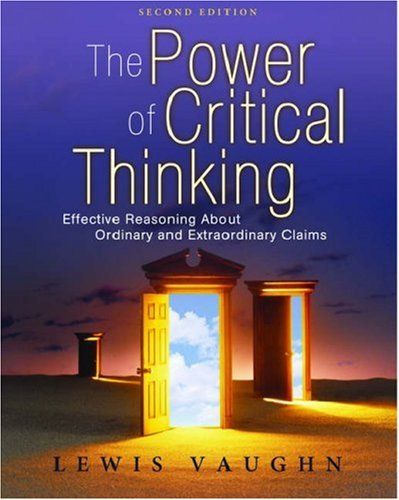
The Power of Critical Thinking
Introduction: Are You Really Thinking?
Introduction: Are You Really Thinking?
Nova: Welcome back to the show. Today, we’re diving into a book that promises to upgrade your brain’s operating system: Lewis Vaughn’s perennial bestseller, The Power of Critical Thinking. We often assume we’re thinking clearly, right? We feel confident in our beliefs. But what if I told you that most of our daily reasoning is built on shaky, unexamined foundations?
Nova: Exactly. The hook is that Vaughn separates like you’re thinking from applying logical rigor. He defines critical thinking not as being negative or overly critical, but as being thoughtful, reflective, and open-minded. It’s about mastering the essentials of reasoning, argumentation, and logic. It’s the difference between having an opinion and having a defensible position.
Nova: Not at all. The reviews consistently praise its student-friendly, conversational prose, often enhanced by humor. It’s designed to be accessible. But the real genius is in its scope. Vaughn doesn't just stick to textbook logic; he tackles both ordinary claims—like what brand of coffee to buy—and extraordinary claims—like the latest viral news story or a fringe scientific theory. That dual focus is crucial for modern life.
Nova: We start by understanding the terrain. Let’s jump into Chapter One: defining what we’re actually analyzing.
Ordinary vs. Extraordinary Claims
The Scope: From Coffee Brands to Conspiracy Theories
Nova: Vaughn’s framework really shines when he forces us to categorize what we’re evaluating. He insists that critical thinking must apply equally to the mundane and the monumental. Think about an advertisement for a new supplement. It makes an extraordinary claim about health benefits, but it’s presented in an ordinary, everyday context.
Nova: He emphasizes evaluating the source and the evidence, regardless of the packaging. One of the key concepts he introduces early on is the importance of. This is a powerful tool that goes beyond simple deduction. It asks: given all the evidence we have, which hypothesis makes the most sense and explains the most data points?
Nova: Precisely. And he grounds this in something tangible: evaluating authority. We are constantly bombarded by appeals to authority. Vaughn breaks down what makes an authority legitimate. Is the person an expert in? Are they citing verifiable data? Or are they just famous? This is where many people stumble when evaluating extraordinary claims online.
Nova: It is. And Vaughn doesn't stop at text. He dedicates significant attention to visual reasoning. In our image-saturated world, this is revolutionary for a logic text. Think about manipulated photos, misleading charts, or even carefully framed video clips. He teaches us to deconstruct the visual argument itself.
Nova: Absolutely. He’s preparing you for the 21st-century information battlefield. The goal isn't just to know what a syllogism is; it’s to apply that rigor to the complex, often visually presented, arguments we face daily. It’s about building a comprehensive defense against sloppy thinking, whether the claim is ordinary or extraordinary.
Nova: That’s the perfect transition. We need to dissect the argument into its core components: premises and conclusions. Let’s move into the anatomy lesson.
Deduction vs. Induction
The Anatomy of an Argument: Premises, Conclusions, and Logic
Nova: At its heart, critical thinking is about arguments. Vaughn is meticulous here. He teaches us to strip away the rhetoric and identify the core structure: the premises—the reasons offered—and the conclusion—what the premises are supposed to prove. It sounds simple, but most people conflate the two.
Nova: That’s the classic deductive versus inductive split. Deductive arguments aim for certainty. If the premises are true, the conclusion be true. Think of mathematical proofs or strict syllogisms. Vaughn calls these arguments or.
Nova: Exactly. But most of the real world operates on induction. Inductive arguments aim for probability, not certainty. They move from specific observations to broader generalizations. If the premises are true, the conclusion is to be true, but not guaranteed. These are judged as or.
Nova: Consider this: Every swan I have ever seen in my life has been white. Therefore, all swans are white. That was a strong inductive argument for centuries, right? But the discovery of black swans in Australia instantly proved the conclusion false, even though the premise—all observed swans were white—was true. That’s the inherent risk of induction.
Nova: Precisely. And he drills down into the mechanics of validity for deductive arguments and strength for inductive ones. He wants you to be able to look at a complex paragraph and map it out: Premise 1, Premise 2, Conclusion. If you can map it, you can test it. If you can’t map it, you’re just reacting emotionally.
Nova: It does. And that’s where the real fun, and the real danger, lies. Because fallacies are the sneaky ways people try to make weak reasoning strong. Let’s talk about the traps we fall into.
From Ad Hominem to Post-Truth Fog
The Minefield: Identifying and Dismantling Logical Fallacies
Nova: This is arguably the most practical section of the book. Vaughn dedicates significant space to informal fallacies—errors in reasoning that are common in everyday discourse. He wants you to build an internal alarm system that screams when one of these appears.
Nova: That’s where the newer editions really shine. While he covers the old guard like and, recent updates explicitly address the modern information environment. They discuss things like —deflecting criticism by pointing out a perceived failing in the accuser—which is rampant in political debates.
Nova: He categorizes them based on the type of error. For instance, fallacies of relevance, where the premises are simply irrelevant to the conclusion, like or. Then there are fallacies of weak induction, where the premises are relevant but don't provide enough support, like.
Nova: It taps into our deep human need for belonging. We evolved to trust the group. Vaughn explains that popularity is a measure of social acceptance, not truth. Think about historical examples: for centuries, the vast majority believed the Earth was the center of the universe. That consensus didn't make it true. Vaughn uses concrete examples like this to make the fallacy stick in your mind.
Nova: That’s a newer addition reflecting our current reality. It’s related to the fallacy—dismissing a claim not because the evidence is weak, but because you suspect the of the person making the claim. In a post-truth environment, people often reject factual evidence simply because they distrust the institution presenting it. Vaughn forces you to separate the from the. You must evaluate the argument on its own merits first.
Nova: Exactly. And this mastery leads us to the final layer of defense—how to build arguments that are not just fallacy-free, but actively sound and persuasive in a constructive way. This involves the more technical side of logic and scientific reasoning.
Beyond Logic: The Practical Application
Building Soundness: Scientific Reasoning and Ethical Reflection
Nova: We’ve talked about tearing down bad arguments. Now, let’s talk about construction. Vaughn dedicates serious attention to scientific reasoning, which is essentially structured, evidence-based inductive reasoning. He outlines the scientific method not as a rigid checklist, but as a dynamic process of hypothesis testing.
Nova: He frames it around testability and falsifiability. A good scientific claim must, in principle, be capable of being proven wrong. If a claim is constructed so that evidence can be explained away—like some pseudosciences do—it fails Vaughn’s test for sound reasoning. He emphasizes that science progresses by things, not just proving them.
Nova: Precisely. And this ties back to that earlier point about. In science, the best explanation is the one that is most testable, most consistent with existing knowledge, and makes the most accurate predictions. It’s a continuous refinement process.
Nova: It’s the ultimate translation. Vaughn shows that a strong argumentative essay is just a well-mapped deductive or inductive argument, written out formally. You state your thesis clearly—that’s your conclusion. Then, every paragraph must contain premises—evidence, examples, expert testimony—that logically support that conclusion. If you find a fallacy in your own draft, you know exactly which premise is weak or irrelevant.
Nova: Because thinking isn't done in a vacuum. Vaughn insists that true critical thinking requires an ethical component. It’s not enough to be logically sound; you must be intellectually honest and fair-minded. This means acknowledging counterarguments fairly, admitting when your evidence is weak, and recognizing your own cognitive biases. It’s about the of the thinker.
Nova: That’s the ultimate takeaway. The power of critical thinking isn't just about being smart; it’s about being thinkers—more honest, more rigorous, and more aware of the extraordinary responsibility that comes with forming beliefs in a complex world.
Conclusion: The Lifelong Practice of Clarity
Conclusion: The Lifelong Practice of Clarity
Nova: We’ve covered a lot of ground today, moving from the basic structure of arguments to the advanced evaluation of scientific claims and the ethics of belief. If there’s one thing listeners should take away from our deep dive into Lewis Vaughn’s work, what is it?
Nova: I agree. The actionable takeaway is to pause before accepting any strong claim—especially those that confirm what you already want to believe. Ask yourself: What is the structure here? Is this an appeal to emotion, or is it supported by relevant, testable premises? And crucially, am I being intellectually honest about the counter-evidence?
Nova: It truly is. It equips you not just for exams, but for life. It’s the power to reason effectively about both the ordinary and the extraordinary claims that shape our reality. Thank you for joining me on this exploration of Vaughn’s essential guide.
Nova: This is Aibrary. Congratulations on your growth!