

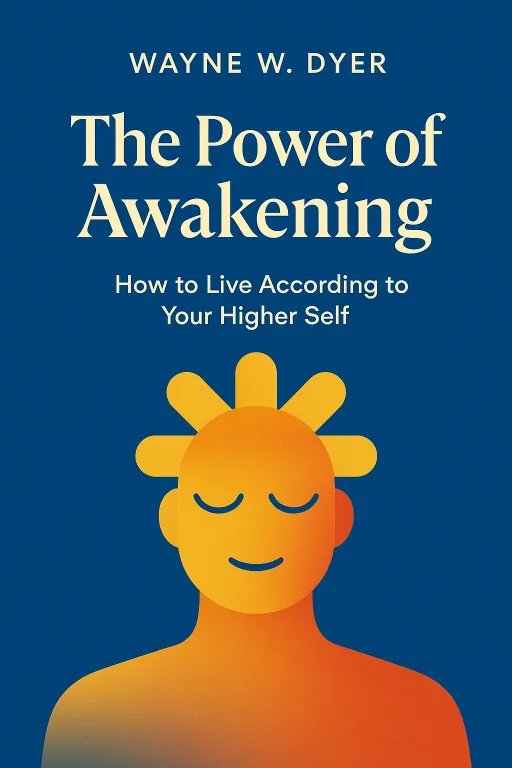
Awakening the Mastermind: Shifting Paradigms and Taming the Ego in Education and Life
Golden Hook & Introduction
SECTION
Atlas: Picture this. You are trapped on a commercial airliner, thirty minutes out of Fort Lauderdale, heading to Chicago. Suddenly, the captain's voice crackles over the intercom. The landing gear is stuck. You are turning around for an emergency landing in Miami. Panic erupts. People are crying, praying, screaming. Now, ask yourself: in that exact moment of crisis, do you let the external chaos dictate your internal state, or do you mentally construct a different reality?
Bridget Boahemaa Opoku: It is a fascinating question of cognitive control, Atlas. From an analytical perspective, most people default to a reactive state. Their brains are flooded with cortisol, and their cognitive bandwidth narrows to immediate survival threats. But what Wayne Dyer suggests in is that we have the latent capacity to choose our cognitive framework, even in high-stress environments. It is about shifting from being a passive victim of circumstances to an active director of our consciousness.
Atlas: Exactly. Spot on. Today, we are tearing down the walls of conventional thinking. We are diving deep into Wayne Dyer's masterwork,. And we are doing it with Bridget Boahemaa Opoku, a graduate student in education with a sharp, analytical mind who loves connecting the dots across complex domains. Bridget, welcome.
Bridget Boahemaa Opoku: Thank you, Atlas. I am thrilled to be here. As someone deeply interested in how we learn, process information, and develop as human beings, Dyer's work offers a rich, systemic framework for personal and intellectual transformation.
Atlas: Let's lay out the map for today's journey. We are tackling this book from three distinct angles. First, we will explore the ultimate cognitive shift: why believing must precede seeing. Second, we will dissect the mechanics of taming the ego to unlock authentic connection and learning. And finally, we will focus on practical mental training—how to cultivate the "witness" to navigate academic, professional, and personal stress. Ready? Let's move.
Deep Dive into Core Topic 1
SECTION
Atlas: Let's start with that airplane story. It actually happened to Wayne Dyer. He was on that exact flight from Fort Lauderdale to Chicago with one hundred and ninety-one other passengers. When they landed safely in Miami, the airline dropped a bomb: no guaranteed seats out, no accommodations. The crowd went wild with anger. They swarmed the counters, yelling, demanding, completely paralyzed by frustration. But Dyer? He walked away from the noise. He closed his eyes, visualized himself landing in Chicago that very night, and immediately called his secretary to look for alternative flights. While everyone else was busy fighting the airline, a single last-minute cancellation opened up on another carrier. Dyer got the seat. He was the only passenger from that original flight to make it to Chicago that day. Bridget, break this down for us. What is the cognitive mechanism at play here?
Bridget Boahemaa Opoku: This is a classic demonstration of selective attention and cognitive bottlenecking. When the other passengers focused entirely on the problem—the airline's failure, the lack of accommodations, the unfairness of the situation—they essentially locked their brains into a state of cognitive paralysis. They were fighting the reality of what. Dyer, on the other hand, practiced what he calls "believing is seeing." He bypassed the emotional reaction, stabilized his internal state, and focused his cognitive resources entirely on the desired outcome: being in Chicago. By doing so, he remained open to opportunities that the angry crowd literally could not see because their attention was entirely consumed by resentment.
Atlas: Yes. Focus on the solution, not the obstacle. Dyer writes, "Fighting anything is the surest way to set yourself up to fail." If you fight war, you feed war. If you fight poverty, you expand poverty. Instead, you must focus on what you want to create.
Bridget Boahemaa Opoku: It is highly logical when you think about it. In educational psychology, we talk about the Pygmalion effect—the phenomenon where higher expectations lead to an increase in performance. If a teacher believes a student has immense potential, they perceive that student's actions through a lens of capability, which in turn influences how they teach and how the student performs. Believing precedes seeing. If we only believe what we can physically see on the surface, we are limited to the status quo. But when we cultivate a deep, internal "knowing" of what is possible, we begin to align our actions, our resources, and our focus to manifest that reality.
Atlas: Think about the story of the young boy from Jamaica. He grew up in extreme poverty, one of fourteen children. He had a wild dream: he wanted to become a doctor. Everyone laughed at him. They told him he was crazy, that it was impossible. But his grandmother gave him a golden piece of advice. She said, "Your mind is more powerful than anything else. Never get the idea out of your mind. Just keep that thought there, no matter what." He listened. He worked multiple jobs, studied medical books by candlelight, applied for every scholarship under the sun, and never let go of that mental image. Today? He is a world-renowned heart surgeon in Washington, D. C. Bridget, how does an analytical mind reconcile a story like that with the harsh realities of systemic limitations?
Bridget Boahemaa Opoku: It is easy to dismiss such stories as outliers or mere wishful thinking, but from a cognitive standpoint, the grandmother was helping him build an incredibly robust internal locus of control. When you are surrounded by systemic poverty, the external feedback loop constantly tells you that you are powerless. If you accept that external feedback as your absolute truth, your brain shuts down search pathways for advancement. By holding onto the mental image of being a doctor, this young man created a cognitive dissonance between his current reality and his internal belief. To resolve that dissonance, his brain was constantly scanning the environment for any micro-opportunity—a scholarship, a book, a mentor—that aligned with his internal image. He was willing to do whatever it took because, in his mind, the outcome was already a certainty. The belief structured his actions, and the actions eventually transformed his physical reality.
Atlas: Powerful. Absolutely powerful. Stop waiting for the world to change before you change your mind. Change your mind first, and watch the world scramble to catch up.
Deep Dive into Core Topic 2
SECTION
Atlas: Let's pivot to the biggest roadblock on this path: the ego. Dyer calls the ego a false self, a shadow that thrives on separation, comparison, and fear. To explain this, he uses a brilliant metaphor: the Stagecoach. Imagine a stagecoach hurtling down a dirt road in an old Western movie. The stagecoach itself is your physical body. The wild horses pulling it are your five senses, constantly dragging you toward immediate gratification—a bakery, a bar, a comfortable bed. The driver holding the reins is your intellect. But in this scene, the driver is wounded, losing control, and the horses are running wild. Inside the carriage sits a passenger: the lady from Philadelphia. She represents your higher self. She has the map, she knows the destination, but she is completely ignored while the carriage careens toward a cliff. Bridget, how do we get the driver to start listening to the passenger?
Bridget Boahemaa Opoku: This metaphor is incredibly rich, Atlas. The ego is essentially the wounded driver who believes he is solely responsible for the journey and must control everything through sheer force of intellect and sensory gratification. The ego tells us, "I am what I have, I am what I do, and I am separate from everyone else." This creates a constant state of anxiety because material possessions can be lost, actions can fail, and separation breeds competition and defensiveness. To get the driver to listen to the higher self—the lady from Philadelphia—we have to practice intellectual humility. We have to recognize that our intellect, while a powerful tool, is not the ultimate authority. It is merely the executor. The higher self provides the direction, the purpose, and the ethical framework.
Atlas: Yes. The ego loves to play the "us versus them" game. Look at the "Border Crossing Analogy" Dyer talks about. We travel across the globe, and we see these arbitrary lines drawn in the dirt centuries ago. We have to show passports, go through customs, and treat people on the other side as "foreigners." The ego loves these divisions. It makes us feel special, separate, superior. But internally, we have to know we are all part of the same human family.
Bridget Boahemaa Opoku: Exactly. And in education, we see this ego-driven separation manifest as academic silos, hyper-competitiveness, and the fear of being wrong. When students or educators operate from a place of ego, their primary goal is to defend their status, prove their superiority, and avoid looking foolish. This completely shuts down deep learning. True learning requires vulnerability. It requires admitting that you do not know everything. When we tame the ego, we transition from a "win-lose" paradigm to a "win-win" paradigm. We realize that another person's success does not diminish our own. We are all pieces of the same jigsaw puzzle, as Dyer says. Every piece is necessary to complete the picture.
Atlas: Let's talk about how we actually tame this beast. Dyer gives us a practical tool: cultivating the "witness." He tells a story from his therapy practice on Long Island. A woman came to him, deeply depressed, claiming that her entire existence was consumed by sadness. Dyer asked her a simple, disarming question: "Have you been noticing your depression lately?" She said, "Yes, constantly." Dyer then asked, "Is the depressed?" Think about that. The part of you that observes the depression cannot itself be depressed. Bridget, what is the psychological significance of separating the self from the emotion?
Bridget Boahemaa Opoku: This is the essence of metacognition—the ability to think about our own thinking. When we are caught in an intense emotional state, like depression, anxiety, or anger, we identify with it. We say, "I am depressed." This identification paralyzes us. But when we cultivate the "witness," we create a psychological distance. We realize, "I am experiencing a sensation of depression, but I am the container, not the content." The witness is objective, non-judgmental, and calm. By stepping back into the role of the observer, we regain our agency. We can choose how to respond to the emotion rather than reacting impulsively. It is a profound shift from subjective immersion to objective awareness.
Atlas: It works for physical pain too. Dyer injured his foot, making it almost impossible to play tennis. Instead of identifying with the injury, he took the witness stance. He told himself, "This is my body's pain, not my pain. I am not my body." He focused his attention on a healthy foot, detached from the frustration, and played through it. Within days, the injury vanished.
Bridget Boahemaa Opoku: It is about reframing our relationship with our physical form. We often mistake the packaging for the contents. Dyer uses the broccoli analogy: imagine boiling the plastic wrapping of frozen broccoli instead of cooking the broccoli itself. That is what we do when we focus entirely on our physical appearance, our limitations, and our aging bodies. We are obsessing over the packaging. The true content is our consciousness, our capacity to love, to learn, and to serve. When we shift our identification to the contents, the limitations of the packaging lose their power over us.
Atlas: Let's look at another incredible story of reframing: the "Lawnmower Mantra." Dyer was vacationing in Hawaii, sitting on his mat early in the morning, enjoying a blissful, silent meditation. Suddenly, a groundskeeper starts up a massive, roaring lawnmower right next to him. Then comes the grass edger. The noise is deafening, abrasive, completely shattering the peace. Dyer's initial reaction? Pure irritation. He wanted to pack up and leave. But then, he had an intuitive flash. He decided to use the noise as his mantra. He leaned into the sound, synchronized his breathing with the roar of the engine, and used it to plunge even deeper into his meditation. He turned a massive distraction into a tool for enlightenment. When he finished, he walked over to the groundskeeper, handed him all the cash in his pocket, and thanked him for being there. Bridget, how do we apply this "lawnmower mantra" concept to the daily chaos of our lives?
Bridget Boahemaa Opoku: This is the ultimate test of cognitive reappraisal. Most of us allow external stimuli to dictate our internal state. If it is quiet, we are peaceful; if it is noisy, we are angry. This means we have zero sovereignty. We are completely at the mercy of our environment. What Dyer did was reclaim his sovereignty. He accepted the reality of the noise, ceased his resistance to it, and integrated it into his practice. In our lives, the "lawnmower" might be a difficult colleague, a sudden change in plans, or a stressful academic deadline. If we fight it, we create suffering. But if we accept it as part of our current curriculum, we can reframe it. We can ask, "What is this situation teaching me right now? Is it teaching me patience? Resilience? Flexibility?" Suddenly, the obstacle becomes the path.
Synthesis & Takeaways
SECTION
Atlas: We have covered a massive amount of ground today. We talked about shifting our cognitive paradigms, understanding that believing precedes seeing. We dissected the ego using the stagecoach metaphor, and we explored how to cultivate the witness to reframe the daily chaos of life. Bridget, as we wrap up, how do you synthesize all of this for someone looking to make a real, practical change?
Bridget Boahemaa Opoku: The core takeaway is that true freedom is an internal job. It requires us to transition from a reactive state of consciousness to a proactive, intentional state. We must recognize that our thoughts are not just passive reflections of reality; they are the active architects of our experience. By taming our ego, letting go of the need to be right, and stepping into the role of the compassionate observer—the witness—we unlock a profound sense of peace and purpose. We realize that we are not our troubles, we are not our limitations, and we are not our physical packaging. We are the consciousness that transcends them all.
Atlas: Beautifully put. Now, let's give our listeners a direct call to action. What is one simple, concrete step they can take today to start living this?
Bridget Boahemaa Opoku: I challenge everyone listening to practice "cultivating the witness" for just five minutes today. The next time you experience a moment of frustration, anxiety, or anger—whether you are stuck in traffic, dealing with a difficult email, or facing a tough task—do not react immediately. Take a deep breath, step back mentally, and observe the emotion. Say to yourself, "I am noticing a feeling of frustration." Identify with the, not the frustration. Watch how quickly that simple shift in perspective diffuses the emotional charge and restores your inner peace.
Atlas: Do it. Don't just think about it—act. Bridget, thank you for bringing your brilliant, analytical mind to this conversation today. This was incredible.
Bridget Boahemaa Opoku: Thank you, Atlas. It was an absolute pleasure.
Atlas: To everyone listening, remember: you are more than what bothers you. You are more than your troubles. Awaken to your higher self, take control of your mind, and go make miracles happen. We will see you next time.









