

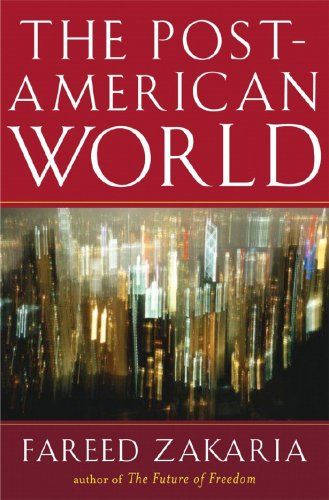
The post-American world
Introduction
Nova: The tallest building in the world is in Dubai. The biggest factory is in China. The largest investment fund sits in Abu Dhabi. And the largest Ferris wheel — that's in Singapore. Now, none of those things used to be true. Not long ago, America topped every list that mattered. So what happened? That is the question Fareed Zakaria tackles in his 2008 bestseller The Post-American World.
Nova: Exactly — and that's the first thing you have to understand. Zakaria opens the book with a line that defines the entire project. He writes: "This is a book not about the decline of America, but rather about the rise of everyone else." It's a crucial distinction. He's not predicting some kind of American collapse. He's describing a world where other countries are simply catching up, and fast.
Nova: That's exactly right. And what makes this book remarkable is that it came out in 2008 — nearly two decades ago — and yet its central argument has only become more relevant. Zakaria was the editor of Newsweek International at the time, and he later hosted CNN's GPS. A Bombay-born immigrant who went from Yale to Harvard, he wrote this book as a kind of wake-up call: America, your dominance is not a permanent feature of the landscape. Others are rising. Pay attention.
Nova: It did. And today we're going to unpack exactly why. What does a post-American world actually look like? How did we get here? And what, if anything, should America do about it?
Key Insight 1
The Rise of the Rest
Nova: So let's start with Zakaria's big idea. He calls it "the rise of the rest." And it's not just about China and India, though they feature heavily. It's about a broad diffusion of economic power across dozens of countries.
Nova: Really broad. Zakaria points out that between the years 2000 and 2007, the global economy grew at its fastest pace in nearly four decades. Income per person around the world rose at a 3.2 percent rate. Countries like Brazil, Indonesia, Turkey, Kenya, South Africa — they weren't just growing. They were transforming. Poverty was falling in countries that housed 80 percent of the world's population.
Nova: Yes. And Zakaria argues that this is actually one of the most seismic shifts in modern international history. He frames it around three great power shifts over the last five hundred years. The first was the rise of the West during the Renaissance. The second was the rise of the United States to superpower status, especially after World War II. And now, this third shift — power dispersing from one dominant player to many.
Nova: Zakaria identifies several forces converging at once. The collapse of communism and the Soviet empire opened up huge swaths of the world. Globalization leveled the playing field. Technology made it possible for jobs to go where people are rather than forcing people to go where jobs are. And political stability in previously chaotic regions created the conditions for growth.
Nova: That's one of Zakaria's most provocative arguments. The United States — and the West more broadly — built this open, globalized economic system. They championed free markets, free trade, the spread of technology and ideas. And it worked beautifully. It pulled billions out of poverty. But the natural consequence is that other countries learned the game and got really good at playing it.
Nova: Exactly. Zakaria puts it bluntly: the biggest challenges we now face come not from the losers of globalization but from the winners. More prosperity means more demand for resources, more strain on the environment, more competition for influence. And nations that were once content to follow the American-led order are now starting to assert themselves on their own terms.
Nova: Yes, and I think it's one of the book's most elegant observations. Zakaria says the world is moving from anger to indifference — from anti-Americanism, which is an emotional reaction to American power, to post-Americanism, which is simply the reality that other powers now have their own agendas and will pursue them regardless of what Washington thinks. It's not rage. It's independence.
Key Insight 2
The Challenger: China's Astonishing Ascent
Nova: Now let's get into the country case studies, because this is where Zakaria's analysis really comes alive. He devotes an entire chapter to China, which he calls "The Challenger." And the statistics here are staggering.
Nova: Here it is: China today exports in a single day more than it exported in all of 1978. One day versus one full year. The size of China's economy has doubled every eight years for three decades. Jeffrey Sachs, the economist, calls it the most successful development story in world history.
Nova: Zakaria points to small, gradual reforms rather than any big-bang transformation. After Mao, Beijing didn't try to overhaul everything overnight. They experimented. They created special economic zones. They tested policies on a small scale, and if they worked, they expanded them. Zakaria describes it as a strategy of quiet modernization, and it was remarkably effective.
Nova: He does, and they're nuanced. He acknowledges something that might make Western readers uncomfortable: not having to answer to voters sometimes helped Beijing act faster and more decisively. But he also identifies a deep vulnerability. The Communist Party spends enormous energy worrying about social stability. They monitor the internet aggressively. They fear unrest. And as living standards rise, the pressure for political reform becomes increasingly difficult to ignore.
Nova: He saw the potential for it very clearly. He warns that China operates on such a massive scale that it can't help but change the nature of the game. He points to China's involvement in Sudan — buying 65 percent of Sudan's oil exports while maintaining a military alliance — and quotes a Chinese deputy foreign minister saying simply, "Business is business." But Zakaria was also optimistic that China's rational, pragmatic leadership would prioritize stability over nationalist adventurism. He believed China understood that openness made it powerful and wouldn't risk sacrificing that.
Nova: Yes — this is fascinating. Zakaria argues that East Asian philosophical traditions, rooted in Confucian ideals of practicality and ethics, produce a very different kind of great power behavior. Historically, countries influenced by Christianity and Islam developed a missionary impulse — they want to spread their values and convert others. Britain did it, America does it, France does it. But China, Zakaria suggests, is more live-and-let-live. Their approach in Africa, for example — non-interference, no lectures about human rights — has proven far more appealing to many developing nations than the Western model that comes with strings attached.
Nova: Exactly. And that is very much the world Zakaria was describing: a world where the old Western playbook no longer guarantees influence.
Key Insight 3
The Ally: India's Messy Democracy
Nova: Now let's cross the Himalayas to India, which Zakaria calls "The Ally." And right away, the contrast with China is stark.
Nova: Well, if China is top-down, state-driven, gleaming skyscrapers and high-speed rail, India is the opposite. Zakaria describes India's growth as bottom-up, messy, chaotic, and largely unplanned. It happens not because of the government, but despite it. And yet — it happens.
Nova: Human capital. Zakaria says the most striking characteristic of India is its vast population of entrepreneurs, managers, and business-savvy individuals. English-speaking, familiar with Western business norms, and increasingly connected to global markets. He writes that it's as if hundreds of millions of people suddenly discovered the keys to unlock their potential.
Nova: Yes. More than 300 million people living on less than a dollar a day at the time of writing. Female literacy below 50 percent. Infrastructure that lags far behind China's. And a government that most Indians, especially the poor, find inefficient or corrupt. Zakaria calls this the central paradox of India: its society is open, eager, and confident, ready to take on the world, but its state is hesitant, cautious, and suspicious of change.
Nova: Because of democracy. India has sustained democratic government for nearly six decades at the time of his writing. Democracy makes for populism and pandering and delays, Zakaria acknowledges. But it also makes for long-term stability. When tensions erupt — and they do constantly in a country of India's diversity — the democratic system absorbs them rather than being overthrown by them. It's messier, but it's resilient.
Nova: He does. He immigrated to the United States from India as a teenager. And he notes a fascinating fact: India is, by at least one measure, the most pro-American country in the world. Indians broadly admire America. They understand America in a way that many other cultures don't. Zakaria sees this as a strategic asset for the United States in the post-American world — a natural ally in a rising power.
Nova: Yes — and this is a major differentiator between India and China. China's one-child policy, however economically successful, created a demographic time bomb. China is aging rapidly. India, by contrast, will continue to have lots of young people — workers — even as the rest of the industrial world ages. Zakaria sees this as a tremendous long-term advantage for India, though he's careful to note that demographics are potential, not destiny. You still need the right policies to turn young people into productive citizens.
Nova: He doesn't really. He's clear that China's economy is three times the size of India's and growing faster — if there was a race, he says, it's over. But he sees both as permanent features of the new global landscape, each shaping the post-American world in different ways.
Key Insight 4
America's Hidden Strengths and Self-Inflicted Wounds
Nova: So if China and India and Brazil and others are rising, what about America? Is it actually in decline? This is where Zakaria gets really interesting.
Nova: Right. And he backs this up with data. The United States has accounted for roughly a quarter of world output for over a century — and Zakaria predicts it's likely to slip only slightly over the next two decades. On military power, America spends almost as much as the rest of the world combined. The real story, he argues, is not absolute decline but relative decline. America's piece of the global pie is getting smaller, not because America is shrinking, but because the pie is getting so much bigger.
Nova: He has deep concerns. And they're mostly political, not economic. He writes that America has become "a power unto itself — militarily dominant, culturally pervasive, and economically unrivaled — but politically gridlocked and intellectually complacent." The greatest danger, he warns, is not the rise of other powers. It's the rise of isolationism and arrogance within the United States.
Nova: It really does. Zakaria was writing before the Tea Party, before the full paralysis of Congress, before the Trump era. But he saw the warning signs: partisan warfare, the power of special interests, a sensationalistic media, a political system that had lost its ability to build broad coalitions to solve complex problems.
Nova: Absolutely. And these are worth listing because they're often overlooked. First, higher education. Zakaria calls it America's best industry. With just five percent of the world's population, the United States has somewhere between 42 and 68 percent of the world's top 50 universities, depending on who's counting. Second, demographics. Unlike Europe, Japan, and China, America will remain a relatively young country well into the twenty-first century. And third — and this is his most powerful argument — immigration.
Nova: Yes. Foreign students and immigrants account for 50 percent of the science researchers in the country. Without immigration, Zakaria says, US GDP growth over the last quarter century would have been the same as Europe's — sluggish. America's edge in innovation is overwhelmingly a product of people who came from somewhere else, looking to make a new life. That constant revitalization is something no other major power can replicate at the same scale.
Nova: He does, and it's a great example of how he complicates the declinist narrative. The statistic you always hear is that China produces 600,000 engineers a year, India 350,000, and America only 70,000. But Zakaria points out that those Asian totals include auto mechanics and industrial repairmen. If you compare apples to apples, America actually trains more engineers per capita than either India or China. The statistics we use to scare ourselves are often misleading.
Nova: That's the book's central warning. America has the raw materials to thrive in the post-American world. The question is whether its political system will allow it to. And Zakaria wrote this in 2008. By the time Release 2.0 came out in 2011, after the financial crisis, his concern had only deepened.
Key Insight 5
Six Rules for a Multipolar Age
Nova: So Zakaria doesn't just diagnose the problem. In the final chapter, he offers a prescription: six guidelines for how the United States should navigate this new world. And I think these are worth walking through.
Nova: Number one: Choose. Zakaria says America has to stop pretending it can do everything everywhere. Priorities matter. You can't be the world's policeman, its banker, its moral conscience, and its innovator all at once without spreading yourself dangerously thin. The Iraq War is his prime example of overreach — an elective war that drained American power precisely when other countries were rising.
Nova: Build broad rules, not narrow interests. Zakaria urges a recommitment to international institutions and mechanisms. The post-World War II order — the UN, the IMF, the World Bank, NATO — these were built largely by America and they served American interests remarkably well. But they need to be updated and strengthened, not abandoned. The temptation to go it alone, to pursue narrow transactional gains, is self-defeating in the long run.
Nova: I love this one. Zakaria contrasts two models of great power behavior. Britain in its imperial heyday played balance-of-power politics — always offsetting and balancing emerging rivals, which eventually created coalitions against it. Bismarck's Germany, by contrast, maintained excellent relations with everyone. Bismarck said you should always be one of three in a world of five great powers — meaning you should always have more friends than any potential rival. Zakaria argues America should adopt the Bismarck approach: maintain relationships everywhere, be the country everyone wants to partner with.
Nova: Order à la carte. This is pragmatic and flexible. Zakaria says not every problem needs to go through the same institution. Sometimes the UN is the right forum. Sometimes NATO. Sometimes the Organization of American States. Sometimes an ad hoc coalition. The key is to use the right tool for the right job, rather than insisting on a single universal architecture.
Nova: This is about proportion. Zakaria argues that the United States often overreacts to small provocations in ways that serve the provocateur's interests. Terrorists want to draw America into costly, draining conflicts. Drug cartels exploit disproportionate responses. The key is to calibrate your response — don't take the bait. A superpower should not be easily provoked.
Nova: Legitimacy is power. This might be Zakaria's most important insight. He argues that legitimacy — being seen as a force for good, as a country that follows rules and commands respect — is not soft sentiment. It's hard power. Legitimacy gives you the ability to set agendas, define crises, and mobilize support. When America lost legitimacy after the Iraq War and Abu Ghraib and Guantanamo, it lost real, tangible influence. Other countries stopped trusting American leadership and started building alternatives.
Nova: Exactly. And that's the fundamental challenge Zakaria lays out. Can America accept a world it no longer dominates and still thrive within it? The answer depends on whether America can overcome its own political dysfunction and rediscover the pragmatism and openness that made it powerful in the first place.
Conclusion
Nova: So let's take a step back. The Post-American World came out in 2008, and in many ways it has aged remarkably well. Zakaria foresaw the erosion of American dominance not through dramatic collapse, but through the steady, relentless rise of other nations. He identified political gridlock and complacency as America's greatest vulnerabilities — warnings that have only grown louder in the years since. And he offered a vision of a multipolar world that is not a threat to be feared, but a reality to be navigated with wisdom.
Nova: That's exactly right. He writes from the perspective of someone who chose America, who came as a teenager from India and was amazed by its dynamism and openness. His confidence in America is real. But it's a confidence rooted in the belief that America can change, adapt, and relearn old virtues — not that it can simply coast on past glory.
Nova: It matters enormously. Because if you believe the story is about decline, the natural reaction is fear, resentment, and retreat. You build walls. You pull back. But if the story is about the rise of others, the natural reaction is engagement. You compete. You cooperate. You adapt. Zakaria is essentially saying: the world is getting richer, more capable, more ambitious. That's good news, not bad. But it means America has to be smarter about how it uses its considerable power.
Nova: I'd say this: the post-American world is not a future to fear — it's already here. The question is whether America will respond with the openness, adaptability, and strategic wisdom that Zakaria prescribes, or whether it will retreat into fear and nostalgia. The choice, as he argues, is ours. And the stakes have never been higher.
Nova: Congratulations on your growth!