

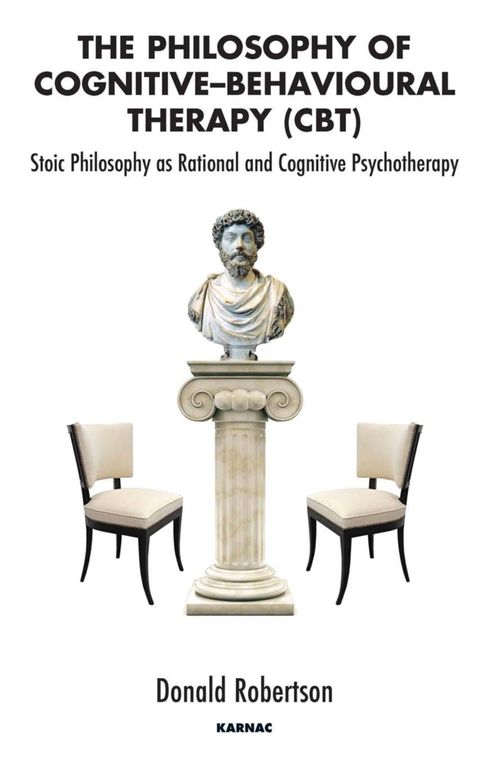
The philosophy of cognitive-behavioural therapy (CBT)
The Ancient Blueprint for Modern Minds
The Ancient Blueprint for Modern Minds
Nova: Welcome to the show. Today, we’re diving into a book that argues your modern therapy session is actually a 2,000-year-old conversation. Imagine walking into a therapist's office today, and the core technique they use—changing your thoughts to change your feelings—was first codified by Roman emperors and Greek philosophers.
Nova: : That sounds like a massive claim, Nova. Are you telling me that Cognitive Behavioral Therapy, the gold standard for anxiety and depression, is just repackaged Stoicism? I thought CBT was all about Beck, Ellis, and structured worksheets.
Nova: That’s exactly what Donald Robertson argues in his essential text, "The Philosophy of Cognitive-Behavioral Therapy." He’s a psychotherapist himself, specializing in anxiety, and he meticulously traces the lineage. He says the founders of CBT, like Aaron Beck and Albert Ellis, were deeply influenced by these ancient schools, but somewhere along the way, the philosophical foundation got stripped out, leaving just the techniques.
Nova: : So, this book isn't just a summary of CBT; it’s a historical excavation. What’s the main philosophical school he’s digging up? Is it Plato? Aristotle?
Nova: It’s overwhelmingly Stoicism. Robertson calls the book "Stoic Philosophy as Rational and Cognitive Psychotherapy." He argues that Stoicism isn't just a set of self-help platitudes about being tough; it’s a complete, evidence-based system for emotional regulation. It’s the missing link that explains CBT works so powerfully.
Nova: : That’s fascinating. Most people think of Stoicism as just 'suck it up and don't show emotion.' If Robertson is linking it to clinical therapy, he must be focusing on a much deeper, more technical aspect of Stoic thought.
Nova: Precisely. We’re not talking about the modern, often misunderstood version. We’re talking about the rigorous, almost scientific approach the Stoics took to analyzing their own judgments. For the next few chapters, we’re going to unpack how these ancient thinkers laid the groundwork for treating everything from panic attacks to chronic worry. Get ready, because this is where psychology meets the Roman Senate.
Nova: : I’m ready. Let’s start by digging into the most famous Stoic quote that Robertson claims is the very bedrock of CBT.
Key Insight 1: The Epictetus Principle
The Core Tenet: Opinions, Not Events
Nova: The absolute cornerstone, the thesis statement of the entire book, comes from the Stoic philosopher Epictetus. He famously said, and I quote, "Men are disturbed not by things, but by the views which they take of them." Robertson highlights this as the direct precursor to the Cognitive Model.
Nova: : That’s the classic line! "It’s not what happens, it’s how you think about what happens." But when you hear it as a Stoic maxim, it sounds grand. When you hear it in a CBT session, it can sometimes sound a little dismissive, like, 'Just change your thoughts!' What does Robertson add to elevate this idea from a cliché to a therapeutic tool?
Nova: He emphasizes the of the Stoic analysis. For the Stoics, the 'view' or 'opinion' wasn't just a fleeting thought; it was a deeply held to an impression. They developed sophisticated methods to dissect these impressions. Robertson points out that modern CBT uses thought records—identifying Automatic Negative Thoughts —which is functionally identical to the Stoic practice of examining your immediate, unexamined judgments.
Nova: : So, the thought record is essentially a modern, written version of an ancient mental exercise. Can you give us an example of how a Stoic would dissect an impression versus how a CBT therapist might approach it?
Nova: Absolutely. Imagine you send an important email to your boss and they don't reply for three hours. The external event is: No reply. The Stoic impression might be: 'My boss hates my work and is about to fire me.' The Stoic therapist—or Robertson’s CBT practitioner—doesn't just say, 'Don't worry.' They ask: 'Is this impression an objective fact, or is it an opinion?'
Nova: : And the answer, of course, is that it’s an opinion. It’s an inference based on zero evidence. The Stoic would then use what they called the 'dichotomy of control' to challenge that opinion. Is the boss's reply in my control? No. Therefore, worrying about it is irrational.
Nova: Exactly. Robertson shows that the Stoics were masters of cognitive restructuring long before the term existed. They categorized judgments into things that are 'up to us' and things that are 'not up to us'. This framework is the philosophical scaffolding holding up the entire CBT structure.
Nova: : It makes so much sense when you frame it that way. It moves CBT from being a set of behavioral tricks to a genuine philosophical system for living. Robertson must dedicate a good chunk of the book to showing how the founders explicitly referenced these ideas, right?
Nova: He does. He cites how early CBT pioneers were often steeped in classical education. They weren't just stumbling upon these truths; they were consciously reviving them. For instance, the concept of 'cognitive distortions'—catastrophizing, all-or-nothing thinking—these are just modern labels for the common errors in reasoning the Stoics identified millennia ago. Robertson is essentially saying, 'We didn't invent this; we just standardized the diagnosis.'
Nova: : I’m starting to see why reviews call this book a 'fascinating intersection.' It’s not just psychology; it’s intellectual history applied to mental health. If the core mechanism is challenging opinions, what are the practical tools the book details that bridge the gap between ancient texts and today's clinical practice?
Nova: That leads us perfectly into the next area: the practical application of Stoic logic as a form of cognitive training. It’s about moving from the principle to the principle. We’ll explore how Stoic exercises become CBT homework assignments.
Key Insight 2: Practicing Resilience Through Logic
From Theory to Practice: The Stoic Homework
Nova: In our last segment, we established that CBT is applied Stoicism. Now, let’s look at the 'how.' Robertson emphasizes that Stoicism was never just theoretical philosophy; it was a daily practice, a form of mental training. He frames this training as the blueprint for what we now call 'homework' in therapy.
Nova: : I’m picturing Marcus Aurelius writing down his daily reflections. What specific practices does Robertson pull out that map directly onto modern CBT techniques? I’m thinking about things like exposure therapy or behavioral experiments.
Nova: The Stoics had several powerful techniques. One is, or the premeditation of evils. This is essentially systematic desensitization or exposure therapy in disguise. Before a potentially stressful event—a public speech, a difficult conversation—the Stoic would mentally rehearse the worst-case scenario, not to dwell in anxiety, but to neutralize its shock value.
Nova: : So, if I’m terrified of public speaking, instead of avoiding it, I mentally walk through the audience laughing, my mind going blank, the whole catastrophe. And by rehearsing it, I rob the actual event of its power to surprise and paralyze me. That’s brilliant, and it’s exactly what exposure therapy aims to do.
Nova: Precisely. Robertson notes that by confronting the worst outcome rationally beforehand, you realize that even if it happens, it’s rarely fatal to your well-being, because your of the event is what causes the real suffering. Another key tool is the 'view from above,' or cosmic perspective. When you feel overwhelmed by a minor social slight, the Stoic is trained to zoom out: 'Will this matter in a year? Ten years? How does this look from the perspective of the cosmos?'
Nova: : That’s a fantastic antidote to rumination. Rumination is always about magnifying the immediate, personal problem. The 'view from above' forces a cognitive shift in scale. It’s a form of cognitive distancing, which is a huge component of mindfulness-based CBT approaches today.
Nova: It is. And Robertson connects this to the Stoic concept of, or self-appropriation—the idea that our circle of concern should expand from ourselves to our family, community, and humanity. When you feel intense personal anxiety, shifting focus outward to your duties or service to others immediately reduces the self-focus that fuels the distress. It’s a behavioral activation strategy rooted in virtue ethics.
Nova: : This is where the philosophy really shines. It’s not just about feeling better; it’s about living better, more virtuously, by being rational. Does Robertson discuss how this philosophical framework helps with specific disorders, given his specialty in anxiety?
Nova: He does, extensively. For anxiety, the Stoic focus on the Dichotomy of Control is the ultimate intervention. Anxiety is fundamentally the fear of future events outside our control. By rigorously applying the Stoic filter—'Is this within my power right now?'—the anxious loop is broken. If the answer is no, the rational response is acceptance and redirection of energy toward what controllable: your present action and judgment.
Nova: : It’s a complete system. It provides the 'why' and the 'how'. I’m curious, though. If this system is so robust, why did modern psychology feel the need to reinvent it under the banner of CBT? Was there a loss of something important when the philosophy was dropped?
Nova: Robertson suggests the loss was depth and resilience. When you only teach the technique—'Challenge that thought'—without the underlying philosophical commitment to reason and virtue, the technique can feel brittle. If you don't understand challenging the thought is important for a good life, you’re less likely to stick with it when things get tough. The philosophy provides the motivation and the context for enduring the therapeutic work. It turns homework into a moral duty to be rational.
Key Insight 3: Bridging Antiquity and Evidence-Based Practice
The Modern Synthesis: Philosophy as Emotional Resilience Training
Nova: We’ve seen the historical parallels and the practical exercises. The final major theme in Robertson's book is the synthesis—how this ancient wisdom translates into what he calls 'emotional resilience training' for the 21st century. He’s not just an academic; he’s a practitioner who uses this every day.
Nova: : When he talks about resilience training, is he suggesting that Stoicism is superior to modern CBT, or that it’s a necessary enhancement? Because CBT is highly evidence-based, which is a modern metric.
Nova: Robertson is careful to position Stoicism as the that validates the evidence-based practice. He argues that CBT’s success is it aligns with Stoic logic, not in spite of it. He points out that the founders of CBT were essentially trying to operationalize the Socratic/Stoic method for a secular, scientific age. The evidence-based nature of CBT simply confirms the efficacy of the ancient method.
Nova: : That’s a powerful argument for integration. But what about the emotional side? Stoicism sometimes gets criticized for being too cold, too focused on pure logic, whereas modern therapy often emphasizes emotional acceptance and validation. How does Robertson reconcile that?
Nova: This is where the book gets really nuanced. Robertson draws heavily on later Stoic thinkers and even incorporates elements from third-wave CBTs, like Acceptance and Commitment Therapy. He shows that Stoicism isn't about emotion; it’s about that causes destructive emotion. You don't suppress sadness over a genuine loss, but you correct the judgment that 'this loss means my life is ruined forever.'
Nova: : So, the Stoic goal isn't apathy, but —a state free from irrational passion, not free from all feeling. That’s a crucial distinction. If I’m feeling intense anger, the Stoic doesn't just say 'don't be angry'; they analyze the judgment fueling the anger, which is often a judgment about an injustice that is outside my control.
Nova: Exactly. And Robertson emphasizes that the Stoics were deeply engaged with the world. They weren't hermits. Marcus Aurelius was running an empire! Their philosophy was designed for high-stress, high-stakes engagement. This makes it incredibly relevant for modern professionals, leaders, and anyone dealing with the constant barrage of information and perceived threats we face daily.
Nova: : I read somewhere that Robertson is involved with the Modern Stoicism movement. Does the book serve as a manifesto for applying these principles outside of a clinical setting—for general well-being?
Nova: It absolutely does. It’s a clinical text, but it functions perfectly as a self-help guide because the core principles are universal. Robertson wants people to reclaim philosophy as a practical tool for living well, not just an academic subject. He’s showing that if you understand the philosophical engine driving CBT, you become your own therapist, capable of self-correction long before a crisis hits.
Nova: : It sounds like the takeaway is that we need to stop seeing philosophy and psychology as separate disciplines. They are two sides of the same coin: the rational examination of the human condition. This book seems to be a powerful call to re-unite them.
Nova: It is. It’s a call to intellectual rigor in our emotional lives. It gives the listener a profound sense of agency, knowing that the tools to manage distress aren't new inventions, but time-tested wisdom waiting to be applied with precision. We’ve covered the historical link, the core mechanism, and the modern application. It’s time to wrap up what this means for us.
Conclusion: Reclaiming Rationality
Conclusion: Reclaiming Rationality
Nova: We’ve journeyed from the lecture halls of ancient Athens to the modern therapist’s couch, all thanks to Donald Robertson’s deep dive into the philosophy underpinning CBT. The key takeaway is clear: our most effective psychological tools are rooted in the rigorous self-examination practiced by the Stoics.
Nova: : The most powerful realization for me is understanding that the 'why' behind challenging a negative thought is rooted in a 2,000-year-old commitment to living rationally. It’s not just about feeling better; it’s about being a better, more reasoned human being. The alone is worth the price of admission for anyone prone to anxiety.
Nova: Absolutely. And for our listeners who might feel overwhelmed by the complexity of modern life, remember the core message Robertson distills: You have immense power over your inner world. Your distress is almost always generated by your to an impression, not the impression itself. That space between event and reaction is where philosophy—and therapy—lives.
Nova: : So, the actionable takeaway is to start questioning our immediate judgments. When something upsets you, don't just react. Pause, and ask: 'What is the opinion I am currently holding about this event? Is that opinion an objective fact, or is it a judgment I can revise?'
Nova: That simple, yet profound, act of questioning is the legacy of Socrates, passed down through the Stoics, and formalized by modern CBT. Robertson’s book is a vital reminder that to truly master our minds, we must first understand the philosophy that guides that mastery.
Nova: : It’s an invitation to be more than just a patient; it’s an invitation to become a philosopher of your own life. A powerful thought to end on.
Nova: Indeed. Thank you for joining us on this deep dive into the intellectual history of mental well-being. This is Aibrary. Congratulations on your growth!