

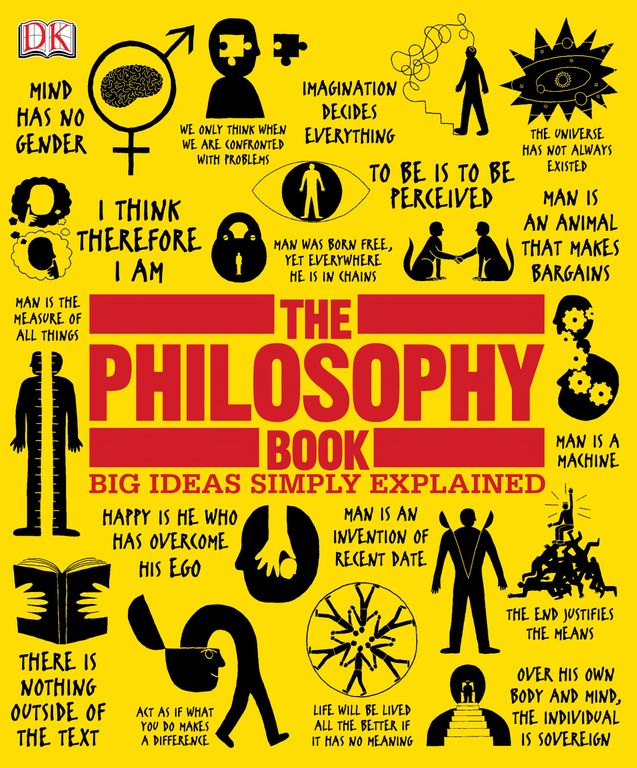
The philosophy book
Big Ideas Simply Explained
Introduction
Nova: What do a Greek mathematician from 500 BCE, a French radical from the 1960s, and a Persian mystic poet all have in common? They are all united in one book — a book that has somehow sold over seven million copies worldwide. And we're talking about a philosophy book. Not a thriller, not a romance novel, but a visual encyclopedia of the biggest ideas in human history.
Nova: : Seven million copies of a philosophy book? That seems almost absurd. I mean, philosophy has a reputation for being dense, inaccessible, something you only encounter when a college professor assigns it. What kind of philosophy book breaks through like that?
Nova: That is exactly the magic of The Philosophy Book: Big Ideas Simply Explained, part of DK's award-winning series, with Will Buckingham as one of the lead contributors. The book does something remarkable. It takes over one hundred of the most profound and sometimes dizzying ideas in philosophy — from Thales of Miletus wondering whether everything is made of water, all the way to Jacques Derrida deconstructing language itself — and presents them through clear text, bold graphics, and a timeline that walks you through two and a half millennia of human thought.
Nova: : So it is essentially a greatest hits of philosophy, but designed for people who do not have a PhD in the subject. I like the sound of that. But here is my question: does simplifying philosophy risk dumbing it down? Can you really capture the nuance of someone like Kant or Nietzsche in a few illustrated pages?
Nova: That is the central tension, and honestly, what makes this book so fascinating to discuss. Buckingham and the team of contributors — including Douglas Burnham, Peter King, and others — do not pretend to give you everything. What they do is give you an entry point. They contextualize each thinker within their historical moment, they highlight the one or two breakthrough ideas that changed the game, and they use visual diagrams to map out how arguments actually work. It is philosophy as a conversation starter, not as a final word. Today, we are going to explore what makes this book tick, the thinkers it covers, and why it matters that a book like this exists in the world.
Key Insight 1
A Timeline of Thought — How the Book Structures 2,500 Years
Nova: Let us start with the architecture of the book itself. The Philosophy Book is organized chronologically into six major eras, and this structure is one of its secret weapons. It opens with The Ancient World, running from about 700 BCE to 250 CE, then moves through The Medieval World, The Renaissance and the Age of Reason, The Age of Revolution, The Modern World, and finally Contemporary Philosophy.
Nova: : So it is essentially a historical tour of philosophy rather than a thematic one. Why does that matter?
Nova: Because philosophy does not happen in a vacuum. When you place Thomas Aquinas right after the Islamic scholars who preserved and translated Aristotle, you suddenly understand why Aquinas was even able to do what he did. When you see Machiavelli writing The Prince in the context of Renaissance Florence — a city recovering from political chaos — his seemingly cold pragmatism starts to make sense. The book shows philosophy as a living conversation across centuries, not a series of isolated geniuses having eureka moments.
Nova: : That is actually a helpful frame. I remember struggling through philosophy in school and feeling like each thinker existed in their own bubble. Descartes here, Hume there, no clear connection.
Nova: Exactly. And the book does something else clever too. Each philosopher gets what you might call a signature treatment: a bold quote that encapsulates their big idea, a short biography, a contextual timeline showing what else was happening in the world at that moment, and then a visual breakdown of their key arguments. For example, Plato's Theory of Forms is illustrated with a diagram that shows the split between the world of ideal Forms and the shadowy world of appearances. It is not just text — it is a designed experience.
Nova: : That visual element seems crucial, especially given how abstract some of these ideas can get. I am thinking of Hegel's dialectic or Kant's categorical imperative. These are not exactly dinner party conversation starters.
Nova: Precisely. And that is the DK signature. They use what they call striking graphics and creative typography to make arguments visible. For Hegel's dialectic — thesis, antithesis, synthesis — they show it as a visual spiral. For Kant, they map out how the categorical imperative works as a kind of logical test. It is philosophy you can almost see. And Will Buckingham, who wrote all the chapters from Nietzsche to Žižek, has talked about how the interplay of narrative and philosophy is central to making these ideas breathe.
Nova: : I want to pause on one thing you just mentioned. Buckingham wrote the modern and contemporary sections, but there were other contributors for earlier periods. That is interesting because it almost mimics the collaborative, conversational nature of philosophy itself.
Key Insight 2
From Thales to Buddha — The Ancient World's Big Bang of Ideas
Nova: The first section of the book covers what you might call the big bang of philosophy. Roughly from 700 BCE to 250 CE, and the remarkable thing is that it was happening simultaneously in different parts of the world. In Greece, you had Thales of Miletus asking what the universe is fundamentally made of — his answer, water — and launching the entire project of rational inquiry. Meanwhile, in China, Confucius was developing an ethical system based on social harmony and respect for tradition, and in India, Siddhartha Gautama, the Buddha, was articulating the Four Noble Truths and the Eightfold Path.
Nova: : It is wild to think that all these foundational ideas were emerging independently around the same time. The book draws those connections?
Nova: It does, and this is one of the things that sets it apart from more traditional Western-centric philosophy primers. The Philosophy Book makes a deliberate effort to include Eastern traditions alongside the familiar Greek lineage. So you get Confucius and Laozi right alongside Socrates and Plato. It is not presented as separate, lesser traditions — they are woven into the same timeline, showing that the impulse to ask big questions is universal.
Nova: : Speaking of Socrates, what is the book's take on him? Because he is this almost mythical figure who never wrote anything down, yet everything in Western philosophy seems to trace back to him.
Nova: The book nails this. It frames Socrates around his most famous line: The unexamined life is not worth living. It explains his dialectical method — this relentless questioning that exposed the holes in people's thinking — and it positions him as the pivot point. Before Socrates, philosophy was mostly about cosmology, about what the universe is made of. After Socrates, philosophy turns inward. It becomes about ethics, about how to live, about the soul.
Nova: : And then his student Plato takes that baton and runs with it. I remember the Theory of Forms being one of those concepts that sounds almost mystical when you first encounter it.
Nova: Right. Plato argued that the physical world we perceive is just a shadow or copy of a higher realm of perfect, unchanging Forms or Ideas. So every chair you sit on is just an imperfect copy of the ideal Form of Chair-ness. The book illustrates this beautifully with a cave-like visual that echoes Plato's own Allegory of the Cave. But then Aristotle, Plato's student, comes along and kind of smashes that framework. He says, no, the real world matters. Go out and observe it. Categorize it. Aristotle founded biology and logic as we know them, and the book positions him as the father of empirical thinking.
Nova: : So within three generations — Socrates, Plato, Aristotle — you get this complete spectrum of philosophical approaches: ethical questioning, abstract idealism, and grounded empiricism. That is astonishing.
Key Insight 3
Faith Meets Reason — The Medieval Synthesis Nobody Expected
Nova: Here is where the story takes a fascinating turn that a lot of people do not know about. After the fall of Rome, philosophy in Europe essentially went into hibernation. The period often called the Dark Ages saw the loss of much classical knowledge. But — and this is a massive but — Islamic scholars in the Middle East were preserving, translating, and building upon Greek philosophy, especially Aristotle.
Nova: : Wait, so while Europe was in its intellectual dark age, the Islamic world was keeping the flame alive?
Nova: Exactly. Figures like Avicenna and Averroes were writing extensive commentaries on Aristotle, wrestling with questions about the soul, God, and the relationship between faith and reason. Avicenna, for instance, developed the famous Flying Man thought experiment. Imagine a person created in mid-air, floating in darkness, with no sensory experience whatsoever. Would that person still know they exist? Avicenna argued yes — proving, in his view, that the soul is independent of the body and that self-awareness is innate.
Nova: : That is remarkably similar to Descartes' I think, therefore I am, but centuries earlier.
Nova: Bingo. And by the 12th century, these Islamic texts started flowing back into Europe, and it reignited philosophical inquiry. Suddenly you have Thomas Aquinas, deeply influenced by Averroes' reading of Aristotle, trying to synthesize Christian theology with Aristotelian logic. The book captures this beautifully — Aquinas is not just a theologian reciting dogma. He is a rigorous logician, building arguments for God's existence using reason, not just revelation.
Nova: : And then there is St. Augustine and the problem of evil, right? That is one of those questions that still keeps people up at night.
Nova: Absolutely. If God is all-good and all-powerful, why does evil exist? Augustine's answer, which the book lays out clearly, is that evil is not a thing in itself — it is a privation, an absence of good, like a hole in a fabric. And he tied it to free will. Humans must have the freedom to choose, and that freedom necessarily opens the door to moral failure. It is a elegant solution that has influenced theology for 1,600 years, even if it does not satisfy everyone.
Nova: : And Boethius tackled a related puzzle: if God knows everything you are going to do, do you really have free will? That paradox could drive a person mad.
Nova: Boethius' solution is stunningly clever. He argued that God exists outside of time entirely. For God, all moments — past, present, future — are a single eternal now. So God does not foreknow your actions in a way that causes them. He simply sees them, the way you might see someone walking down the street. It is not causation, it is observation from a timeless vantage point. The book presents this as one of those aha moments in philosophy where a seemingly intractable puzzle gets reframed in a completely new way.
Key Insight 4
From Descartes to Revolution — How Reason Reshaped the World
Nova: Now we arrive at the era that really feels like the birthplace of the modern mind: the Renaissance and the Age of Reason, roughly 1500 to 1750. This is when everything shifts. The authority of the Church starts crumbling under the weight of scientific discovery. Copernicus says the Earth goes around the Sun. Galileo proves it with a telescope. And suddenly, the whole medieval worldview is on shaky ground.
Nova: : And in the middle of this, Descartes walks in and essentially says, let us tear everything down and start over.
Nova: That is exactly what he did. Descartes decided to doubt everything — his senses, his memories, even the existence of the external world — until he arrived at something indubitable. And he found it: the fact that he was doubting proved he was thinking, and thinking proved he existed. Cogito ergo sum. I think, therefore I am. The book presents this as a seismic moment. It is the birth of modern epistemology — the study of how we know what we know.
Nova: : But Descartes' approach also split philosophy into two camps, did it not? The rationalists and the empiricists.
Nova: Yes, and the book maps this split beautifully. On one side, you have the rationalists — Descartes, Spinoza, Leibniz — who believed that reason alone, independent of sensory experience, could unlock fundamental truths. Spinoza even wrote his Ethics in the style of a geometric proof, with axioms and propositions, as if morality could be deduced like a theorem. On the other side, you have the empiricists — John Locke, George Berkeley, David Hume — who insisted that all knowledge comes through the senses. Locke famously described the mind as a tabula rasa, a blank slate, at birth. Everything we know is written on it by experience.
Nova: : Berkeley took empiricism to a wild conclusion though, did he not? Something about nothing existing unless it is perceived?
Nova: To be is to be perceived. Berkeley argued that material objects have no independent existence outside of perception. A tree falling in a forest with no one around? It does not make a sound, because there is no perception of it. But Berkeley was a bishop, so he solved this by saying God is the ultimate perceiver, always watching, which ensures the world stays in existence even when no human is looking. It is one of those ideas that sounds absurd but is weirdly difficult to disprove.
Nova: : And then we get the political philosophers — Hobbes, Locke, Rousseau — who start asking not just what is real, but how should we live together?
Nova: Precisely. The social contract theorists fundamentally changed how we think about government. Hobbes, writing in the shadow of the English Civil War, saw human life in a state of nature as solitary, poor, nasty, brutish, and short. He argued we need a powerful sovereign to keep us from each other's throats. Locke had a much more optimistic view and argued for natural rights — life, liberty, and property — that governments exist to protect. Rousseau gave us the idea of the general will. These were not just academic debates. These ideas directly fueled the American and French Revolutions.
Key Insight 5
The Modern Crack-Up — Nietzsche, Existentialism, and the Death of Certainty
Nova: This brings us to the sections that Will Buckingham himself wrote — from Nietzsche through to Žižek. And this is where philosophy gets, frankly, a little unhinged in the best possible way. The 19th and 20th centuries are when the old certainties — God, progress, rational order — start crumbling.
Nova: : Nietzsche is the seismic event here, right? God is dead, and we have killed him.
Nova: That is the most famous and most misunderstood line in philosophy. Nietzsche was not celebrating the death of God. He was issuing a warning. If the foundation of Western morality — Christian belief — collapses, what holds everything else up? He predicted that the 20th century would be defined by nihilism and a desperate search for new values. And looking at two world wars and the rise of totalitarianism, he was terrifyingly prescient. The book presents Nietzsche not as a nihilist but as a diagnostician of nihilism, urging humanity to create its own values rather than collapse into despair.
Nova: : And from that diagnosis, existentialism is born. Kierkegaard, Heidegger, Sartre — they all grapple with this problem of meaning in a godless universe.
Nova: Exactly. Kierkegaard, a deeply religious thinker, paradoxically laid the groundwork for existentialism by arguing that faith requires a leap — a radical, personal, subjective commitment that cannot be justified by reason. Heidegger, deeply problematic as a person but philosophically monumental, asked the question that had somehow been forgotten: what does it mean to be? His answer involved analyzing human existence — what he called Dasein — as being-toward-death, fundamentally defined by our finitude and our thrownness into a world we did not choose.
Nova: : And then Sartre takes it to its most radical conclusion: existence precedes essence. We are not born with a pre-defined purpose. We create ourselves through our choices.
Nova: And that is terrifying and liberating in equal measure. Sartre says we are condemned to be free. There is no human nature to fall back on, no divine plan, no cosmic purpose. You are entirely responsible for what you make of yourself. The book captures this existentialist tone beautifully — the anxiety, the vertigo, but also the radical possibility.
Nova: : But philosophy in the 20th century did not just go inward. There was also the linguistic turn, right? Wittgenstein and the idea that many philosophical problems are just confusions of language.
Nova: Yes. Wittgenstein argued that philosophy had been tying itself in knots by misusing language. The limits of my language mean the limits of my world. If we clarify how language actually works, many philosophical puzzles simply dissolve. And from there, philosophy fragments into post-structuralism — Derrida deconstructing texts to reveal hidden contradictions, Foucault analyzing how power shapes knowledge, and then contemporary thinkers like Peter Singer on animal rights and Arne Naess on deep ecology. The book covers all of this, and Buckingham's chapters bring a fresh, accessible energy to thinkers who are notoriously difficult.
Conclusion
Nova: So what do we take away from this whirlwind tour through The Philosophy Book? I think the most important thing is that philosophy is not a museum of dead ideas. It is a living, breathing conversation that stretches back two and a half thousand years, and every question we grapple with today — about artificial intelligence, about climate ethics, about identity and justice — has deep roots in this tradition.
Nova: : That is what strikes me most. You read this book and you realize that Thales wondering whether everything is made of water is not that different from a modern physicist asking what the fundamental substance of reality is. The tools have gotten more sophisticated, but the wonder is the same. And the book's format — the visuals, the timelines, the bite-sized explanations — it democratizes access to that wonder in a way that traditional philosophy textbooks never could.
Nova: And that is exactly why seven million copies have sold. Will Buckingham and the team at DK cracked a code that many thought was impossible: make philosophy beautiful, make it visual, make it accessible, without making it shallow. Each entry is an invitation, not a final judgment. You read about Confucius and you want to read the Analects. You encounter Simone de Beauvoir and you want to read The Second Sex. The book is a launchpad, not a destination.
Nova: : And Buckingham himself is an interesting figure to end on. He is not just an academic philosopher — he is a novelist, a traveler, someone who co-directs a social enterprise called Wind&Bones that explores how writing fosters connection. He embodies the idea that philosophy belongs in the world, not in a seminar room. His most recent book is called Hello, Stranger: How We Find Connection in a Disconnected World. That feels like philosophy in action — taking big ideas and applying them to the most human of problems: how we relate to each other.
Nova: The final line of the book's journey lands us with contemporary thinkers like Slavoj Žižek, Julia Kristeva, and Luce Irigaray — grappling with language, power, gender, and meaning. And the message is clear: philosophy has not ended. The big questions are still open. What is consciousness? What is justice? How should we live? The Philosophy Book does not answer these questions definitively — no book can. But it hands you the map and says: here is where we have been. Now where will you go?
Nova: : That is a beautiful way to put it. So for anyone listening who has ever been intimidated by philosophy — this book, and really this whole series, is a reminder that the big questions belong to everyone. You do not need a degree. You just need curiosity.
Nova: And maybe a willingness to have your assumptions shaken up a little. Because as Socrates taught us, the beginning of wisdom is knowing that you do not know. This is Aibrary. Congratulations on your growth!