

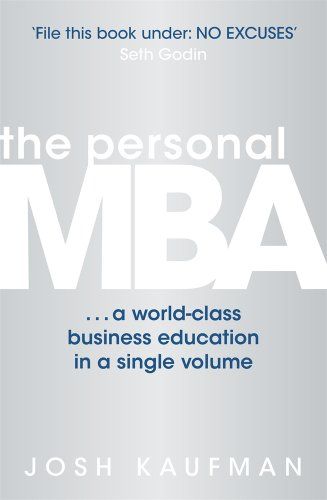
The personal MBA
Introduction
Nova: Here's a question for you: what if I told you that spending $200,000 on a business degree might be one of the worst investments you could make?
Nova: That's exactly what Josh Kaufman argues in his book The Personal MBA. And it's not just a provocative hot take. He points out that there's actually no strong evidence that an MBA improves business or career success — yet the average top-tier program can set you back six figures, plus two years of lost income.
Nova: Exactly. Kaufman's big idea is that business isn't rocket science. It's a set of predictable, learnable skills. And he distills them into one book — 248 bite-sized mental models across marketing, sales, finance, psychology, systems thinking, and productivity. Originally published in 2010 and updated for a 10th anniversary edition, the book has become a foundational text for self-taught entrepreneurs everywhere.
Nova: That's the pitch. And today we're going to walk through the most powerful ideas in it — why every business boils down to just five parts, how human psychology drives every purchase, why systems thinking matters more than hustle, and how to train your brain to make better decisions. Ready?
Why Skip Business School?
The $200,000 Question
Nova: Let's start with the elephant in the room. Kaufman's opening argument is pretty blunt: business school is an expensive bet that a piece of paper will make you successful. And he's not just guessing — he did the math.
Nova: A top MBA program costs around $200,000 in tuition and expenses, plus two years of foregone salary. So you're looking at an all-in cost that can easily exceed $300,000. And for what? Kaufman argues that most MBA curricula are built around outdated case studies and abstract theory that don't translate well to the real world.
Nova: That's the most common defense, and Kaufman doesn't dismiss it entirely. But his counterpoint is compelling: with the money you'd save, you could start a real business, make real mistakes, learn real lessons, and build a real network — not of classmates, but of customers, suppliers, and partners who actually matter to your venture.
Nova: Exactly. Kaufman himself doesn't have an MBA. He was a brand manager at Procter and Gamble, then became a researcher and business coach. He built his own curriculum by reading hundreds of business books, testing ideas in practice, and distilling what actually worked. The Personal MBA is the result — and it's structured around the idea that if you understand a core set of mental models, you can navigate nearly any business situation.
Nova: Good call. A mental model is just a simplified way of understanding how something works. Think of it as a conceptual tool. Instead of memorizing a hundred case studies, you learn a principle like the Iron Law of the Market — and then you can apply it to any industry, any product, any situation. Kaufman gives you 248 of these.
Nova: It is, but they're organized into three big buckets: how businesses work, how people work, and how systems work. And that's exactly how we'll explore them today.
Every Business Demystified
The Five-Part Framework
Nova: So here's the cornerstone of the entire book. Kaufman says every single business — whether it's a lemonade stand or a billion-dollar tech company — is made up of five interdependent processes.
Nova: Just five. Number one: Value Creation. Discovering what people need or want, then creating it. Number two: Marketing. Attracting attention and building demand. Number three: Sales. Turning prospective customers into paying customers. Number four: Value Delivery. Giving customers what you promised and ensuring they're satisfied. And number five: Finance. Bringing in enough money to keep going.
Nova: Right? But Kaufman has this great test. Take any one of these five away and see what happens. A venture that doesn't create value for others? That's just a hobby. A venture that doesn't attract attention? That's a flop. A venture that doesn't sell? That's a nonprofit at best. A venture that doesn't deliver what it promises? That's a scam. And a venture that doesn't bring in enough money? It closes.
Nova: That's precisely how Kaufman wants you to think. These five parts flow into each other. You create value, you market it to get attention, you sell to close the deal, you deliver to satisfy the customer, and you manage the money to keep the cycle going. If the chain breaks anywhere, the whole thing suffers.
Nova: Exactly. It's a litmus test. And what I love is that this framework democratizes business thinking. You don't need an MBA to ask: what value am I creating? How am I getting attention? How do I close the sale? How do I deliver? And is the money working?
Nova: It is, and Kaufman fills it in beautifully. He identifies twelve distinct forms of value you can create. It's not just products and services. It's shared resources, subscriptions, resale, leases, agencies, audience aggregation, loans, options, insurance, and capital. Most entrepreneurs get stuck thinking in just one or two forms. Kaufman shows you there are at least a dozen ways to structure a business model.
What Makes People Buy?
The Iron Law and Human Drives
Nova: Alright, let's talk about something that's both obvious and deeply overlooked. Kaufman introduces what he calls the Iron Law of the Market. And it is cold, hard, and unforgiving.
Nova: Here it is: if you don't have a large group of people who really want what you have to offer, your chances of building a viable business are very slim. That's it. No amount of brilliant marketing or sales technique can save you if the market simply doesn't want what you're selling.
Nova: Constantly. The classic first-time entrepreneur mistake is falling in love with your own idea and never verifying whether anyone else wants it. Kaufman says the best approach is simple: make things people want to buy. Not things you think they should want. Not things that are clever or innovative for their own sake. Things they actually want.
Nova: This is where Kaufman brings in psychology. He references research from Harvard professors Paul Lawrence and Nitin Nohria, who identified four core human drives: the drive to acquire, the drive to bond, the drive to learn, and the drive to defend. And Kaufman adds a fifth: the drive to feel — the desire for sensory stimulation, pleasure, excitement, and emotional experiences.
Nova: Yes. Think about it. Luxury goods tap into the drive to acquire. Social media taps into the drive to bond. Online courses tap into the drive to learn. Insurance taps into the drive to defend. And everything from restaurants to concerts to video games taps into the drive to feel.
Nova: That's the insight. And Kaufman takes it further with his Pricing Uncertainty Principle. Here's the counterintuitive part: price is not determined by what something costs to make. It's determined by what the customer perceives it's worth.
Nova: Exactly. Think about a bottle of water at a concert versus at a grocery store. Same water, vastly different perceived value. Kaufman says all prices are arbitrary and malleable. The key is to anchor your price to the outcome or transformation you provide, not the effort it took to create it.
Nova: Right. And here's another counterintuitive point Kaufman makes: competition is actually a good sign. If there are already successful businesses serving a market, that proves the market exists. Your biggest risk — that nobody wants what you're selling — is already eliminated. Now you just have to do it better.
Nova: Totally. He even recommends becoming a paying customer of your competitors. Buy their stuff. Experience their process. Learn what they do well and where they fall short. Then create something even more valuable.
How to Build and Improve
Think in Systems, Iterate Fast
Nova: Let's shift into the third big section of the book — how systems work. Kaufman argues that every business is a complex system made up of interdependent parts. And if you want to improve it, you need to think like a systems engineer.
Nova: It's actually liberating. The core concept is bottleneck analysis. In any system, there's always one constraint that limits overall performance. Find that bottleneck and fix it, and the entire system improves. Fix anything else, and you're just spinning your wheels.
Nova: Say you run a bakery. You're producing 100 loaves a day, but you could sell 200. Where's the bottleneck? Maybe it's your oven capacity. Buy a bigger oven and you double output. But now the bottleneck might shift to your mixer, or your delivery van, or your front counter staff. The point is: you focus your improvement efforts on the one thing that's actually limiting you, rather than trying to improve everything at once.
Nova: Exactly. And this connects to Kaufman's Iteration Cycle, which he calls the WIGWAM method. It stands for Watch, Ideate, Guess, Which, Act, Measure.
Nova: Watch — observe what's happening. What's working and what's not? Ideate — brainstorm what you could improve. Guess — based on what you've learned, which idea will make the biggest impact? Which — decide which change to actually make. Act — make the change. Measure — what happened? Was it positive or negative? And then you loop back to Watch and start again.
Nova: That's exactly right. And Kaufman emphasizes speed. The faster you move through iteration cycles, the faster you improve. He's essentially advocating for the lean startup mentality years before it became a buzzword — launch small experiments, gather real data, adapt in real time. Most business plans don't survive first contact with customers anyway.
Nova: Beautifully put. And Kaufman has practical advice on getting good data. When you ask for feedback, don't ask friends and family — they'll sugarcoat it. Ask real potential customers. Ask open-ended questions. Listen more than you talk. And here's the killer tip: give people the opportunity to preorder before your product even exists. Someone saying they'd buy is meaningless. Someone actually pulling out their credit card? That's real feedback.
Nova: He calls it shadow testing. And it's one of those ideas where once you hear it, you can't believe more people don't do it.
Productivity, Psychology, and Better Decisions
Your Brain Is the Business
Nova: Now, one of my favorite parts of the book is where Kaufman zooms in from the big business frameworks to the individual human operating system — your brain. Because at the end of the day, businesses are run by people. And if you can't manage your own mind, you can't manage anything else.
Nova: Exactly. And Kaufman starts with a concept that I think about almost daily: the cognitive switching penalty. Every time you switch from one task to another, your brain takes time to refocus. Those little interruptions — checking email, glancing at your phone, jumping between projects — they don't just cost you the seconds you spend on them. They cost you the minutes it takes to get back into deep focus.
Nova: It's a myth. Kaufman is adamant: single-tasking and time blocking are the real productivity multipliers. Set aside focused blocks of time for your most important work. Guard your attention like it's money, because it is.
Nova: He talks about willpower as a limited resource — something that depletes throughout the day. That's why successful people automate as many decisions as possible. Steve Jobs wearing the same outfit every day wasn't just a quirk; it was a strategy to preserve mental bandwidth for decisions that actually mattered.
Nova: Right. And Kaufman also dives deep into cognitive biases — the systematic errors our brains make. Confirmation bias, where we seek out information that supports what we already believe. The sunk cost fallacy, where we keep investing in something failing just because we've already invested so much. Anchoring, where the first number we hear influences all subsequent judgments.
Nova: Kaufman's answer is awareness plus structure. Just knowing these biases exist helps you catch them. But he also recommends using structured decision-making tools. One of his favorites is expected value: multiply the potential reward by the probability of success. It sounds simple, but it forces you to think probabilistically instead of emotionally.
Nova: Yes — one of the most important concepts in the book. Every yes is a no to something else. When you say yes to a meeting, you're saying no to deep work. When you say yes to a client who pays poorly, you're saying no to finding a better one. Kaufman wants you to weigh every decision against what you're giving up.
Nova: That's the heart of it. Kaufman even dedicates space to meta-learning — learning how to learn. He talks about spaced repetition, deconstructing complex skills into sub-skills, practice loops with feedback. In a world where the half-life of skills keeps shrinking, the ability to learn faster than your competitors is maybe the ultimate business advantage.
The Intangibles That Compound
Trust, Brand, and the Long Game
Nova: I want to touch on one more theme before we wrap up, because it ties everything together. Throughout the book, Kaufman keeps circling back to something that doesn't show up on a balance sheet: trust.
Nova: Beautifully said. Kaufman argues that reputation is the most valuable intangible asset any business has. And it's built through consistency, competence, and ethical alignment — delivering what you promise, over and over, without cutting corners.
Nova: Catastrophic. Customers who feel burned don't just leave — they tell everyone they know. And in the age of social media, that can snowball overnight. On the flip side, Kaufman talks about reciprocity — one of the most powerful psychological principles in business. When you provide unexpected value to someone, they feel a deep, almost instinctive urge to reciprocate.
Nova: That's the idea. And it connects to brand. Kaufman says a brand isn't a logo or a tagline — it's a promise delivered repeatedly. Every interaction a customer has with your business either strengthens or weakens that promise. Great businesses understand this at a visceral level.
Nova: That's exactly right. And I think that's why The Personal MBA has resonated with so many people. It strips away the jargon, the gatekeeping, and the mystique. It says: business is just people creating value for other people. Everything else is details.
Conclusion
Nova: So let's bring it all together. Josh Kaufman's The Personal MBA makes a bold claim: you don't need to spend six figures and two years of your life to learn how business works. What you need is a set of mental models that help you see clearly, decide wisely, and act effectively.
Nova: The Iron Law of the Market reminds us that no amount of cleverness can save a product nobody wants. Human psychology — those five core drives — explains why people buy. And the Pricing Uncertainty Principle tells us that value, not cost, determines what you can charge.
Nova: And on the personal side, Kaufman's insights on cognitive biases, willpower management, single-tasking, and opportunity cost are just as valuable for anyone trying to get more done — whether or not they ever start a business.
Nova: If there's one quote from the book that captures the spirit of the whole thing, it might be this: "Business is not and has never been rocket science — it's simply a process of identifying a problem and finding a way to solve it that benefits both parties."
Nova: It is. Kaufman's ultimate message is that business education belongs to everyone. You don't need permission. You don't need a degree. You need curiosity, a willingness to learn, and the courage to apply what you learn in the real world.
Nova: Exactly. And if you take nothing else away, remember this: create value for others, and the rest follows.