

Unlocking the Secrets of Human Behavior
Golden Hook & Introduction
SECTION
Nova: Okay, Atlas, quick game. I'll throw out a common social scenario, and you tell me the very first, gut-level judgment you usually make about the person involved. Ready?
Atlas: Oh, I like this. Hit me. My judging reflexes are primed.
Nova: Someone cuts you off in traffic, aggressively, swerving right in front of you.
Atlas: Ugh. Immediately, "What a jerk. Entitled, probably late for something unimportant, completely oblivious." My blood pressure spikes just thinking about it.
Nova: Exactly! That visceral reaction, that snap judgment about their character. And what if I told you that immediate assessment, while perfectly natural, might be fundamentally incomplete? Not because you're wrong about their driving, but because you're missing half the story, or perhaps, even the bigger picture.
Atlas: Oh, I see where this is going. You're telling me my internal monologue needs an editor.
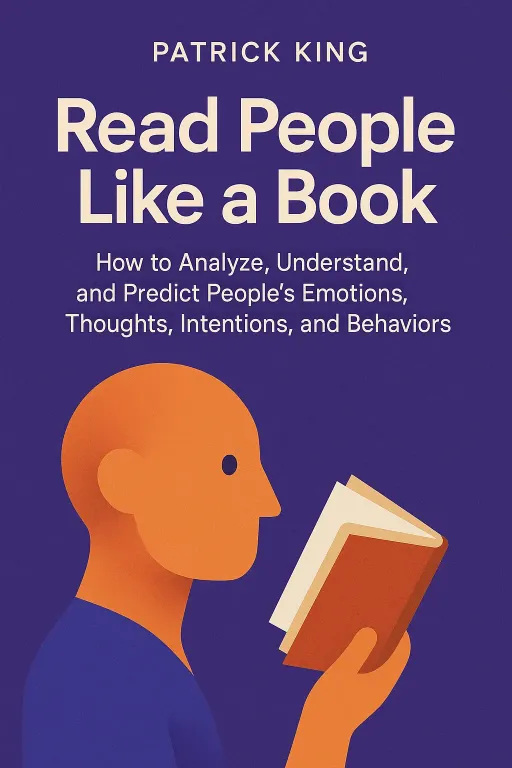
Nova: Perhaps a co-author! Today, we're diving into the fascinating, often contradictory, world of understanding human behavior, drawing insights from two incredibly powerful, yet distinct, perspectives. On one hand, we have Patrick King's highly popular and practical guide, "Read People Like a Book," a go-to for anyone looking to sharpen their observational skills and interpret those subtle cues we pick up in daily interactions. King's work is widely praised for its actionable techniques, offering immediate tools to gauge intentions and personality.
Atlas: And then, on the other hand, we have the academic heavyweight, "The Person and the Situation," by Lee Ross and Richard E. Nisbett. This isn't your weekend read for quick tips; it's a foundational classic in social psychology, acclaimed for its rigorous research and its profound, often unsettling, challenge to how we fundamentally understand why people do what they do.
Nova: Exactly. King gives us the microscope for individual behavior, while Ross and Nisbett hand us the wide-angle lens for environmental influence. And the core of our podcast today is really an exploration of the intricate dance between who we are as individuals and the powerful environments that shape our every move.
Atlas: So, we're going from decoding the individual to understanding the invisible forces around them. That sounds like a journey to mental clarity right there.
Decoding the Individual: The Observable Cues
SECTION
Nova: It absolutely is. Let's start with Patrick King, because his approach often resonates immediately with people who want to improve their social intelligence. King is all about active observation. He’s essentially saying, "Look closer. Listen better. People are constantly broadcasting information, often without saying a word."
Atlas: So, it's about becoming a human lie detector, or at least a better interpreter of the silent signals. But what are we actually looking for? What's one simple thing people often miss?
Nova: Well, King emphasizes clusters of cues, not just isolated gestures. But a powerful starting point is the mismatch. Think about someone saying "yes" verbally, but their shoulders are hunched, their eyes are darting, or their hands are fidgeting under the table. Their body language screams "no," even if their voice says "yes."
Atlas: I can totally picture that! Like when someone says, "Oh, I'm fine," but their jaw is clenched, and they're staring intensely at a spot on the wall. The words are one thing, the whole rest of them is another.
Nova: Precisely. King breaks down these nonverbal cues into categories: body language, obviously, but also vocal nuances—the tone, pace, volume of their speech. Even behavioral patterns, like how someone interacts with space or who they gravitate towards in a group. He provides practical frameworks, almost like a checklist, to help you quickly gauge intentions and personality traits. Is someone genuinely enthusiastic, or just trying to be polite? Are they confident, or putting on a front?
Atlas: That makes sense. We’re often picking up on these things subconsciously anyway, but King is giving us a conscious framework. That could be incredibly useful in a negotiation, or even just understanding a friend who's struggling but won't say it outright.
Nova: Absolutely. He's making the implicit explicit. He's saying, if you learn to pay attention, you can pick up on signs of discomfort, interest, deceit, or genuine connection that are far more reliable than just the spoken word. It's about getting more data points to form a more accurate picture of an individual's internal state.
Atlas: That’s a great way to put it: getting more data points. But I’ve been thinking, Nova, isn't there a danger in over-interpreting? Like, if I see someone cross their arms, I immediately assume they're closed off or defensive, when maybe they're just cold. It feels like a slippery slope to mind-reading.
Nova: That's a crucial point, and King himself would agree. It's not about becoming a psychic. It's about and, not divining absolute truths. The goal is better information, not absolute certainty. It's a skill that requires practice and calibration, and always, considering context. Because, as powerful as these individual cues are, they are only one piece of a much larger, more complex puzzle.
The Unseen Hand: How Situations Shape Us
SECTION
Nova: And that calibration, Atlas, is crucial because while we're busy observing those subtle individual cues, there's a powerful, often invisible force at play that King's book doesn't fully delve into. And that brings us to the profound and often counter-intuitive insights of Ross and Nisbett in "The Person and the Situation."
Atlas: Okay, so if King is about what we see, Ross and Nisbett are about what we don't?
Nova: Precisely. Their central argument is a huge challenge to common sense: they argue that situational factors often exert a more powerful influence on our behavior than individual dispositions. We tend to believe people act the way they do because of who they —their personality, their character, their intentions. But Ross and Nisbett present compelling evidence that often, it's the that's dictating the show.
Atlas: Whoa. That sounds like a radical claim. Are you saying our personality doesn't matter? That's a huge claim! Like, if someone cuts me off in traffic, I'm supposed to think about their bad day, not that they're just a jerk? My immediate reaction is always to attribute it to their character.
Nova: And that, my friend, is exactly what Ross and Nisbett call the "Fundamental Attribution Error." It's our pervasive tendency to overemphasize personality traits and underestimate the power of external circumstances when explaining other people's behavior. We attribute their actions to their inherent character, rather than the subtle environmental pressures or constraints they might be facing.
Atlas: Okay, so basically, we blame the person, not the system or the circumstances. That feels incredibly common. Can you give me an example that really hammers this home?
Nova: Absolutely. One of the most famous illustrations comes from the "Good Samaritan" experiment. This was a study where seminary students—people studying to become priests—were asked to prepare a sermon on the parable of the Good Samaritan. They were then told to go to another building to deliver it.
Atlas: Okay, so they're literally thinking about helping people.
Nova: Exactly. But here's the twist: on their way to the other building, they encountered a confederate slumped in a doorway, coughing and groaning, clearly in distress. The researchers varied one crucial situational factor: how much of a hurry the students were in. Some were told they had plenty of time, others were told they were slightly late, and a third group was told they were late.
Atlas: I can already guess where this is going. The ones in a huge hurry just walked by.
Nova: That's right. The percentage of students who stopped to help dropped dramatically as their perceived urgency increased. In the "very late" condition, only about 10% stopped, even though they were literally on their way to preach about the importance of being a Good Samaritan! The situation—the pressure of being in a hurry—overrode their personal values and their very purpose.
Atlas: Whoa. That's a total paradigm shift. It means that person cutting me off might not be inherently aggressive, but maybe they just got a frantic call from a daycare, or they're late for a critical meeting. Their "jerk" behavior is actually a function of an extreme situational pressure.
Nova: Exactly. It challenges our inherent bias to label people based on single actions. It illuminates how often we misunderstand why people do what they do, simply because we're not adequately factoring in the unseen hand of their environment. It makes you realize how many times we've probably misjudged someone.
Synthesis & Takeaways
SECTION
Nova: So, Atlas, we have Patrick King telling us to keenly observe the individual's every twitch and tone, and then we have Ross and Nisbett showing us that those observations might be completely misleading if we ignore the powerful situational forces at play. How do we hold both these powerful truths without getting whiplash?
Atlas: That's the deep question, isn't it? It’s not about choosing one over the other. It’s about seeing the whole picture, about integrating these two seemingly contradictory ideas into a more nuanced understanding.
Nova: And that's where the real magic happens. The goal isn't to become a cynic who believes personality doesn't exist, nor is it to be naive and only see character. The goal is to cultivate what we might call "situational empathy" alongside "observational acuity."
Atlas: Situational empathy. I like that. So, it's about using King's tools for observation, but then consciously applying Ross and Nisbett's lens for interpretation?
Nova: Precisely. When you observe a behavior—say, a colleague being unusually quiet and withdrawn in a meeting—instead of immediately attributing it to their "introverted personality" or "disinterest", you consciously pause. You ask: "What situation might be influencing this behavior right now?"
Atlas: Okay, so instead of "They're always so quiet," it's "Is something happening in this meeting, or in their day, that's making them quiet?" That's a huge difference.
Nova: It is. Maybe they just had a difficult conversation before the meeting, or they're feeling unwell, or the meeting dynamic itself is stifling. By consciously asking that question, you move beyond the Fundamental Attribution Error. You gain a more accurate, and often more empathetic, understanding.
Atlas: So, for forming truly accurate judgments, we look for patterns of behavior diverse situations to understand individual traits, but we always acknowledge the immense power of situational factors a specific moment. It’s about being a detective, not a judge.
Nova: Exactly! It leads to less frustration, more effective communication, and much deeper, more authentic relationships. It's the difference between dismissing someone as "difficult" and understanding the pressures that might be making them difficult.
Atlas: That's actually really inspiring. It means we have more control over our reactions and understanding than we think, and it gives us a pathway to being much more compassionate in our daily lives.
Nova: It absolutely does. So, here’s a concrete challenge for our listeners: next time you find yourself making a snap judgment about someone's character based on a single action, pause. Take a deep breath. First, quickly assess the non-verbal cues. Then, consciously ask yourself: what situational factors might be at play here that I'm not seeing? It’s a small mental step, but it builds a stronger inner compass for navigating the complexities of human interaction.
Atlas: That’s a profound way to look at it. It turns everyday interactions into opportunities for growth.
Nova: It truly does.
Outro
SECTION
Nova: Thank you for joining us on this journey into the fascinating world of human behavior.
Atlas: We hope this discussion sparks some critical thinking and helps you build a stronger inner compass for understanding yourself and others.
Nova: We love hearing from you, so share your thoughts on this episode and how you navigate the complexities of individual traits versus situational influence.
Atlas: This is Aibrary. Congratulations on your growth!