

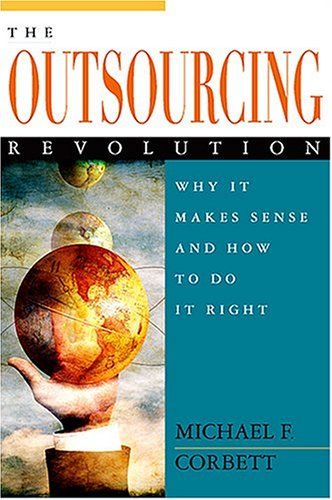
The outsourcing revolution
The Great Unbundling: Introducing The Outsourcing Revolution
The Great Unbundling: Introducing The Outsourcing Revolution
Nova: Welcome back to the show! Today, we are diving deep into a concept that has fundamentally reshaped the global economy, yet remains deeply controversial: outsourcing. We’re talking about the seminal 2004 book, The Outsourcing Revolution by Michael F. Corbett.
Nova: : Wait, 2004? That feels ancient in tech years. Why are we looking at a book from nearly two decades ago? Isn't outsourcing just about sending call centers overseas now?
Nova: That’s the perfect entry point! Because Corbett wasn't just writing about sending jobs abroad. He was writing about a fundamental, structural reorganization of the corporation itself. He called it a revolution, not just a trend. He argued that companies would soon be more 'outsourced' than 'in-sourced.'
Nova: : More outsourced than in-sourced? That’s a bold claim. It sounds like he was predicting a complete dismantling of the traditional, vertically integrated company structure.
Nova: Exactly. Corbett, who is recognized as a pioneer in Business Process Outsourcing or BPO, laid out the blueprint for this shift. He saw it as a management tool to transform the organization away from being self-sufficient behemoths into agile, focused entities.
Nova: : So, this book isn't just a 'how-to' guide for cutting payroll; it’s a strategic manifesto. What was the immediate reaction to this idea back then?
Nova: Well, the research shows it was highly controversial, often blamed for job losses. But Corbett’s genius, according to experts who reviewed it, was that he provided a 'penetrating analysis of outsourcing's true payoffs' while also offering a 'comprehensive framework for decision making.' He gave the strategy legitimacy.
Nova: : I’m intrigued. It sounds like he was trying to separate the fear-mongering from the actual business logic. Let’s unpack that logic. What was the first major shift he identified that made this a 'revolution' rather than just a cost-cutting measure?
Nova: Let's jump right into the core concept. We’ll call our first chapter 'The Paradigm Shift: From Self-Sufficiency to Strategic Focus.' Get ready, because this is where the conversation gets strategic.
Key Insight 1: Redefining the Corporation
The Paradigm Shift: From Self-Sufficiency to Strategic Focus
Nova: Corbett’s primary argument is that the old model—the vertically integrated company that tried to do everything internally—was becoming obsolete. He saw outsourcing as the necessary evolution.
Nova: : It’s like a master chef deciding they don't need to grow their own wheat or raise their own cattle anymore. They just need to focus on the final, unique dish.
Nova: That’s a fantastic analogy! He wanted companies to focus on their core competencies—the unique value they bring to the market. Everything else—the non-core, but necessary, functions—should be handed off to specialists.
Nova: : But how do you define 'core'? For a software company, is coding the core? Or is it the unique algorithm they developed? It seems like a blurry line.
Nova: That’s where the framework comes in. Corbett stresses that the decision isn't arbitrary. It requires rigorous analysis to determine what truly differentiates you. If your internal accounting department is just as good as the best external provider, maybe you keep it. But if an external provider can offer world-class IT infrastructure at half the cost and higher reliability, that’s a clear signal.
Nova: : So, the goal isn't just to get rid of tasks, but to upgrade the entire operational baseline by leveraging external excellence. Did he give examples of functions that were prime candidates for this initial shift?
Nova: Absolutely. Think about back-office functions—payroll, HR administration, maybe even certain aspects of IT maintenance. These are essential, but they rarely provide a competitive edge. He noted that outsourcing these functions allows internal resources—talent and capital—to be redirected toward innovation and market growth.
Nova: : I remember reading that John Sculley, the former CEO of Apple Computer, endorsed the book, calling it a 'clear and compelling' read. That kind of endorsement suggests this wasn't just academic theory; it was boardroom-ready strategy.
Nova: It was. And the impact was immediate in certain sectors. By framing it as a strategic tool for the 21st-century global economy, he elevated the conversation above simple labor arbitrage. He was saying, 'This is how you structure for global competition.'
Nova: : It sounds like the biggest hurdle wasn't the execution, but overcoming the organizational inertia—the fear of letting go of control over those internal functions.
Nova: Precisely. That fear is what he spent a lot of time refuting. He argued that true control comes not from micromanaging every process, but from establishing robust governance and clear service level agreements with world-class partners. It’s a shift from operational control to strategic oversight.
Nova: : So, the first revolution was realizing that being big and self-contained was a liability, not a strength. Let's move on to the 'why' behind the 'what.' What were the evolving motivations he identified beyond the obvious cost savings?
Key Insight 2: Expertise, Focus, and Agility
Beyond the Bottom Line: The Strategic Drivers of Outsourcing
Nova: We know cost reduction was the initial driver, but the research confirms Corbett quickly moved past that. He identified that organizations were outsourcing to gain access to specialized knowledge they couldn't afford to build internally.
Nova: : That makes sense. Why hire a full team of cybersecurity experts when you can subscribe to a top-tier security firm’s entire capability for a fraction of the cost?
Nova: Exactly. One summary noted that while cost savings were a major factor, gaining 'outside expertise' was consistently ranked as a top reason, often cited by 70 percent of companies in the studies he referenced.
Nova: : So, it’s about buying capability, not just cutting expense. But what about agility? In today’s fast-moving market, speed to market is everything.
Nova: Agility is huge. By outsourcing non-core functions, a company can scale up or down much faster than if they had to hire, train, or lay off internal staff for every fluctuation in demand. It turns fixed costs into variable costs, which is a massive advantage in volatile markets.
Nova: : That’s a key takeaway for our listeners running smaller or mid-sized operations. It democratizes access to world-class operational support.
Nova: It does. And Corbett emphasized that this focus on core competencies leads to better service overall. When a vendor’s entire business model is built around providing excellent payroll processing, they are inherently more motivated to innovate in that specific area than an internal department whose main focus is just keeping the lights on.
Nova: : But this is where the controversy often flares up. If the goal is better service and focus, why does the public perception remain so negative, often centered on job losses?
Nova: Corbett directly addressed this. He acknowledged the controversy, noting that outsourcing 'tends to get blamed whenever jobs move from one country to another.' However, his counter-argument was that the jobs being outsourced were often those that were inefficient or non-strategic anyway. The revolution, in his view, was about creating higher-value jobs internally by shedding low-value ones.
Nova: : So, the trade-off is: lose some operational jobs, but gain strategic jobs focused on innovation and managing the outsourcing relationships themselves.
Nova: Precisely. He was advocating for a strategic reallocation of human capital. It’s not about eliminating work; it’s about concentrating human effort where it generates the most unique value for the enterprise.
Nova: : It sounds like the book forces leaders to ask a very uncomfortable question: If we stopped doing this function tomorrow, would our customers notice, or would our competitors gain an advantage?
Nova: If the answer is no to both, it’s a prime candidate for the next chapter: the framework for execution. Because simply deciding to outsource isn't enough; doing it wrong can be catastrophic.
Key Insight 3: Governance and Partnership
The Framework: How to Do It Right
Nova: This is where Corbett moves from the 'Why' to the 'How.' He provides a comprehensive framework, complete with case studies, detailing how companies successfully planned, implemented, and managed these massive shifts.
Nova: : If the goal is partnership, what’s the biggest mistake companies make when setting up these agreements?
Nova: The biggest mistake, according to the analysis of his work, is treating the vendor like a cheap vendor instead of a strategic partner. If you only focus on the initial contract price, you miss out on the long-term value.
Nova: : That’s the classic short-term thinking trap. You negotiate the lowest hourly rate, but then you spend all your internal management time fixing their mistakes.
Nova: Exactly. Corbett champions strong governance. This means establishing clear, measurable Service Level Agreements—SLAs—that align the vendor’s success directly with the client’s strategic goals. It’s about shared outcomes, not just task completion.
Nova: : Are we talking about things like 'gain-sharing' agreements, where if the vendor finds a way to make the process 10% more efficient, they both share in the savings?
Nova: That’s the spirit of it! It moves the relationship from transactional to collaborative. The book details how to structure these relationships so the vendor is incentivized to bring forward new ideas and improvements, not just maintain the status quo.
Nova: : What about the cultural integration? Outsourcing often involves transferring internal teams or processes. How did Corbett suggest managing the human element on the client side?
Nova: He stressed the need for dedicated transition teams and clear communication to manage internal anxiety. Furthermore, the client organization needs to develop new internal skills—the ability to manage complex contracts, monitor performance metrics, and foster the vendor relationship. The skill set shifts from doing the work to managing the relationship.
Nova: : So, the internal team doesn't shrink to nothing; it evolves into a high-level relationship management and governance corps. That’s a much more sustainable model than just cutting staff and hoping for the best.
Nova: It is. And the case studies he included were crucial because they showed the practical application—how specific companies navigated vendor selection, contract negotiation, and post-implementation monitoring. It provided tangible proof that this complex strategy could yield significant competitive advantages when executed correctly.
Nova: : It sounds like the framework is essentially a risk mitigation strategy wrapped around a value-creation opportunity. If you follow the steps, you avoid the pitfalls that give outsourcing its bad name.
Key Insight 4: Outsourcing in the Age of AI
The Revolution Continues: From BPO to Digital Co-Sourcing
Nova: Now we have to bridge the gap. Corbett wrote this in 2004. Today, we hear terms like 'digital transformation,' 'automation,' and 'AI adoption' dominating the conversation. How does his framework hold up?
Nova: : I suspect the core principles of strategic focus and governance still apply, but the has changed dramatically. We aren't just outsourcing manual data entry anymore, are we?
Nova: Not at all. The research shows that modern outsourcing is deeply intertwined with technology. Today's trend isn't just outsourcing processes; it's outsourcing the of advanced digital tools like AI and automation.
Nova: : So, instead of outsourcing a team to process invoices, you outsource a vendor who will implement Robotic Process Automation—RPA—to handle those invoices, and they manage the bots for you?
Nova: Precisely. We’re seeing a shift toward what some analysts call 'co-sourcing' or 'smart sourcing.' The vendor isn't just doing the work; they are bringing the technology and the expertise to fundamentally redesign the work itself.
Nova: : That sounds like the ultimate realization of Corbett’s vision—leveraging external expertise to achieve a level of operational excellence that would be impossible to build internally due to the sheer pace of technological change.
Nova: It is. The pressure to adopt AI and cloud infrastructure is immense. For many companies, the fastest, most reliable way to integrate these complex systems is through specialized outsourcing partners. The focus shifts from 'Can we do this?' to 'Who can do this best, right now?'
Nova: : And this also addresses the job loss controversy from a new angle. If the vendor is implementing automation, they are replacing manual labor with technology, which is a global trend, not just an outsourcing one.
Nova: That’s a crucial distinction. The outsourcing revolution paved the way for the digital revolution by proving that external partnerships are viable. The current wave is about leveraging those established partnership channels to deploy cutting-edge tech.
Nova: : So, if a company today is looking at a major digital overhaul, Corbett’s book, even though it’s older, still provides the essential strategic checklist for vendor selection and governance, right?
Nova: Absolutely. The technology changes, but the principles of defining your core, establishing clear metrics, and building a true partnership—those are timeless. He gave us the foundational language for these complex global relationships.
Conclusion: The Enduring Legacy of Strategic Unbundling
Conclusion: The Enduring Legacy of Strategic Unbundling
Nova: We’ve covered a lot of ground today, moving from the controversial beginnings of BPO in the early 2000s to the AI-driven partnerships of today. What’s the ultimate takeaway from Michael Corbett’s The Outsourcing Revolution?
Nova: : The biggest lesson for me is that outsourcing, when done correctly, isn't about shrinking the company; it’s about sharpening its focus. It’s a strategic choice to concentrate resources where you create unique value, while leveraging the best-in-class capabilities everywhere else.
Nova: I agree. Corbett successfully reframed the debate. It’s not about 'us versus them'; it’s about optimizing the entire value chain. The book’s enduring power lies in its insistence on governance and partnership over mere cost reduction.
Nova: : For any leader feeling overwhelmed by the complexity of modern business—whether it's managing global supply chains or integrating new AI tools—Corbett’s message is clear: Don't try to do everything yourself. Identify your unique contribution and partner brilliantly for everything else.
Nova: That strategic discipline is what separates the market leaders from the legacy players. The revolution he described is now just standard operating procedure, but only for those who followed the right framework.
Nova: : It’s a powerful reminder that true innovation often comes from knowing what to let go of. Thanks for guiding us through this foundational text, Nova.
Nova: My pleasure. The journey to operational excellence is continuous, and understanding the strategic roots of outsourcing is key to navigating the next decade of digital transformation. This is Aibrary. Congratulations on your growth!