The Architecture of Wealth and Power
Golden Hook & Introduction
SECTION
Nova: If you look closely at a hundred-dollar bill, you are holding nothing but a piece of cotton-blend paper with some ink on it. It has no intrinsic utility. You cannot eat it, you cannot build a house with it, and it will not keep you warm in the winter. Yet, we trade our most valuable time and effort for it.
Atlas: That is the most frustrating part of economics. We all agree to act like it has value, but the moment that collective agreement fractures, that paper becomes confetti. It is the ultimate magic trick, isn't it?
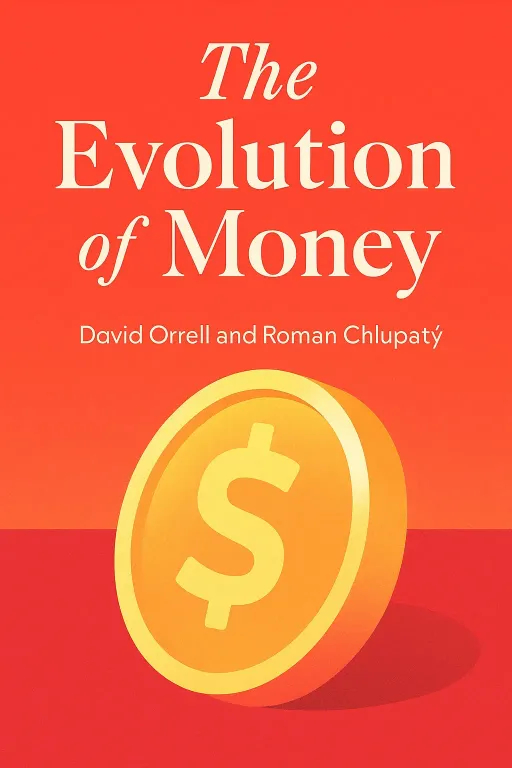
Nova: Exactly. It is a magic trick that relies entirely on a shared delusion. Today, we are exploring the architecture behind that magic. We are looking at two seminal works that explain why this system works, and more importantly, why it sometimes collapses. We are diving into The Evolution of Money by David Orrell and Roman Chlupatý, and The Origins of Political Order by Francis Fukuyama.
Atlas: These are heavy hitters. Orrell and Chlupatý essentially deconstruct money, stripping it of its mystical status, while Fukuyama does the same for the state itself. When you put them together, you get this masterclass on the invisible structures that allow our businesses and lives to actually function.
Nova: That is the goal. We want to understand the framework of wealth and power so that you, as a strategic architect, can build something that actually lasts.
Money as a Social Technology
SECTION
Atlas: I want to start with that idea of money as a social technology. We have this tendency to think of money as physics—like gold is heavy, therefore it is valuable. Or crypto is scarce, therefore it is valuable. But Orrell and Chlupatý argue that is completely backwards. What do they mean by that?
Nova: They argue that money is not a physical object, but a record-keeping system. Think back to ancient Mesopotamia. They were not trading gold coins; they were using clay tablets to track debts and credits. The money was the ledger, not the item. It is a record of trust between two parties.
Atlas: That feels like a massive shift in perspective. If money is just a ledger, then the most important part of the economy is not the currency itself, but the reliability of the ledger.
Nova: Precisely. If I trust that you will honor your debt, I will accept your promise as payment. That is the birth of credit. The physical token—the coin, the paper, the digital bit—is just a placeholder for that underlying relationship. When you view money through this lens, you realize that it is a technology for scaling trust. In a small village, I know you, so I trust your promise. In a global economy, I do not know you, so I need a third-party ledger—a bank, a government, a blockchain—to guarantee that promise.
Atlas: I am curious about the implications of that for a modern business. If money is just a manifestation of trust, then whenever a company or a system experiences a crisis, it is not actually a financial crisis. It is a trust crisis.
Nova: You have hit the nail on the head. That is exactly what happens during market crashes. It is not that the factories stopped working or the goods vanished. It is that the participants stopped believing in the ledger. They stopped believing that the promises made by the other side would be honored.
Atlas: That makes the, quote-unquote, financial system sound incredibly fragile. If the entire foundation is just our collective agreement, what happens when that agreement is tested?
Nova: That is where the second half of our discussion comes in. Because if money is the ledger of trust, then you need an institution strong enough to enforce that trust. And that brings us directly to Francis Fukuyama.
The Political Triad of Power
SECTION
Atlas: I have always admired Fukuyama’s ability to take the chaos of history and turn it into a clean, structural model. He talks about this triad, right? The state, the rule of law, and accountable government.
Nova: Yes, and it is a delicate balance. To build a stable society—or even a stable market environment—you need all three. First, you need a strong state. That is the capacity of a government to actually get things done. If you want to build a road, enforce a contract, or protect property rights, you need a state with the power to act.
Atlas: That makes sense. A weak state is essentially anarchy. But then you have the second leg, the rule of law.
Nova: Correct. The rule of law means that the state itself is subject to the law. It is not just the citizens who have to obey; the leaders and the institutions have to play by the same rules as everyone else. If the state has power but ignores the law, you just have a tyranny.
Atlas: And the third leg, accountable government, is what prevents the tyranny. That is the mechanism for the people to say, wait, this is not what we agreed to.
Nova: Exactly. Accountable government ensures that the state’s interests align with the interests of the society. When you have all three—a state that is strong, a law that is supreme, and a government that is accountable—you create an environment where long-term investment is possible. You create trust.
Atlas: That is a perfect bridge. If money is the ledger of trust, then the institutional triad is the protector of that ledger. If you are a business leader, you are not just operating in a market; you are operating within a political container. If that container cracks, your ledger becomes worthless.
Nova: I love that image. The political container. Think about it. If you are running a high-stakes venture, you are making bets on the future. You are betting that the currency will exist, that the contracts will be honored, and that the laws will not change overnight. You are betting on the stability of that container.
Atlas: But here is the problem. I look at the news, and I see institutions that seem to be decaying. We see governments that are not accountable, or states that are paralyzed by gridlock. If the container is cracking, does that mean the money is doomed?
Nova: Not necessarily doomed, but it means the nature of the game changes. Institutional decay is a slow process. It starts when the balance between the three elements of the triad is disrupted. Maybe the state becomes too powerful and starts ignoring the law. Or maybe the government stops being accountable and starts serving only a narrow elite. When that happens, the trust system starts to fray.
Atlas: That reminds me of the concept of rent-seeking. When the institutions are not functioning, the most profitable way to make money is not by creating value, but by capturing the institution.
Nova: That is a brilliant observation. When the rules of the game become unstable, the smart money stops building things and starts lobbying. They stop innovating and start insuring themselves against political risk. That is the definition of institutional decay. It is a shift from creative production to defensive extraction.
The Collision of Wealth and Power
SECTION
Atlas: Let’s get practical for our listeners. If I am leading an organization, I am not a politician. I cannot fix the rule of law. So how do I build resilience against this decay?
Nova: You start by recognizing that your business model is not separate from the political landscape. You have to perform a risk assessment on the institutions you rely on. Ask yourself: Is my business model dependent on a specific political favor? Is it dependent on a state that might not be able to function in five years?
Atlas: That is a uncomfortable question. Most leaders want to believe they are masters of their own destiny. They want to think that if they work hard and innovate, they will win. But you are saying that if the surrounding container is rotting, the hard work might not matter.
Nova: It is the difference between a sailor and the ocean. You can be the best sailor in the world, but if the ocean is turning into a hurricane, you have to change your navigation. You cannot just row harder. You have to build a more resilient vessel.
Atlas: So, how do we build that vessel? If I’m a strategic architect, I’m thinking about diversification and autonomy.
Nova: Diversification is part of it. But it is also about understanding the depth of your dependencies. A lot of companies today are built on top of digital infrastructures that are essentially public goods—the internet, payment rails, cloud services. Those are modern institutions. If those institutions are weak, or if they are subject to political whims, your business is inherently fragile.
Atlas: That makes me think about the shift toward decentralization. People are looking at things like blockchain not just because of the technology, but because they are looking for a ledger that exists outside of a potentially decaying political container.
Nova: That is the perfect connection back to Orrell and Chlupatý. They talk about how money evolves to solve trust problems. When the old institutions of trust—the central banks, the governments—start to lose their credibility, the market innovates new technologies of trust. That is not just a technological trend; it is a defensive reaction to institutional decay.
Atlas: It is like the market is trying to build a new container because the old one is leaking.
Nova: Exactly. And for a business leader, the takeaway is not to panic, but to be aware of where your trust is anchored. Are you anchoring your trust in a stable, multi-generational institution? Or are you anchoring it in a system that is currently being tested by political volatility?
Atlas: I can see how this changes the way you look at long-term planning. Instead of just doing a five-year financial projection, you need to do a five-year institutional stability projection.
Nova: That is a high-level way to put it. Ask yourself: Are the political structures that support my industry strengthening, or are they weakening? If they are weakening, how can I reduce my reliance on them?
Atlas: That is the definition of systemic resilience. It is not just about having cash in the bank; it is about having a business model that can survive if the rules of the game change.
Synthesis & Takeaways
SECTION
Nova: We have covered a lot of ground today. We started with the idea that money is not a physical commodity, but a social technology of trust. It is the ledger of our collective promises.
Atlas: And then we layered on the political reality. That trust ledger requires a sturdy container—a state that works, laws that apply to everyone, and a government that answers to the people. When that container decays, the ledger becomes unreliable, and the game changes.
Nova: The ultimate insight here is that wealth and power are inseparable. You cannot have a flourishing economy without a flourishing political order. And as a leader, your job is not just to optimize your internal processes, but to understand the external ecosystem you are part of.
Atlas: I think about the listener who is feeling the pressure of this. Maybe they are running a business in a volatile market, or they are just trying to understand why everything feels so unstable right now. The takeaway is that this is not just about them. This is a structural reality.
Nova: It is. And the most powerful thing you can do is to stop pretending the institutions are permanent. They are living, breathing, and sometimes dying systems. If you want to build something that lasts, you have to build it with the assumption that the environment will change.
Atlas: That is a sobering thought, but it is also empowering. Because once you accept that the ground can shift, you stop building on sand. You start looking for the bedrock.
Nova: And the bedrock is always the same: strong, accountable, and transparent relationships. Whether that is between a government and its people, or between a company and its customers. Trust is the only currency that never devalues.
Atlas: That is a great place to land. It makes me want to go back and re-evaluate every contract and every partnership I have, just to see where the trust is actually coming from.
Nova: That is exactly the kind of strategic thinking that leads to mastery. We hope this episode gave you a new lens to view the structures around you.
Atlas: This has been a fantastic conversation. It really clarifies why these big, abstract concepts are so vital for the day-to-day work we do.
Nova: We are glad you joined us for this deep dive. Take this perspective into your next project and see if it changes the way you build your foundations.
Atlas: We will see you in the next one. This is Aibrary. Congratulations on your growth!