Decoding the Rise and Fall of Human Societies
Golden Hook & Introduction
SECTION
Nova: Most of us walk around with a silent, dangerous assumption that the world is on a one-way street toward improvement. We assume that because we have better technology, better medicine, and more information than our ancestors, our systems—our companies, our governments, our own professional habits—are naturally getting better, too.
Atlas: That is the ultimate trap, isn't it? We act like progress is a self-driving car. We just sit back, buckle up, and assume we are heading toward a more efficient destination. But the reality is that systems are not static. They do not just sit there and get better. They are constantly fighting a war against their own weight.
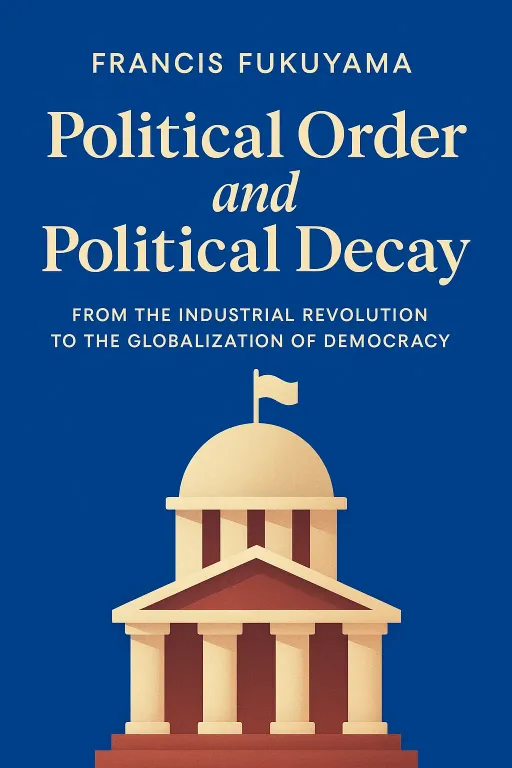
Nova: Exactly. And that is the central tension in the work of Francis Fukuyama. Today, we are diving into his massive, sweeping analysis of human history, specifically his two-part masterpiece, The Origins of Political Order and Political Order and Political Decay. Fukuyama is this towering figure in political science, someone who spent years tracing the arc of human organization from pre-human primate groups all the way to the French Revolution and beyond. He is not just looking at laws; he is looking at the biological and social machinery that allows a group of people to function together without tearing each other apart.
Atlas: I love that you brought up the idea of machinery. Because when you look at his work, it feels less like a dusty history book and more like a manual on why things break. He is essentially asking, why do some societies thrive for centuries while others crumble under the weight of their own bureaucracy? And honestly, that question is just as relevant for a team of ten people as it is for a nation of millions.
Nova: That is the perfect bridge. Because whether you are running a household, a startup, or a government, the fundamental mechanics of order and decay remain the same.
The Three Pillars of Stability
SECTION
Atlas: Okay, let’s get into the mechanics. If we are looking at this like a structure, what is the foundation? Fukuyama talks about these three pillars that hold everything up. But for anyone listening who isn't a political science major, how do we visualize that?
Nova: Think of it as a three-legged stool. If you want a stable, functional society, you need three specific components working in harmony. First, you need a strong state—the capacity to make decisions and actually enforce them. Second, you need the rule of law—the idea that the state itself is bound by rules that it cannot just ignore when it feels like it. And third, you need democratic accountability—a feedback loop that ensures the people in charge are actually serving the people they govern.
Atlas: That sounds straightforward, but I imagine the friction comes when you try to balance them. It feels like if you lean too hard on one, the others collapse.
Nova: You hit the nail on the head. That is the genius of his argument. If you have a strong state but no rule of law, you have a dictatorship. You have efficiency, but it is the efficiency of a hammer. It crushes everything in its path. On the flip side, if you have rule of law and accountability but no state capacity—meaning no ability to actually get things done—you have a gridlocked system. It is all talk and no walk.
Atlas: I see this in corporate environments all the time. You have a company with great culture and plenty of meetings to discuss accountability, but they cannot ship a product to save their lives because the state capacity—the operational power—is weak. They have the law and the feedback, but they cannot execute.
Nova: Precisely. And that is where Fukuyama’s historical analysis becomes so vivid. He traces how different societies stumbled into this balance. He points to how England, for instance, developed these pillars in a very specific, messy, and violent sequence. It was not a grand plan. It was a centuries-long tug-of-war between the king, the church, and the local elites. They had to fight to force the king to accept the rule of law.
Atlas: It sounds like the stability we enjoy today is actually a byproduct of constant, unresolved tension.
Nova: That is a profound way to put it. Stability is not the absence of tension; it is the presence of a system that manages that tension productively. The state has enough power to act, but the law holds it back from overreaching, and the citizens hold it accountable for results. When those three legs are equal, the stool stands. When one leg grows too long or too short, the whole thing tips over.
The Entropy of Institutions
SECTION
Atlas: Okay, so we have built our stable stool. We have our three-legged system. But your second point was about decay. And this is the part that really scares me. If we build something great, why does it have to degrade? Why can’t we just keep the system we built?
Nova: Because of a phenomenon Fukuyama calls institutional capture. Think of it like barnacles on the hull of a ship. When a ship is new, it cuts through the water, fast and efficient. But as it sits in the harbor of success, barnacles start to attach themselves to the hull. These are interest groups, legacy processes, entrenched bureaucracies, and people who benefit from the status quo.
Atlas: And the barnacles do not see themselves as the problem. They see themselves as part of the ship.
Nova: Exactly. They argue that they are essential. They create rules to protect their own position, and over time, those rules become rigid. The ship, which was designed to move forward, becomes so heavy with these barnacles that it barely moves at all. It is still a ship, it still looks like a ship, but it has lost its ability to navigate.
Atlas: This is happening everywhere. In a business, you have a process that was created to solve a specific problem five years ago. That problem is gone, but the process remains because the department in charge of that process needs a reason to exist. They are the barnacles.
Nova: That is the definition of political decay. It is not necessarily that the leaders are evil or corrupt in a cartoonish way. It is that the system has developed a rigid internal logic that prioritizes its own survival over its original purpose. Fukuyama highlights that modern institutions are prone to this because they become so complex that the average person—or even the average manager—can no longer understand how to change them. They get trapped in a cage of their own making.
Atlas: So, the very systems we create to provide order eventually become the source of disorder because they stop adapting. They lose the feedback loop.
Nova: Yes. In the beginning, the institution was responsive. It was listening to the environment. But as it grows, it starts to insulate itself. It starts to prioritize internal politics over external results. The feedback loop that was supposed to provide accountability—that third leg of the stool—gets captured by the people inside the system. They start defining what success looks like in a way that protects them, rather than in a way that serves the mission.
Atlas: I am thinking about how this applies to the listener. If you are working in a large organization, you feel this. You see a rule that makes no sense, and you ask why it exists, and the answer is always, well, that is just how we do things here. That is the decay talking.
Nova: That is the sound of a system that has stopped evolving. Fukuyama’s warning is that if you do not have a mechanism for constant, painful self-correction—if you do not have a way to scrape off those barnacles—the system will eventually face a systemic collapse. It will either break under the weight, or it will become so irrelevant that a new, more agile system will replace it.
Synthesis & Takeaways
SECTION
Atlas: We have covered a lot of ground here, from the origins of the state to the inevitable creep of institutional barnacles. But I want to bring this home. If we are the architects of our own professional and personal networks, how do we prevent this decay? How do we build something that stays agile?
Nova: You have to cultivate a culture of what I would call productive instability. You have to be willing to question the rules that everyone else treats as laws of physics. Start by identifying one rigid rule in your current workflow—one process, one meeting, one policy—that feels like it exists just to protect the status quo rather than to produce value.
Atlas: I like that. It is a very actionable challenge. Identify the barnacle.
Nova: Exactly. Identify the barnacle, and then propose a flexible, feedback-driven alternative. Ask yourself: If we were building this from scratch today, would we still do it this way? If the answer is no, then you have found a point of decay.
Atlas: That is such a powerful question because it strips away the history. It does not matter how long we have been doing it this way. What matters is, does this serve the mission right now?
Nova: That is the essence of it. Fukuyama’s work is a reminder that order is not a destination. It is a practice. It is a constant, daily effort to keep the state strong, the laws fair, and the accountability real. When you stop practicing, the decay begins.
Atlas: It is a bit humbling, honestly. It means you never get to just set it and forget it. You are always the gardener, always weeding, always pruning. But that is also the only way to keep the garden alive.
Nova: It is the only way to stay relevant. We are all building something—our careers, our families, our impact. The goal is not to build a monument that stands forever. The goal is to build a system that is alive enough to change.
Atlas: I love that. Build a system that is alive enough to change. That is a great note to land on.
Nova: It is the difference between a tombstone and a living organism. If you want to avoid the decay, you have to be the one who asks the uncomfortable questions. You have to be the one who scrapes off the barnacles.
Atlas: I am definitely going to look at my own calendar and inbox differently after this conversation. There are definitely a few barnacles I need to address.
Nova: Well, we have done the work of tracing the arc of history, now it is up to our listeners to apply it to their next fifteen minutes.
Atlas: And that is a wrap on today’s dive into the rise and fall of systems. Thank you for joining us. This is Aibrary. Congratulations on your growth!