Architecting Resilient Systems in Times of Decay
Golden Hook & Introduction
SECTION
Nova: The moment you perfect a system, you have actually signed its death warrant.
Atlas: That sounds like a paradox, Nova. Most people spend their entire careers trying to build the perfect, frictionless system. You are telling me that perfection is a liability?
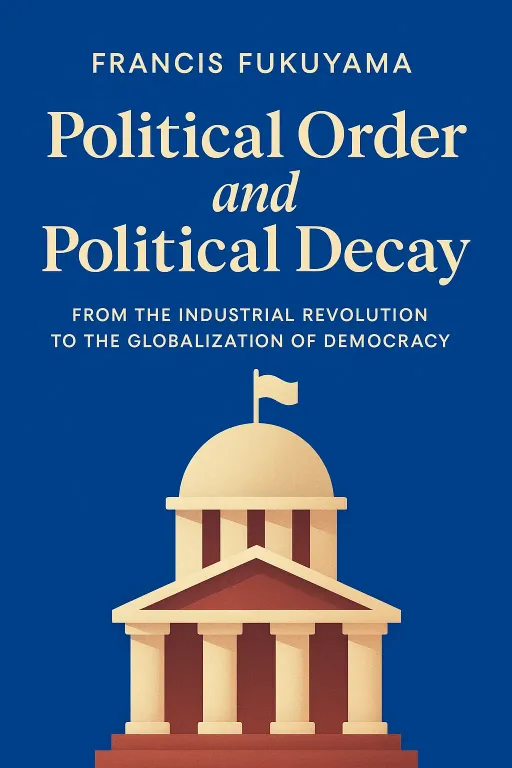
Nova: It is the ultimate liability. When a system reaches a state of perceived perfection, it stops evolving. It hardens. It becomes rigid. And in a world that is constantly shifting, rigidity is just a slower form of failure. Today, we are looking at the mechanics of why great organizations, governments, and even our own personal workflows eventually crumble. We are diving into the intellectual architecture of Francis Fukuyama. Specifically, his two-volume work, The Origins of Political Order and Political Order and Political Decay.
Atlas: Right, Fukuyama. He is usually associated with big, sweeping historical claims about the end of history and the rise of the state. But you are suggesting his work has a blueprint for how we should be building our own systems today?
Nova: Exactly. Fukuyama is fascinating because he traces the lifecycle of human institutions all the way back to tribal societies. He shows that the problems we face in modern corporations or even our daily routines are the same problems that caused empires to rise and fall. He was not just writing history; he was writing a manual on why things break. And if we understand why they break, we can build them to last.
Atlas: I am intrigued. I have always viewed history as a series of random events, but you are framing it as a design problem. Let us get into the architecture of this. Where does the decay actually start?
The Lifecycle of Decay and the Tribal Trap
SECTION
Nova: It starts with the tension between our biology and our ambition. Fukuyama argues that humans have a natural, almost evolutionary drive toward what he calls patrimonialism. In plain English, that is just nepotism. We are hardwired to favor our kin, our friends, and the people we know.
Atlas: That makes sense. It is the classic "hiring your cousin" scenario, or the "who you know" culture in a corporate office. It feels like the path of least resistance.
Nova: It is the path of least resistance, but it is the death of institutional efficiency. In the early stages of a tribe, this is actually a survival mechanism. You trust your family because you have to. But as a group grows, that same instinct becomes a poison. If you keep hiring based on relationships instead of competence, your organization stops being a meritocracy and starts being a social club.
Atlas: So, the decay begins not when things go wrong, but when the original, successful strategy—hiring people you trust—becomes the default setting for every decision, even when the environment has changed?
Nova: Precisely. That is the definition of intellectual rigidity. You are applying a "tribal" solution to a "state" problem. When Fukuyama talks about political decay, he is often talking about interest-group capture. This is when an organization stops serving its original purpose and starts serving the people who currently hold power within it.
Atlas: I see this everywhere. You look at a legacy company that has been around for fifty years, and you realize the processes are not there to serve the customer anymore. They are there to protect the middle managers who built those processes.
Nova: That is a perfect real-world example. It is the classic shift from "doing the work" to "protecting the silo." The system becomes a closed loop. The information that flows up to the decision-makers is filtered to keep the status quo intact. And because the system is closed, it cannot see the threats coming from the outside.
Atlas: It sounds like the system develops an immune system that rejects any new information, even if that information is the cure for its own obsolescence.
Nova: That is a brilliant way to put it. An immune system that rejects the cure. And that is why we see these massive, powerful institutions suddenly hit a wall. They have optimized for internal comfort rather than external relevance.
Atlas: So, if the drift toward this kind of decay is natural—if it is literally in our biological programming to favor our tribe and protect our turf—are we doomed? Is every system destined to rot from the inside out?
The Three Pillars of Stability
SECTION
Nova: We are not doomed, but we are at risk if we do not build counterweights. Fukuyama identifies three pillars that keep a system from falling into this trap. If you want a resilient system, you need all three: a strong state, the rule of law, and democratic accountability.
Atlas: Let us break those down. A "strong state" sounds like having a lot of power. But in a business or a personal workflow, what does that mean?
Nova: In this context, it means capacity. It means the ability to actually get things done. A weak state is one that has the rules but cannot enforce them. It is the manager who sets a goal but has no idea how to track progress. Capacity is the ability to execute on the vision.
Atlas: Okay, so you need the engine—the capacity to execute. What about the "rule of law"? That sounds like a constraint.
Nova: It is a constraint, but it is a liberating one. The rule of law means that the rules apply to everyone, including the people at the top. In a system without the rule of law, the leaders are above the rules. They can change the goalposts whenever they want. If you are building a system, the rule of law is your documentation. It is your standard operating procedure. It is the agreement that says, "This is how we operate, and we do not deviate just because it is convenient for the boss today."
Atlas: I love that. It is the difference between a system that relies on a "hero" to save the day and a system that runs on its own logic. If you rely on a hero, you are one bad day away from collapse. If you rely on the rule of law—or in our case, the protocol—you are resilient.
Nova: Exactly. And that brings us to the third pillar: democratic accountability.
Atlas: Which I assume means more than just voting once a year.
Nova: Far more. It means feedback loops. It means the people who are affected by the system have a way to influence it. In a government, it is voting. In a team, it is the ability for a junior member to say, "Hey, this process is broken," and actually be heard. It is the mechanism that forces the system to pay attention to reality instead of just its own internal narrative.
Atlas: This is starting to click. If you have capacity, but no accountability, you get a tyranny. You get a leader who is very good at doing the wrong thing. If you have accountability, but no capacity, you get a mess. You have a lot of opinions but nothing actually gets done. And if you have no rule of law, you just have chaos.
Nova: You have just mapped the failure modes of every organization I have ever worked with. Most organizations are either high-capacity but deaf to feedback, or they are very democratic but completely incapable of making a decision.
Atlas: It is a delicate balance. But how do we apply this? If I am an aspiring leader, or someone trying to optimize my own output, I cannot exactly rewrite the constitution of my company.
The Adaptation Checkpoint
SECTION
Nova: You do not need to rewrite the constitution. You need to implement the "Adaptation Checkpoint." This is the actionable takeaway from Fukuyama’s work. The core of his thesis is that decay happens when institutions fail to adapt to a changing environment. So, you build the adaptation into the schedule.
Atlas: Okay, I am listening. But be careful. If you just say "have more meetings," I am going to push back. We already have too many meetings.
Nova: It is not a meeting to discuss the work. It is a meeting to discuss the system. Every quarter, you step back and ask three questions, directly derived from those three pillars.
Atlas: I like the sound of this. What are the questions?
Nova: First: Do we still have the capacity to execute? Are our tools, our processes, and our energy levels actually serving the goal, or are they just artifacts of how we did things last year?
Atlas: That is a great reality check. We often keep using tools because we spent money on them, or because we are used to them, not because they are the best way to get the work done today.
Nova: Exactly. The second question: Does the rule of law still hold? Are we following the processes we set, or have we allowed "exceptions" to become the new rule? If everyone is bypassing the system, the system is dead. You either need to fix the system or change the rule, but you cannot let the rule become a suggestion.
Atlas: That is usually where the rot starts. The "exception" that everyone knows about but no one talks about.
Nova: And the third question: Is there real accountability? Is the feedback loop still open? If you are a leader, are you actually hearing the truth, or are people just telling you what you want to hear to keep the peace?
Atlas: That is the hardest one. Because nobody wants to tell the boss that the system is broken.
Nova: Which is why you have to institutionalize it. You have to make the "Adaptation Checkpoint" a sacred event. It is not about blame. It is about acknowledging that the environment has changed, and therefore, our systems must change too.
Atlas: I imagine this feels like a relief to a team. Instead of feeling like they are failing because they cannot work within a rigid, outdated system, they get to be the architects who update the system.
Nova: That is the shift from victimhood to agency. When you treat your organization or your personal workflow as a living thing that requires constant pruning and maintenance, you stop being afraid of change. You start looking for it.
Atlas: It is like gardening. You do not just plant the seeds and walk away. You have to weed, you have to water, you have to adjust for the weather. If you do not, the weeds take over. And in a business, those weeds are the interest-group capture we talked about earlier.
Nova: That is a perfect analogy. The interest groups are the weeds. They are the things that grow fastest and choke out the useful plants. The Adaptation Checkpoint is your time to get out into the garden and pull them up before they take over the whole plot.
Synthesis & Takeaways
SECTION
Atlas: This has been a massive shift in perspective for me. I started this thinking Fukuyama was just about grand, distant political history. But you have shown how his work is really about the fundamental struggle of any organized effort.
Nova: It is the struggle against entropy. Systems naturally drift toward decay. It is the default setting of the universe. To stay resilient, you have to actively push against that drift.
Atlas: So, the takeaway for anyone listening—whether they are leading a team of fifty or just trying to optimize their own professional life—is to stop assuming your systems are permanent.
Nova: Exactly. Treat your workflows as prototypes, not monuments. Every quarter, run your adaptation check. Ask: Do we have the capacity? Is the rule of law actually being followed? And is the feedback loop honest?
Atlas: I think I am going to start doing this on the first of every quarter. I will call it my "System Audit." It sounds much more professional than "Fixing the Mess."
Nova: It is a System Audit, but it is also an act of courage. It takes courage to admit that the way we did things yesterday might not be the way we should do them tomorrow. But that is the only way to build something that actually lasts.
Atlas: I love that. Resilience is not about strength. It is about the ability to change while keeping your core purpose intact.
Nova: That is the definition of a resilient system. It bends, it updates, it learns, but it never loses sight of why it exists in the first place.
Atlas: This has been a masterclass in institutional design. I feel like I have a much clearer roadmap for how to keep my own professional life from falling into that trap of rigidity.
Nova: I am glad to hear that. Remember, the goal is not to reach a state of perfection, because that is the beginning of the end. The goal is to reach a state of constant, intelligent evolution.
Atlas: Constant evolution. I can get behind that. Thank you for walking me through this, Nova.
Nova: It has been a pleasure. And to everyone listening, take that first step. Audit your systems this week. You might be surprised at what you find.
Atlas: This is Aibrary. Congratulations on your growth!