

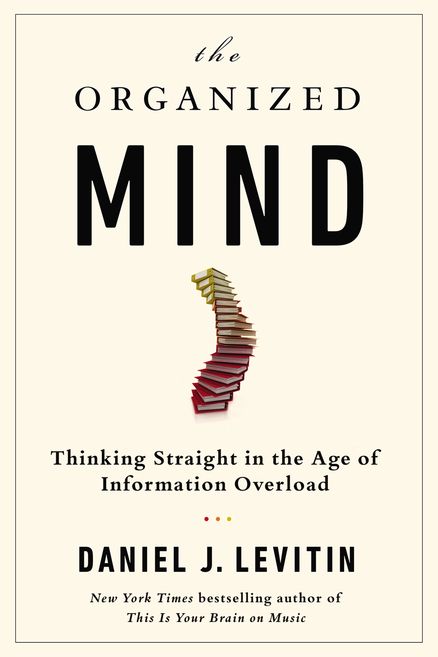
The organized mind
Introduction
Nova: Did you know that the average person today is exposed to the equivalent of 175 newspapers worth of information every single day? That's not a typo. Back in the 1970s, it was about one newspaper's worth. Now it's 175.
Nova: Host 2: Wait, 175 newspapers? That's absurd. How is anyone supposed to function like that?
Nova: Exactly the question that neuroscientist Daniel J. Levitin asks in his book The Organized Mind: Thinking Straight in the Age of Information Overload. And his answer is both fascinating and a little alarming. Our brains simply weren't built for this world. They evolved to help hunter-gatherers survive on the savanna, not to process thousands of emails, notifications, and decisions every day. And yet, here we are.
Nova: Host 2: So what's the consequence? Are we all just walking around with fried brains?
Nova: In a sense, yes. Levitin argues that decision overload, constant multitasking, and the sheer volume of stuff in our lives are depleting our mental resources in ways we don't even recognize. But the book isn't just a diagnosis. It's packed with neuroscience-backed strategies to reclaim your attention, organize your life, and think clearly again.
Nova: Host 2: I need that. I think we all need that. Let's dig in.
The Mismatch Between Ancient Wiring and Modern Life
Your Brain Wasn't Built for This
Nova: Here's the foundational insight of Levitin's book. Our brains evolved over tens of thousands of years to focus on one thing at a time. They're wired to notice change, movement, and potential threats. That was great when we were scanning the horizon for predators. But now? Every notification, every email ping, every buzz from our phone triggers that same ancient alert system.
Nova: Host 2: So my phone is basically pretending to be a saber-toothed tiger?
Nova: That's not far off. Levitin points out that the attentional system is a limited-capacity resource. Recent experiments show that working memory can hold roughly four items at a time, not the seven to nine we used to think. Four. And every time we're interrupted, that precious cognitive real estate gets wiped and we have to rebuild.
Nova: Host 2: Four things at a time. And yet I've got thirty browser tabs open, a phone buzzing, and a to-do list that scrolls for days.
Nova: Right. And here's a wild statistic from the book. In 1976, the average supermarket stocked about 9,000 items. By 2014, that number had ballooned to 40,000. Yet most households only need about 150 items to satisfy 80 percent of their needs. Every time you walk into a grocery store, your brain has to ignore nearly 40,000 things just to find the ones you want.
Nova: Host 2: That's exhausting just thinking about it. And that's just groceries.
Nova: Exactly. And Levitin emphasizes that decision-making burns real metabolic energy. The brain consumes glucose whether you're deciding on a president or a pasta sauce. The decision-making network doesn't prioritize. So by the time you get to the big, important decisions of the day, you might already be cognitively depleted.
Nova: Host 2: That explains why I can spend twenty minutes choosing a Netflix show and then have no mental energy left for actual work.
Nova: Precisely. And this is why Steve Jobs wore the same black turtleneck every day. Barack Obama limited his suits to blue or gray. They were eliminating trivial decisions to preserve bandwidth for what actually mattered. Levitin calls this protecting your attentional filter. Millions of neurons are constantly monitoring your environment, deciding what's important. You can help them by reducing the noise.
Nova: Host 2: So the first takeaway is basically: stop making so many pointless decisions.
Nova: Yes. Automate the small stuff. Set up automatic bill payments. Plan your meals once a week. Create routines. Your brain will thank you.
Why Juggling Tasks Makes You Less Intelligent
The Multitasking Myth
Nova: Host 2: Okay, but here's where I get defensive. I pride myself on multitasking. I answer emails during meetings, I listen to podcasts while cooking, I text while walking. It feels productive.
Nova: And Levitin says that feeling is a lie. A powerful, diabolical illusion. He quotes Earl Miller, a neuroscientist at MIT and a leading expert on divided attention, who states flatly that our brains are not wired to multitask well. What we call multitasking is actually rapid task-switching. And every switch comes with a cognitive cost.
Nova: Host 2: How big of a cost are we talking?
Nova: Here's a jaw-dropping finding from the book. Glenn Wilson, formerly of Gresham College London, conducted research showing that simply being in a situation where you're trying to concentrate and an unread email is sitting in your inbox can reduce your effective IQ by ten points. Ten points. And in a direct comparison, Levitin reports that the cognitive losses from multitasking are even greater than the cognitive losses from smoking marijuana.
Nova: Host 2: Wait, what? Being distracted by email is worse for your brain than being stoned?
Nova: That's what the research shows. And it gets worse. Russ Poldrack, a neuroscientist at Stanford, found that when students study while watching TV, the information from their schoolwork gets stored in the striatum, a brain region specialized for procedures and skills. Without the TV distraction, the information goes to the hippocampus, where it's organized, categorized, and made easy to retrieve. So multitasking literally sends your learning to the wrong part of your brain.
Nova: Host 2: So when I'm half-reading a report while half-scrolling Twitter, I'm not learning anything useful?
Nova: You're learning it, but it's going to the wrong filing cabinet. And metabolically, task-switching is brutal. The prefrontal cortex and striatum burn through oxygenated glucose when you shift attention. Constant shifting depletes nutrients so fast that you feel exhausted and disoriented within a short time. By contrast, staying on task actually uses less energy and reduces the brain's need for glucose.
Nova: Host 2: That's so counterintuitive. You'd think doing more things at once would burn more calories and feel more efficient.
Nova: It's the opposite. Levitin also describes a dopamine-addiction feedback loop. Every time you check your phone or answer a ping, your brain gets a tiny hit of dopamine. It feels good. But you're training yourself to crave distraction. The prefrontal cortex, the very region you need for sustained focus, has a novelty bias. It's easily hijacked by shiny objects. So you're literally rewiring your brain to be more distractible.
Nova: Host 2: That's terrifying. But also explains a lot about my relationship with my phone.
Nova: Levitin's recommendation is clear. Become fanatical about focused work. Block out flight times where you turn off notifications, close your door, and work on one thing. Check email only two or three times a day at set times, not continuously. When you're in focused mode, allow zero distractions. The rewards of sustained attention are exponentially greater than the empty calories of a thousand little tasks.
The Power of Externalizing Memory
Get It Out of Your Head
Nova: Host 2: So if my brain can only hold about four things at once and multitasking is destroying me, what's the solution? Just try harder?
Nova: That's the opposite of what Levitin recommends. The single most fundamental principle of the organized mind, he says, is to shift the burden of organizing from your brain to the external world. Your brain is terrible at retrieval. It stores information, but when you try to pull it back out, it often comes out distorted, and you don't even realize it's been altered.
Nova: Host 2: Wait, my memory is lying to me and I don't know it?
Nova: Constantly. The brain doesn't replay memories like a video. It reconstructs them. And each reconstruction introduces potential errors. Levitin cites Patrick Jane, the mentalist, who described memory as an untrained brain having a crappy filing system. It takes everything and throws it willy-nilly into a big dark closet. So the solution is to stop relying on that closet.
Nova: Host 2: So write everything down?
Nova: Yes. And Levitin traces this insight back 5,000 years to the invention of written language. He notes that when writing was first introduced, people like Plato complained it would rot the mind and create forgetfulness. When the printing press arrived in the 1400s, Erasmus complained about a swarm of books. Leibniz predicted a return to barbarism. Sound familiar?
Nova: Host 2: It sounds exactly like what people say about social media today.
Nova: Precisely. Every generation fears the new technology. But written language was the original external memory system. It freed the brain from having to store everything internally. And Levitin says we need to embrace that principle fully. Use to-do lists. Use 3x5 cards. Use digital tools. Never keep tasks floating in your head. If something takes up mind space, write it down.
Nova: Host 2: But what about the two-minute rule I've heard about?
Nova: Yes, Levitin endorses that too. If something takes less than two minutes, do it immediately. If it takes longer, capture it in your external system. Then categorize everything. Work, personal, kids, health. The brain loves categories. It makes retrieval vastly easier. And for things that don't fit anywhere, create a junk drawer. A miscellaneous category. The brain accepts that as a valid category, and it actually reduces stress.
Nova: Host 2: So a physical junk drawer is actually neuroscientifically validated.
Nova: Absolutely. And Levitin offers three golden rules of organization. Rule one: a mislabeled item or location is worse than an unlabeled one. Mislabeling creates confusion that undermines the whole system. Rule two: if there's an existing standard, use it. Don't reinvent the wheel. Rule three: don't keep what you can't use. If it's broken, unfixable, or useless, get rid of it. Clutter is cognitively expensive.
Nova: Host 2: That sounds almost Marie Kondo-esque.
Nova: It's very aligned. Levitin points out that the average American household has over 2,200 visible objects in just the living room and two bedrooms. Three out of four Americans report their garages are too full to park a car inside. All that visual clutter competes for your attentional resources. Every object you see triggers a tiny decision in your brain: ignore this, deal with this, move this. It adds up.
Nova: Host 2: So decluttering isn't just about aesthetics. It's about cognitive hygiene.
Nova: Perfectly put. And one more crucial insight: designate a place for every object and always put it back. The hippocampus is the brain region responsible for remembering location, and it works brilliantly for things that have a fixed home. That's why you always know where the toothpaste is but constantly lose your keys. Keys don't have a designated spot. Give them one.
Why Doing Nothing Is Actually Doing Something
Sleep, Rest, and the Creative Brain
Nova: Host 2: So we've talked about attention, multitasking, and externalizing memory. What about the role of rest? I feel like the book must address that.
Nova: It does, and it's one of the most compelling sections. Levitin emphasizes that sleep is among the most critical factors for peak performance, memory, productivity, immune function, and mood regulation. And here's a stunning finding: a night of sleep more than doubles the likelihood that you'll solve a problem requiring insight.
Nova: Host 2: More than doubles? So sleeping on a problem is literally scientifically valid.
Nova: Completely. During sleep, the brain doesn't rest. It uses the break from incoming information to sort through the day's data. Memories are consolidated. Ideas are integrated with existing knowledge. The brain is literally organizing itself while you sleep. That's why fresh solutions so often appear in the morning.
Nova: Host 2: And there was something about bimodal sleep, right?
Nova: Yes. Levitin discusses how sleeping a solid eight hours is a relatively modern invention. Our ancestors practiced segmented or bimodal sleep. They'd sleep for four or five hours after dinner, wake for an hour or more in the middle of the night, and then sleep another four or five hours. Some historians and sleep researchers believe this may actually be a more natural pattern for the human brain.
Nova: Host 2: So if I wake up at 3 a. m., I'm not broken. I'm just historically normal.
Nova: Exactly. And here's another counterintuitive finding. A ten-minute nap can be the equivalent of an extra hour and a half of sleep at night. Companies like Google have recognized this, putting nap pods and recreational spaces in their offices. Levitin cites research showing that a sixty-hour work week, though fifty percent longer than a forty-hour week, reduces productivity by twenty-five percent. It takes two hours of overtime to accomplish one hour of work.
Nova: Host 2: So working longer makes you less effective. That's a tough sell in hustle culture.
Nova: But the data is clear. And Levitin notes that for each additional ten hours of vacation an employee takes, their year-end performance ratings improved by eight percent. Rest isn't the enemy of productivity. It's the foundation of it.
Nova: Host 2: There's also something about staying mentally young, right?
Nova: Yes. As people age, they often perceive time racing by because their cognitive processes slow down, making life feel like it's moving faster. Younger people view life as open-ended and discovery-oriented. Older people tend to view life as constrained and want to preserve what they already know. Levitin's advice for staying mentally young: learn new hobbies, spend at least an hour a day socializing, and an hour a day in physical activity. Keep exposing your brain to novelty, but in a controlled, intentional way, not the frantic dopamine hits of notification checking.
Nova: Host 2: So it's about choosing your novelty, not being a slave to it.
Nova: Beautifully said. And that's really the heart of the organized mind. It's not about becoming a rigid, hyper-efficient robot. It's about being intentional with your attention so you have the mental space to be creative, present, and fully human.
Conclusion
Nova: So let's bring it all together. Daniel Levitin's The Organized Mind gives us a neuroscience-based framework for navigating the age of information overload. The brain is a finite resource. Attention is limited. Decision-making burns real energy. Multitasking is a myth that makes us less intelligent, not more.
Nova: Host 2: And the antidote isn't to try harder. It's to work with the brain rather than against it.
Nova: Exactly. Externalize your memory. Write everything down. Categorize ruthlessly. Give every object a home. Automate trivial decisions. Block out focused work time with zero distractions. Check email on a schedule, not continuously. And prioritize sleep and rest as non-negotiable pillars of cognitive performance.
Nova: Host 2: I love how practical this is. It's not just theory. It's things like: use the two-minute rule. Create a junk drawer. Don't keep what you can't use. Put your keys in the same place every time.
Nova: Right. And the deeper message is that organizing your external world organizes your internal world. When you reduce the cognitive load of clutter, trivial decisions, and constant interruptions, you free up bandwidth for what actually matters. Deep thinking. Creativity. Relationships. The things that make life rich.
Nova: Host 2: So the organized mind isn't about being a productivity machine. It's about reclaiming your humanity from the machines.
Nova: That's it exactly. Levitin reminds us that 5,000 years ago people feared writing would destroy memory. In the 1400s they feared books would end intellectual life. Today we fear social media and AI. The pattern is the same. The technology isn't the problem. How we manage our attention in relation to it is.
Nova: Host 2: One final question. If there's one thing from this book you want every listener to remember, what is it?
Nova: You don't have to process everything. You can't. The goal isn't to consume more information faster. It's to be intentional about what you let in, externalize what you need to keep, and protect your focused attention as the precious, limited resource it truly is.
Nova: Host 2: That's a message worth organizing our minds around.
Nova: This is Aibrary. Congratulations on your growth!