

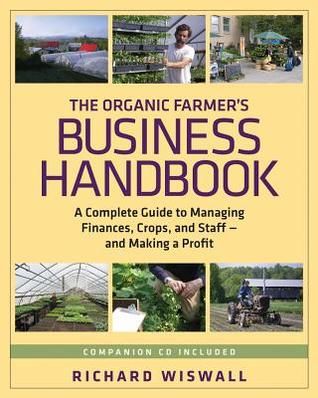
The Organic Farmer's Business Handbook
A Complete Guide to Managing Finances, Crops, and Staff - and Making a Profit
Introduction
Nova: What if I told you that most small-scale organic farmers handle a hundred thousand dollars or more in revenue every year, work sunup to sundown, and yet at the end of it all, they're lucky to take home twenty thousand dollars? That's the reality Richard Wiswall lays bare in his book, The Organic Farmer's Business Handbook. And he should know. He lived it.
Nova: Exactly. And here's the kicker: Wiswall argues that it doesn't have to be this way. In fact, after he started applying the business principles in his own book, he says he paid himself the equivalent of ten thousand dollars for two days of work in just his first year of getting serious about the numbers.
Nova: I know, I know. But stick with me. Richard Wiswall runs Cate Farm in central Vermont. He's been farming organically for over thirty-five years on 22 acres and in seven hundred-foot-long greenhouses. And for the first decade, he was like so many farmers: passionate about growing, utterly allergic to the business side of things. He jokes in the book that, quote, thank goodness for the IRS, unquote, because annual tax filing was often the only reason he looked at his bottom line.
Nova: That is precisely the audience for this book. And today, we're going to walk through what makes The Organic Farmer's Business Handbook so different from every other farming book out there. It's not about how to grow better carrots. It's about how to know which carrots are actually making you money, and which ones are quietly bleeding you dry while you're too busy to notice.
Why Passion Doesn't Pay the Bills
The Big Lie in Farming
Nova: Let's start with the core provocation of this book. Wiswall opens by directly challenging something that's practically gospel in small farming circles: the idea that there's simply no real money in farming.
Nova: And Wiswall calls that out as a fallacy. In 1993, he took a Holistic Management class where the presenter said, quote, the biggest fallacy in farming is that there is no money in it, unquote. That statement rewired his brain. He realized that farmers handle enormous sums of money. Fifty thousand, a hundred thousand, two hundred thousand dollars or more in a season. But because they don't track where it comes from and where it goes, they end up with almost nothing left over.
Nova: Exactly. Wiswall writes something that really stings. He says, and I'm paraphrasing here, that a person involved in any other line of business would think it ludicrous that many farmers don't keep track of where the money comes from and where it goes. Would an auto parts store run without knowing its numbers? A shoe store? Of course not.
Nova: That's the paradox Wiswall addresses head-on. He admits he operated the same way in his early years. The current checkbook balance was his only indicator of financial health. And here's what he discovered: the lack of dependable profitable returns is what limits farm success, not production techniques.
Nova: Bingo. And that's where the book really starts to get practical. Wiswall doesn't just diagnose the problem. He builds an entire system to fix it, and the centerpiece of that system is something deceptively simple called the Crop Journal.
One Pocket Folder That Changes Everything
The Crop Journal Revolution
Nova: So picture this. You walk into a farm office and you see a basic pocket folder with loose-leaf pages inside. Nothing digital, nothing fancy. That's the Crop Journal. Each page is dedicated to one crop. And every single time anyone does anything to that crop, weeding, mulching, cultivating, harvesting, they write it down.
Nova: It can be, and Wiswall is really careful about this. He stresses over and over: start small. Don't try to record everything everyone does all day. That's a recipe for giving up. Instead, focus on the crops that matter most or the ones you're most curious about. The key is that at the end of the season, you have real data.
Nova: It tells you the actual cost of producing each crop. How many person-hours went into weeding five hundred bed feet of carrots? How long does it take to pick fifty pounds of blueberries? Combine that with what you sold the crop for, and suddenly you have a real enterprise budget. Profit equals income minus expenses. It's not complicated math. It's just math nobody was doing.
Nova: That's the understatement of the year. Wiswall tells this story about discovering that kale, of all things, was one of his most profitable crops. Kale! The humble, sturdy green that nobody was Instagramming back in the nineties. Meanwhile, green beans, which every market farmer grows because customers expect them, were a loss leader at best.
Nova: Because they're incredibly labor-intensive to harvest. You're bent over, picking individual pods, and it takes forever. If you're paying yourself or your workers a fair wage for that time, the numbers often don't add up. But nobody knows that unless they track it. Wiswall writes that labor expenses for harvesting and weeding, plus yields and sales price, have the biggest impact on enterprise budgets. Pay attention to those three things, and the picture gets very clear very fast.
Nova: Exactly. Once you can list all your crops in order of net return, you can make real strategic decisions. Maybe you keep growing beans because they bring people to your market stand, but you grow fewer of them. Maybe you double down on kale and expand your plantings. Maybe you drop that one crop that's been losing money for years without you even knowing it.
Nova: It is. But Wiswall frames it as liberation, not loss. Knowledge is power. And he has this wonderful, encouraging tone throughout the book. At every point where you might start to feel overwhelmed, he drops in something like, quote, that's it! No rocket science in there, unquote. Or, quote, checkbook balancing is just a different crossword puzzle, unquote. He makes it feel doable.
Efficiency, Employees, and the Long Game
Farming Smarter, Not Harder
Nova: So once you know which crops are profitable, the next layer is efficiency. And this is where Wiswall really shines, because he's been in the fields himself for decades. He knows every inefficiency because he's lived every inefficiency.
Nova: Here's a great one. He points out that hand transplanting is actually more efficient than using a tractor for areas of a quarter acre or less. Most small farmers assume they should mechanize everything, but the numbers don't always support that. He also talks about how tractor and implement use is not free, even if you already own the machines sitting in the barn. There's fuel, maintenance, depreciation. You have to account for all of it.
Nova: In some cases, absolutely. Another big theme in the book is employee management. Wiswall doesn't just tell you how to hire people. He includes sample job descriptions, timesheet templates, a payroll calculator. He talks about being the kind of farmer people actually want to work for. Because if you have high turnover, you're constantly training new people, and that's expensive.
Nova: Precisely. And then there's the chapter that most farming books don't even touch: retirement. Wiswall asks the uncomfortable question. How do you retire from farming without having to sell the farm? For so many small farmers, the land is their only asset. There's no 401k, no pension. He walks through strategies for investing profits, planning ahead, making sure the business supports you not just this season, but for the rest of your life.
Nova: It is radical. And it connects back to his fundamental message: farming is a business. A wonderful, meaningful, soul-satisfying business, but a business nonetheless. Treat it like one. He even jokes that he risks becoming known as an UBCOF: an Uber Bean Counting Organic Farmer. But he's happy to wear that label if it means farmers stop going broke.
Nova: He does. Wiswall covers novel marketing strategies, compares the profitability of different sales channels, farmers markets versus CSA versus restaurants versus wholesale. Different channels have different costs, different labor requirements, different returns. Again, it all comes back to knowing your numbers so you can make informed choices. The book also comes with a companion CD that includes 24 comprehensive crop budgets plus templates, cash flow projections, profit and loss statements. It's essentially a financial toolkit in a sleeve.
Nova: That's exactly how reviewers have described it. The Foreword Reviews piece called it, quote, not only a sound investment; at its price, it's a steal, unquote. And Lynn Byczynski, the editor of Growing for Market magazine, wrote, quote, what a breath of fresh air! Richard Wiswall challenges the conventional notion that there's no real money in farming. He argues that farmers should be well-compensated, and then he shows how to make that happen, unquote.
Conclusion
Nova: So let's pull this all together. Richard Wiswall's The Organic Farmer's Business Handbook was published in 2009, and in the years since, it has become required reading for anyone serious about making a living from organic farming. It's used in university extension programs, recommended by organizations like NOFA Vermont, and Wiswall himself has consulted with over ninety farmers across New England to help them increase profitability.
Nova: That's beautifully put. And Wiswall makes it feel accessible. He doesn't assume you're an accountant. He assumes you're a tired farmer who would rather be weeding than doing data entry, and he meets you right there. Start small. One crop journal. A few enterprise budgets. Build from there.
Nova: Grab a pocket folder and some loose-leaf paper. Label one page for your most important crop. Every time you do anything to that crop this week, write it down. How long it took, what you did, how much you harvested, what you sold it for. That's it. That's the beginning of everything Wiswall teaches.
Nova: That was Wiswall's experience. Once he knew his numbers, he could focus on the crops and practices that actually generated profit, and the returns compounded fast. He went from struggling for a decade to building a thriving farm that's supported his family for over thirty-five years. And he wrote this book because he genuinely wants other farmers to experience that same transformation.
Nova: And as Wiswall would say, that's it. No rocket science in there. Just a sharp pencil and the willingness to use it.