The Cognitive Architecture of Lifelong Resilience
Golden Hook & Introduction
SECTION
Nova: Most people think optimism is just a personality trait. They believe you are either born with the sunny disposition of a golden retriever or the gloom of a Victorian poet, and that is just the hand you are dealt for life.
Atlas: That is exactly how I have always looked at it. You are either the person who sees the glass half-full, or the person who is already checking the structural integrity of the glass because you are waiting for it to shatter.
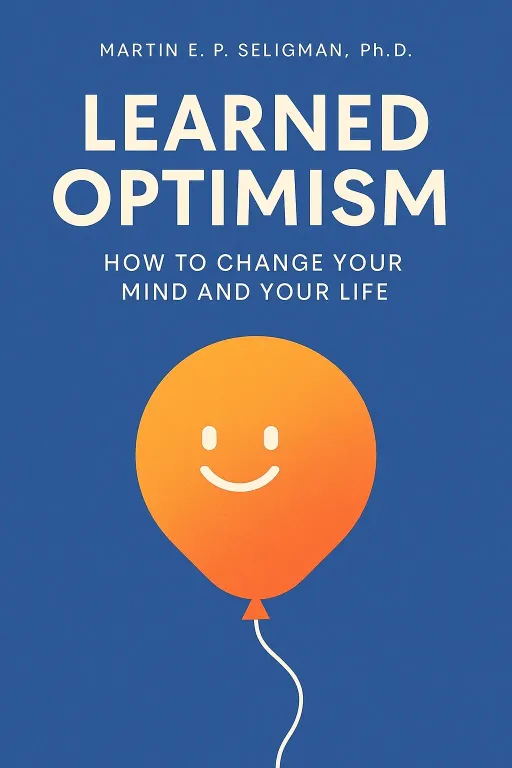
Nova: And that is the exact misconception that keeps people stuck. Today, we are dismantling that idea because optimism is not a temperament. It is a cognitive architecture. We are diving into the work of Martin E. P. Seligman, specifically his foundational book Learned Optimism and his later work, The Optimistic Child.
Atlas: I know Seligman. He is the titan of positive psychology, right? But I always thought his work was about teaching people to ignore the bad stuff and just smile through the pain.
Nova: That is the most common critique, but it is fundamentally wrong. Seligman actually started his career studying the opposite: learned helplessness. He spent years in the lab figuring out why dogs, and eventually humans, give up when they feel they have no control. He shifted the entire field of psychology from just fixing broken people to understanding how we can build human flourishing. The books we are discussing today are the blueprints he developed to teach us how to consciously reframe our thoughts.
Atlas: Okay, so we are not talking about toxic positivity or ignoring reality. We are talking about a structural approach to how we process the world.
Nova: Exactly. Let’s look at how we build the foundation of our resilience.
The Architecture of Setbacks
SECTION
Atlas: So, if this is a cognitive architecture, walk me through the blueprint. If I am sitting at my desk, I just got a project proposal rejected, and my brain immediately goes to the worst-case scenario, what is actually happening in my head?
Nova: You are falling into what Seligman calls the explanatory style. It is the habitual way you explain the causes of bad events to yourself. He identifies three dimensions that determine whether that rejection is going to be a temporary speed bump or a permanent wall. He calls them the Three Ps: Permanence, Pervasiveness, and Personalization.
Atlas: I have definitely felt all three of those in a single afternoon. Walk me through them.
Nova: Let’s break it down. Permanence is the time dimension. A pessimist looks at that rejected proposal and says, this always happens. I never get my ideas approved. They view the setback as an enduring, unchangeable state of affairs. An optimist, however, sees it as temporary. They think, okay, this specific proposal didn't land today, but the next one might. They see it as a discrete event in time, not a permanent condition of their career.
Atlas: That makes sense. It is the difference between saying I am a bad architect and saying I designed a bad layout for this one specific client.
Nova: Precisely. That leads us to the second dimension: Pervasiveness. This is the space dimension. A pessimist takes a setback in one area of their life—say, work—and lets it bleed into everything else. They think, I failed at work, so I must be incompetent at everything. My personal life is a mess, my finances are going to crash. They catastrophize. The optimist keeps the setback contained. They say, I had a tough day at the office, but my home life is stable, my health is fine, and I am still capable in other areas.
Atlas: I can see how that becomes a cascade effect. If you let one failure leak into every other room of your house, eventually the whole structure feels unstable.
Nova: You are using the perfect analogy for an architect. Think of it like load-bearing walls. If you decide that one failure is a load-bearing wall for your entire identity, the whole thing collapses when that one wall gets a crack. Seligman argues that we need to isolate our failures. Don't let one bad event become the foundation for your entire self-concept.
Atlas: That leaves the third P. Personalization. This is the one I struggle with the most.
Nova: Personalization is about the source of the cause. When something goes wrong, do you blame yourself or the circumstances? The pessimist internalizes the failure. They say, I am stupid, I am lazy, I am just bad at this. The optimist, while still taking responsibility for their actions, looks at external factors. Maybe the market was bad, maybe the client had a bad day, or maybe the timing was off.
Atlas: Wait, hold on. Does that not sound like just making excuses? I feel like if I start blaming the market or the client for my failures, I am losing the ability to improve. I am losing my agency.
Nova: That is a critical distinction to make. This is not about abdicating responsibility. If you made a mistake, you own it. But there is a difference between saying, I messed up this calculation because I was rushing, versus saying, I am fundamentally incapable of doing math. The first is an actionable, specific, and temporary error. The second is a permanent, pervasive, personal indictment of your character. One allows you to fix the drawing. The other makes you want to throw away the whole drafting table.
Atlas: I see the difference. One is a diagnostic tool for improvement, and the other is a hammer you use to beat yourself up.
Nova: Exactly. Seligman’s research shows that people who use the pessimistic style—viewing setbacks as permanent, pervasive, and personal—are significantly more likely to suffer from depression and give up on their goals. But the people who use the optimistic style—viewing setbacks as temporary, specific, and often external—are the ones who persist. They are the ones who keep building.
The Generational Blueprint
SECTION
Atlas: So, we have the framework for how to handle our own setbacks. But you mentioned his book, The Optimistic Child. That implies this isn't just for adults trying to fix their own internal dialogue. This is something we can teach, or perhaps something we have been taught incorrectly?
Nova: It is both. In The Optimistic Child, Seligman takes these same principles of explanatory style and applies them to development. He argues that we are essentially teaching children how to explain the world to themselves before they even know they are doing it.
Atlas: How does that actually happen? I imagine most parents aren't sitting their kids down to give a lecture on the three Ps of cognitive explanatory style.
Nova: It is much more subtle than that. It happens in the daily feedback loop. Think about how a parent reacts when a child fails at something, like a math test or a sports game. If the parent says, You are just not a math person, they are teaching the child to view ability as permanent and personal. They are literally building a pessimistic architecture in that child's mind.
Atlas: That is terrifying. It is like you are handing them a blueprint for their own limitations.
Nova: It is. And the alternative is not to tell the child they are a genius at everything. That leads to a different kind of fragility. The alternative is to teach them to be accurate. When a child fails, instead of saying, You are not a math person, you say, You didn't study enough for this specific test, or, You haven't mastered this specific concept yet. You are teaching them that the failure is temporary, specific, and changeable.
Atlas: So, you are teaching them that their effort has a direct, causal link to the outcome. You are teaching them that they have agency over their own cognitive development.
Nova: Exactly. Seligman calls this the immunization against depression. By teaching children to challenge their own negative explanations, you provide them with a psychological immune system. When they hit the inevitable setbacks of adolescence and adulthood, they don't immediately default to the belief that they are worthless. They have the tools to look at the situation and say, Okay, this is a problem, not a catastrophe.
Atlas: I am curious about the application here. If I didn't grow up with this—if my own internal architecture is built on that pessimistic foundation—how do I retrofit that? Can you actually change your explanatory style as an adult, or are we stuck with the childhood foundation?
Nova: That is the beauty of Seligman’s work. He is adamant that this is a skill, not a trait. You can learn optimism. It is like building muscle. It takes repetition. You have to catch yourself in the act of thinking.
Atlas: What does that look like in the wild? If I am in the middle of a high-pressure situation, how do I actually pause and reframe?
Nova: You have to externalize the process. This is the tiny step we talked about earlier. When you hit a setback—and it could be anything from a burnt dinner to a lost contract—you have to write it down. You have to move the thought from your head onto paper.
Atlas: Write it down? Does that actually work?
Nova: It works because it forces you to slow down. When it is just a thought, it happens at the speed of electricity. It is instantaneous and emotional. When you write it down, you are forced to analyze the structure of your own argument. You write down the event, then you write down your explanation for it. And then, you actively challenge it. You look for the evidence that your explanation is wrong.
Atlas: So if I write, I lost the contract because I am a terrible negotiator, I then have to look at that sentence and ask, Is that actually true? What is the evidence?
Nova: Right. You look for the specific, temporary cause. Maybe you lost the contract because the competitor had a lower price, or because you were under-prepared for that one specific meeting. That is a specific, temporary, and external cause. It does not mean you are a terrible negotiator. It means you need to adjust your strategy for the next meeting.
Atlas: I see how that changes the emotional charge. It turns a crisis of identity into a logistical problem.
Nova: That is the goal. You are not trying to be delusional. You are trying to be accurate. Pessimism is often just as inaccurate as extreme, ungrounded optimism. The goal is to move closer to reality.
Synthesis & Takeaways
SECTION
Atlas: This feels very aligned with how an architect approaches a project. You don't look at a collapsed beam and say, The whole building is garbage. You analyze why that specific beam failed. Did the calculations go wrong? Was the material flawed? You isolate the problem, you fix the design, and you move forward.
Nova: That is the perfect synthesis. Resilience is not about being unbreakable. It is about knowing how to repair the structure. Seligman’s work gives us the tools to do that repair work in our own minds.
Atlas: It also makes me think about how we communicate with others. If I can do this for myself, I can probably do this for my team or my family. I can help them reframe their setbacks instead of reinforcing their self-doubt.
Nova: Absolutely. You become an architect of culture, not just of your own mind. When you stop using permanent, pervasive, and personal language with others, you start creating an environment where people feel safe to take risks and learn from failure.
Atlas: I want to try this. The next time I hit a wall, I am going to stop, pull out a notepad, and actually map out the explanation. I think the act of writing it down is going to be the game-changer for me. It stops the loop.
Nova: That is the most practical step you can take. It is about moving from being a passive victim of your thoughts to being the designer of your internal landscape.
Atlas: I love that. It takes the mystery out of it. It is not about magic; it is about engineering.
Nova: Exactly. And remember, the goal isn't to be happy all the time. The goal is to be resilient. To be able to endure the inevitable failures of life and keep building. That is the true architecture of a life well-lived.
Atlas: I’m walking away with a much clearer sense of how to handle the next inevitable 'no' I get. It’s not a reflection of my worth; it’s just data for the next draft.
Nova: That is the most optimistic thing you could say. And it’s the most accurate one, too.
Atlas: Thanks for breaking this down. It really feels like a blueprint I can actually use.
Nova: My pleasure. And for everyone listening, take that tiny step today. When you hit a snag, write it down. Challenge the permanence. Challenge the pervasiveness. Find the specific, temporary cause. You might be surprised at how much stronger your foundation becomes.
Atlas: This is Aibrary. Congratulations on your growth!