Actionable Steps to Financial Clarity & Independence
Golden Hook & Introduction
SECTION
Nova: Atlas, five words. Give me your honest, gut reaction to 'financial planning.' Go.
Atlas: Overwhelming. Confusing. Necessary. Slightly. Terrifying.
Nova: Oh, I love that. "Slightly Terrifying." That's a whole mood right there. And honestly, it sums up what a lot of people feel when they even about their finances. It’s this giant, complex beast.
Atlas: Absolutely. It’s like being handed a map to a treasure island, but the map is written in ancient hieroglyphs, and half the landmarks are missing. You know the treasure is there, but the journey itself feels impossible.
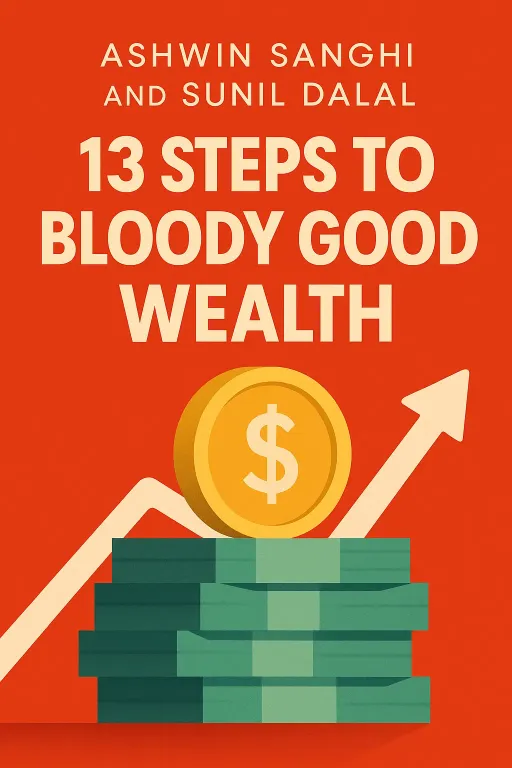
Nova: What if I told you we have two brilliant guides today who aim to make that journey not just possible, but clear, consistent, and dare I say, bloody good? We’re diving into the world of financial clarity and independence, drawing insights from two fantastic books. First, "13 Steps to Bloody Good Wealth" by the unexpected duo, Ashwin Sanghi and Sunil Dalal.
Atlas: Ashwin Sanghi? The thriller novelist? That’s quite the pivot from ancient secrets and historical conspiracies to budgeting and investing. I'm intrigued by what a storyteller brings to finance.
Nova: Exactly! It’s fascinating, isn't it? Sanghi, renowned for his complex historical thrillers, teams up with Sunil Dalal to bring a narrative flair and demystifying approach to wealth. It’s like he’s cracking the code of money, much like he cracks historical mysteries. And then, we have Carl Richards' profoundly simple, yet powerful, "The One-Page Financial Plan."
Atlas: Ah, Carl Richards. The "Sketch Guy." I appreciate his ability to cut through the noise with those hand-drawn diagrams. It's a refreshing change from dense financial jargon. For someone who likes to synthesize complex ideas, his approach is instantly appealing.
Nova: It truly is. These two books, from very different angles, converge on a powerful truth: financial independence isn't about mastering endless complexities; it's about clarity, consistency, and a deeply personalized approach. Today, we're going to explore how we can demystify wealth creation and then simplify our financial goals down to their absolute core.
Demystifying Wealth Creation: Actionable Steps and Practicality
SECTION
Nova: So, let’s start with the idea of demystifying wealth creation. Ashwin Sanghi and Sunil Dalal, with their "13 Steps to Bloody Good Wealth," really tackle this head-on. They argue that wealth isn't some mystical secret reserved for a select few. It's a process, a series of practical, digestible steps.
Atlas: That sounds incredibly appealing, especially for listeners who often feel like finance is a world of opaque algorithms and insider trading. But wait, isn't 'wealth creation' just for the super-rich or those with an incredibly high-risk tolerance? What about the average person trying to build a secure future, not just get rich quick?
Nova: That’s a crucial question, and it’s precisely what Sanghi and Dalal address. They strip away the mystique. They explain that the principles of wealth creation are universal, regardless of your starting point. Think of it like learning to build a house. You don't start with the roof; you start with the foundation, then the walls, then the plumbing. Each step is manageable.
Atlas: I guess that makes sense. It's about breaking down a daunting project into bite-sized tasks. But can these 'steps' really apply to everyone, or is it another one-size-fits-all that doesn't account for unique journeys, for people with different risk appetites or life stages?
Nova: That’s where the "demystified" part comes in. They focus on steps. For instance, one of their core ideas is about understanding your cash flow – knowing exactly where your money comes from and where it goes. It sounds simple, almost too basic, but it’s the bedrock. They illustrate this with stories of individuals who thought they were financially savvy but had no real grasp of their daily spending, leading to a constant feeling of scarcity despite decent incomes.
Atlas: So, it's less about finding a magic bullet or a secret investment and more about consistent, disciplined small actions that build upon each other. That resonates with the idea of sustainable growth. But how does that translate into something tangible? Can you give us an example of one of these "demystified steps" that listeners can actually grasp?
Nova: Absolutely. Let's take the concept of 'investing.' For many, it conjures images of stock market tickers flashing past, complex charts, and jargon. Sanghi and Dalal break it down. They might say, "Understand the difference between saving and investing." Savings are for short-term goals; investing is for long-term growth, leveraging the power of compounding. They'll tell a story about a young professional, let’s call her Priya, who diligently saved a portion of her salary but kept it all in a low-interest savings account for years. She felt secure, but her money wasn't working for her.
Atlas: That’s a common trap. We're taught to save, but not necessarily how to make those savings grow strategically.
Nova: Exactly. Priya then reads the book and realizes that even a modest, consistent investment in a diversified fund, started early, could dramatically outperform her savings account over decades. The book doesn't tell her specific stock to buy, but it explains the of diversification, the of long-term thinking, and the of automation – setting up regular investments so it becomes a habit, not a heroic effort. The outcome for Priya is not just more money, but a sense of control and understanding over her financial future, replacing anxiety with purposeful action.
Atlas: That’s a powerful shift. It’s about building a system, not just reacting to market fluctuations. It helps people move from a reactive stance to a proactive one, which is key for anyone trying to build lasting wealth and secure their future. It also connects to the idea of micro-learning – tackling one small, high-impact concept at a time.
Nova: Precisely. They make it clear that consistency beats intensity. You don't need to be a financial wizard; you need to be consistent with good habits. It’s about building momentum, one step at a time, towards that "bloody good wealth."
The Power of Simplicity: Clarifying Values and the 'One-Page Plan'
SECTION
Nova: That focus on consistency and building good habits naturally brings us to the profound simplicity championed by Carl Richards in "The One-Page Financial Plan." While Sanghi and Dalal give us the 'how,' Richards asks us to consider the 'why.' He champions the idea of distilling your entire financial life onto a single page.
Atlas: A one-page plan? That sounds almost too simple. For someone who's a strategist and likes to anticipate change, details often matter. Aren't we missing critical nuances by boiling it down so much? My concern is that simplifying too much might lead to overlooking important risks or opportunities.
Nova: That’s a very fair point, and it’s a common misconception about Richards' approach. He’s not saying ignore the details; he’s saying the details that matter most to. The one-page plan isn't a spreadsheet; it's a framework built on your core values and goals. He gives an example of a couple, let’s call them the Millers, who were constantly stressed by their finances. They had a complex portfolio, multiple advisors, and an intimidating stack of financial documents. Yet, they felt adrift.
Atlas: I can imagine. Sometimes, more information just leads to more overwhelm, especially if you don't have a clear filter to process it through.
Nova: Exactly. Richards’ method asked them to answer two fundamental questions: "What's most important about money to you?" and "What do you want to accomplish with it?" For the Millers, after much deliberation, they realized their core values were "freedom to travel" and "meaningful family experiences." Their detailed financial plan, however, was optimized for early retirement in a specific, expensive city, which felt less and less aligned with their true desires.
Atlas: That's fascinating. So, the one-page plan isn't a rigid blueprint of to do, but more like a compass guiding your financial journey, constantly recalibrated by your core values. How does clarifying 'values' actually translate into concrete financial decisions? It sounds a bit abstract. Like, if my value is 'freedom,' how does that tell me whether to invest in stocks or real estate?
Nova: That's the magic. Once the Millers identified "freedom to travel," their financial decisions became clearer. They realized they didn't need to save for that expensive early retirement in a static location. Instead, they started exploring investments that could generate passive income, allowing them to work remotely or take extended sabbaticals. They reallocated funds from a down payment on a larger house to a travel fund and a diversified income-generating portfolio. Their 'one page' now clearly stated: "Values: Freedom, Family Experiences. Goals: Generate $X passive income by age 55 for extended travel; fund children's experiential education."
Atlas: Wow. That's a powerful shift from an arbitrary goal to a deeply personal one. It helps you prioritize. It’s about aligning your money with your life's purpose, rather than letting money dictate your purpose. For someone focused on well-being, that connection between values and financial action is critical. It transforms money from a source of stress into a tool for living your best life.
Nova: Precisely. Richards argues that when your financial plan is this clear and concise, it becomes a living document. It’s not static. If your values or goals shift, you update your one page. He often notes that his "Sketch Guy" approach helps people visualize this simplicity, making complex ideas instantly accessible. It’s about making the implicit explicit, and then letting that clarity guide every decision. It’s like designing the architecture of your future, ensuring every beam and every window serves your ultimate vision.
Atlas: And that's where the synergy really comes in. Sanghi and Dalal give you the practical toolkit to build the house, but Richards provides the architectural blueprint, ensuring that house is truly dream home, not just an impressive structure.
Synthesis & Takeaways
SECTION
Nova: Absolutely, Atlas. It feels like these two books, despite their different origins and initial approaches, converge on this profound idea: financial clarity isn't about mastering complex algorithms or having insider information. It's about mastering yourself, your habits, and understanding your deepest motivations.
Atlas: It really does. It’s a powerful combination. On one hand, you have the practical, demystified steps that empower you to take action, and on the other, you have the profound simplicity of aligning your money with your core values. For anyone striving to be a Futurist or a Strategist, this is about building a secure foundation for the future, one that supports your well-being and allows you to innovate with confidence. It’s about purposeful action.
Nova: Exactly. The takeaway isn't to get bogged down in endless financial research, but to take that crucial first step. Our challenge for you this week, inspired by these insights, is simple: take just 20 minutes. Sit down and outline your core financial values. What truly matters to you about money? And then, identify one immediate, actionable step you can take this week towards a long-term goal that aligns with those values.
Atlas: That’s incredibly practical. It's about translating abstract desires into concrete actions, even tiny ones. It’s not just about building wealth; it’s about building the architecture for a future you actually want, sustainably, and with profound clarity.
Nova: And that clarity, that alignment of action with intention, is what truly leads to financial independence and, ultimately, a more purposeful life. It’s about taking control, one clear, consistent step at a time.
Atlas: Fantastic. It’s about making money serve your life, not the other way around.
Nova: This is Aibrary. Congratulations on your growth!