

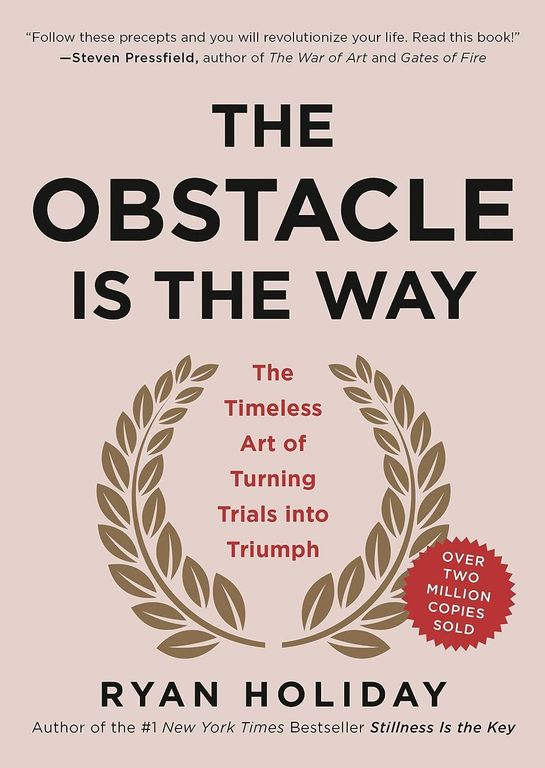
The Obstacle Is the Way
The Timeless Art of Turning Trials into Triumph
Introduction: The Ancient Secret to Modern Success
Introduction: The Ancient Secret to Modern Success
Nova: Welcome to The Synthesis, the show where we distill the world's most powerful ideas into actionable insights. Today, we are diving deep into a book that has become a modern manifesto for resilience: Ryan Holiday's "The Obstacle Is the Way."
Nova: : That title alone feels like a punch to the gut, Nova. It’s so simple, yet so counterintuitive. We spend our lives trying to obstacles. Why would we want to embrace them?
Nova: Exactly! But the core idea, drawn from the ancient philosophy of Stoicism, is that the obstacle isn't just something to tolerate; it the path. Holiday quotes Marcus Aurelius: "The impediment to action advances action. What stands in the way becomes the way."
Nova: : That's heavy. It’s like saying if you want to get to the top of the mountain, the rockslide blocking the trail is actually the only way you’re going to learn how to climb properly.
Nova: Precisely. This isn't just motivational fluff; it’s a practical operating system used by everyone from Roman emperors to modern CEOs. We're going to break down the three core disciplines Holiday extracts from Stoicism that allow you to flip any negative into a positive: Perception, Action, and Will.
Nova: : I’m ready to learn how to stop fighting the current and start using it. Let’s start at the beginning. How do we even begin to an obstacle as a path?
Nova: That brings us to our first discipline, the foundation of everything: Perception. This is where the real work begins.
Key Insight 1: The Power of Interpretation
Discipline One: Perception - Controlling the Narrative
Nova: In the Stoic view, events themselves are neutral. It’s our judgment about them that causes suffering. Holiday emphasizes that we have absolute control over how we frame a situation. If you see a layoff as a disaster, it paralyzes you. If you see it as a forced opportunity to pivot to a better industry, it mobilizes you.
Nova: : That sounds great in theory, but what about truly terrible things? Like a massive market crash or a personal betrayal? How do you stop the emotional reaction long enough to apply this rational lens?
Nova: That’s where the historical context helps. Holiday points to figures who faced existential threats. Think about the Stoic philosopher Epictetus, who was born a slave. His physical reality was brutal, but his inner world was free because he controlled his perception of his circumstances. He didn't perceive himself as a victim of his master; he perceived himself as a student of life, regardless of his chains.
Nova: : So, it’s about separating the from the we tell ourselves about the fact. I think that’s where a lot of people get tripped up. I actually saw some commentary online suggesting that Holiday’s approach can lead to a kind of cold ruthlessness—that focusing only on the opportunity makes you ignore the human cost or lack mercy.
Nova: That is a fascinating and important challenge to bring up. It touches on the common misconception of Stoicism. Holiday isn't advocating for being a sociopath. He’s advocating for so that your response is strategic, not reactive. The goal isn't to be merciless; it's to ensure your is virtuous and effective, which often requires clarity.
Nova: : Can you give us an example of that clarity in action? Something that wasn't just about personal gain, but about navigating a complex, unfair situation?
Nova: Absolutely. Consider the boxer Jack Johnson. Holiday uses him as a prime example of someone facing systemic, hateful obstacles—racism in early 20th-century America. The obstacle was the crowd’s hatred and the media’s slander. If Johnson perceived that as an insurmountable wall of hate, he would have crumbled. Instead, he perceived it as fuel, as a stage upon which he could demonstrate his superior skill and character. He didn't try to change the crowd's mind immediately; he changed his to their noise.
Nova: : He used their negativity as a backdrop to highlight his own excellence. That’s a powerful reframing. It shifts the focus from what they are doing him, to what he is doing the situation.
Nova: Exactly. The perception discipline is about recognizing that you cannot control the external noise—the market, the critics, the unfair rules—but you have 100% control over the internal signal you choose to amplify. If you perceive the obstacle as a test of your patience, you practice patience. If you perceive it as a test of your creativity, you practice creativity. The obstacle becomes the curriculum.
Nova: : So, before we even try to anything, we have to nail down we are looking at. It’s mental preparation before physical engagement. It sounds exhausting, though, maintaining that level of objective detachment all day.
Nova: It is a discipline, not a switch. But the payoff is that once you’ve framed it correctly, you stop wasting energy fighting the reality of the situation and start channeling that energy into the next step. And that next step is the second discipline: Action.
Key Insight 2: The Necessity of Forward Momentum
Discipline Two: Action - Moving Through the Blockage
Nova: Once you’ve perceived the obstacle correctly—as a challenge, not a catastrophe—the Stoics demand action. Passivity is the enemy. You can’t meditate your way out of a problem that requires movement. This is where the rubber meets the road.
Nova: : But what if the obstacle is so huge that any action feels futile? Like trying to move a boulder with a toothpick. Where do you find the motivation to take that first, tiny, seemingly useless step?
Nova: Holiday draws heavily on military history here, particularly Dwight D. Eisenhower. Eisenhower was famous for his ability to manage massive, seemingly impossible logistical challenges, like planning the D-Day invasion. The obstacle wasn't one thing; it was a thousand moving parts, bad weather forecasts, enemy intelligence, and political infighting.
Nova: : How did he apply the Stoic principle? He couldn't just the weather to change.
Nova: He couldn't control the weather, but he could control the of preparation. His action wasn't one grand, sweeping gesture. It was a relentless focus on the next necessary step, the next piece of intelligence to gather, the next contingency plan to draft. He understood that momentum is created by small, correct actions taken sequentially. The obstacle becomes the roadmap for those actions.
Nova: : So, if the obstacle is a massive, complex project, the action isn't 'finish the project.' The action is 'write the first sentence of the first memo.'
Nova: Exactly. And Holiday stresses that action must be. If the direct path is blocked, you don't just stop; you look for the side path, the tunnel, the overpass. The obstacle forces you to innovate in ways you never would have considered if the road had been smooth.
Nova: : I’ve heard this compared to the concept of 'failing forward.' If the first attempt fails because of the obstacle, that failure itself provides data, which then informs the next, better action.
Nova: Precisely. Failure isn't the opposite of success; it's a necessary component of the action phase. If you try to scale a wall and slip, you’ve learned something about the grip, the angle, or your own strength. That knowledge is now part of the way forward. The Stoics believed that virtue—courage, resourcefulness—is only tested and proven through friction. Without the obstacle, you have no opportunity to virtuously.
Nova: : It’s a very active philosophy, then. It demands engagement. It’s not about sitting back and accepting fate; it’s about wrestling with fate until it yields a better version of you.
Nova: That wrestling match is the essence of the second discipline. But even if you act perfectly, you might still face setbacks, criticism, or outcomes you can’t control. That leads us to the final, and perhaps most profound, discipline: Will.
Key Insight 3: Character is the Ultimate Outcome
Discipline Three: Will - Forging Inner Resilience
Nova: Perception sets the stage, Action moves the pieces, but Will is the internal engine that keeps running when everything else breaks down. This is about accepting the outcome, whatever it may be, and finding strength in the process itself.
Nova: : This feels like the hardest part. If I’ve done everything right—perceived correctly, acted decisively—and I lose the contract, or the project collapses, how do I summon the Will to keep going without feeling defeated?
Nova: This is where the deep well of Stoic thought comes in. The Will discipline teaches that the true victory isn't the external prize; it's the development of your character during the struggle. Let’s go back to Jack Johnson. He faced intense, personal, and unjust opposition. He couldn't control the color of his skin or the prejudices of the public. His Will had to be focused solely on maintaining his composure, his discipline in the ring, and his dignity outside of it.
Nova: : So, even if he had lost the fight, if he had fought with honor and discipline, he would have succeeded in the Stoic sense?
Nova: Absolutely. He would have succeeded in forging an unbreakable character. Holiday emphasizes that external success is fleeting—it can be taken away by luck, politics, or time. But the internal fortitude you build by facing adversity head-on? That is yours forever. That is the true prize.
Nova: : That’s a radical shift in goal-setting. Most people set goals like 'Make $10 million' or 'Win the championship.' This suggests the goal should be 'Become the kind of person who handles losing $10 million with grace and learns from it.'
Nova: Precisely. It’s about focusing on what is. We are up to our effort, our attitude, and our response. We are not up to the final result. The Will discipline is the acceptance of that boundary. It’s the quiet confidence that comes from knowing you gave your best effort, regardless of the scoreboard.
Nova: : I wonder if this is why the book resonates so much with high-performers in sports and business. They understand that the pressure cooker is where true talent is revealed. The obstacle isn't a detour; it's the crucible.
Nova: It is the crucible. And the final, surprising element of Will is gratitude for the obstacle itself. Not gratitude for the pain, but gratitude for the the pain forces you to learn. It’s the realization that without that specific, terrible thing happening, you would have remained weaker, less prepared, and less virtuous. The obstacle was a necessary gift.
Nova: : A gift wrapped in barbed wire. It certainly changes how you approach Monday morning when the inbox is overflowing with problems.
Conclusion: Character Over Outcome
Synthesis and Application: Living the Obstacle Way
Nova: We’ve covered the three pillars: Perception, Action, and Will. If you take one thing away today, let it be this framework. When a problem hits, don't react immediately. First, check your Perception: Am I seeing this as a disaster or a test? Second, engage in Action: What is the smallest, most creative step forward I can take right now?
Nova: : And third, solidify your Will: Accept the outcome, whatever it is, knowing that the true success was the character you built while navigating the challenge. It’s about the internal transformation, not the external trophy.
Nova: Holiday’s work is a powerful reminder that life is not about avoiding difficulty, but about mastering our response to it. The smooth path leads to soft character. The rough path, the obstacle-laden path, is the one that forges true strength.
Nova: : It makes me look at every minor annoyance today—the slow internet, the traffic jam—not as an interruption to my day, but as a tiny, free training session for my inner resilience. It’s a complete paradigm shift.
Nova: It is. And remember that this philosophy isn't new; it’s been tested by emperors, generals, and thinkers for millennia. It’s timeless because human nature, and the nature of challenges, hasn't changed. The obstacle is not in your way; it your way.
Nova: : A powerful lesson in turning adversity into advantage. Thank you, Nova, for breaking down this essential guide to resilience.
Nova: Thank you for joining us on this journey into the ancient art of turning trials into triumph. This is Aibrary. Congratulations on your growth!