

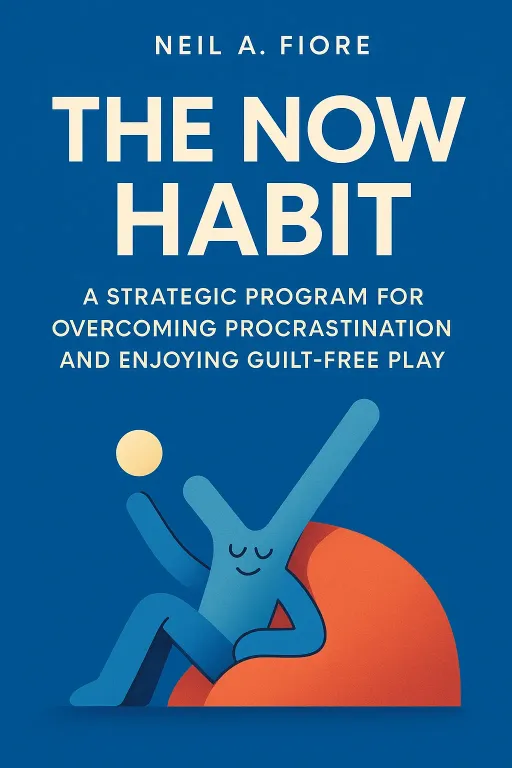
The Billable Hour & The Now Habit: A Lawyer's Guide to Conquering Procrastination
Golden Hook & Introduction
SECTION
Nova: You’re a top-tier lawyer. A massive, multi-billion dollar deal lands on your desk. The file is a foot high. You know you need to start, but you... check your email. You organize your pens. You do anything but touch that file. Why? What if I told you that paralysis isn't laziness, but a highly-evolved self-defense mechanism?
shnxf58fp8: That’s a question that I think haunts a lot of people in my profession. It feels like a personal failure, a lack of discipline.
Nova: Exactly! But that's the revolutionary idea from Neil Fiore's 'The Now Habit,' and it changes everything for high-performers. Welcome to the show, everyone. Today, we're joined by shnxf58fp8, a corporate, M&A, and tax attorney who lives and breathes this high-pressure world. We're going to use 'The Now Habit' as a strategic manual for the mind.
shnxf58fp8: Thanks for having me, Nova. I’m intrigued. A 'strategic manual' is language I understand.
Nova: I thought you might! Today, we're going to tackle this from two powerful perspectives. First, we'll uncover the real psychological reason high-achievers like you procrastinate. Then, we'll reveal a counterintuitive but brilliant system for getting more done by scheduling play first. So, shnxf58fp8, that opening scenario… does that ring a bell in the legal world?
shnxf58fp8: It's not just a bell, it's a fire alarm. The bigger the deal, the more complex the tax implications, the heavier that file feels. The avoidance tactics become almost comical. You suddenly find yourself deep-cleaning your office keyboard instead of opening the purchase agreement.
Deep Dive into Core Topic 1: Redefining Procrastination
SECTION
Nova: It's such a universal feeling! And this is where Fiore's first big idea comes in. He says procrastination isn't a character flaw. It's a habit we learn to cope with anxiety. It’s a temporary escape from a task we associate with pressure, judgment, or the fear of failure.
shnxf58fp8: So it's a symptom, not the disease itself.
Nova: Precisely. And the disease is often anxiety. There’s a powerful story in the book about a woman named Clare. She's a young professional at a marketing company, a classic high-achiever, always been a good student. But at her job, she's struggling. She keeps putting off major projects, and she gets a terrible performance review. Her job is literally on the line.
shnxf58fp8: I can feel the anxiety just hearing that. That's the nightmare scenario for any associate at a law firm.
Nova: Right? And when she goes to therapy, she realizes the problem isn't laziness. The problem is that she's terrified. She's terrified of not being perfect, of being judged by her critical boss, of failing to live up to the 'star employee' image she has of herself. Procrastination becomes her shield. By not starting the project, she can't be judged on it.
shnxf58fp8: That makes so much sense. Law school drills into you that 'good enough' is failure. You're trained to spot every flaw, to anticipate every counter-argument. You internalize this impossibly high standard. So when you face a real-world task, like drafting a critical clause in a merger agreement, the fear of missing something, of not being perfect, can be paralyzing.
Nova: And that ties directly to a key quote from the book: "The fear of judgment is the key fear that stems from over-identifying who you are, your worth as a person, with your work."
shnxf58fp8: That's the core of it. In M&A, a mistake in the due diligence can cost a client millions. Your work your reputation. It feels like your entire personal and professional worth is condensed into that one document. So you procrastinate on starting the review because as long as you haven't started, you haven't failed yet. It's a temporary, and very costly, safe harbor.
Nova: A costly safe harbor. I love that phrasing. It perfectly captures the paradox. You're trying to protect yourself, but the 'protection' itself is what causes the damage—missed deadlines, added stress, poor quality work done at the last minute.
shnxf58fp8: And the cycle feeds itself. The last-minute rush produces work that you know isn't your best, which reinforces the feeling of inadequacy and makes you even more anxious about the next big project. It's a vicious loop.
Nova: It is. But if we accept that the problem is anxiety and fear, then the solution can't just be 'try harder' or 'be more disciplined.' That's like telling someone with a fear of heights to just 'not be scared.' It doesn't work.
shnxf58fp8: So what does work? If not more discipline, then what?
Deep Dive into Core Topic 2: The Unschedule & Guilt-Free Play
SECTION
Nova: This is where it gets really interesting, and, I think, radical for a world that runs on billable hours. Fiore proposes we need to schedule first.
shnxf58fp8: Okay, you have my attention. That sounds like heresy in my industry. The mantra is 'bill more hours.'
Nova: I know! But think about it. If work feels like a punishment, a source of endless anxiety, you'll naturally resist it. Fiore's solution is a tool called the 'Unschedule.' It flips traditional time management on its head. Instead of a to-do list filled with obligations, you start with a blank weekly calendar.
shnxf58fp8: Okay, I'm with you so far.
Nova: First, you block out all of your non-work commitments. And I mean all of them. Dinners with friends, your workout, time with your family, sleep, even just an hour to read a novel or watch a movie. These are your protected blocks of guilt-free play.
shnxf58fp8: So you're building the week around your life, not your work.
Nova: Exactly! The empty 'white space' that's left over is the time you're allowed to work. And here's the psychological genius of it: for a procrastinator who resists being told what to do, this system creates a subconscious desire to work. The work isn't an endless slog anymore; it's a limited opportunity. You start to think, "Oh, I only have these two hours. I'd better make them count."
shnxf58fp8: That’s fascinating. My first thought is, 'There's no white space on my calendar!' But the logic is sound. The guilt we feel when we're to be working but are scrolling on our phones or watching TV is corrosive. It's not real rest. It’s just… anxious avoidance.
Nova: You nailed it. Fiore calls it 'guilt-free play.' It's a strategic recharge, not a guilty escape. He tells a story about a professor named Jeff who was completely blocked on writing a research paper for three years. He felt lazy and guilty. His therapist told him to stop trying to write and instead join a community theater, something he'd always wanted to do.
shnxf58fp8: And let me guess, he suddenly found the motivation to write?
Nova: He did! He poured 20-30 hours a week into rehearsals, loved it, and felt energized. After the play was over, he realized he could apply that same sense of commitment and enjoyment to his work. By scheduling in things he loved, the work periods became shorter, more focused, and less dreadful. He finished the paper. The play gave him the energy for the work.
shnxf58fp8: That resonates deeply. It's like when you're stuck on a complex tax provision. Staring at it for eight hours straight is utterly useless. Your brain just shuts down. But going for a run, having dinner with a friend, and coming back to it the next morning… suddenly the connection is clear. This 'Unschedule' systemizes that insight. It's not about being lazy; it's about creating the mental conditions for high-level analytical work.
Nova: It’s treating yourself like a peak performer, not a machine. The author himself used this system to finish his doctoral dissertation in one year while working a full-time job. He only averaged about 15 to 20 hours of focused, quality work on it per week, and he had plenty of leisure time. Because when he worked, he was working.
shnxf58fp8: Quality over quantity. It’s a simple concept, but so hard to implement when your performance is measured in six-minute increments. This provides a framework to actually do it.
Synthesis & Takeaways
SECTION
Nova: So let's bring this all together. We've seen that procrastination is a shield against anxiety, especially the fear of judgment that's so intense in fields like law.
shnxf58fp8: And that the way to lower that shield isn't with brute force or more discipline, but with the strategic promise of guaranteed, guilt-free rest.
Nova: It’s a total mindset shift. And I think, shnxf58fp8, you put it perfectly. It's about seeing yourself as a strategic performer.
shnxf58fp8: Right. Rest isn't a weakness or a luxury; it's a non-negotiable part of the performance. A tired mind can't spot a fatal flaw in a contract. A rested mind can.
Nova: The book is filled with these powerful, simple reframes. But if we could leave our listeners with just one, maybe it's this one. The next time you face a daunting task—that massive brief, that complex deal—don't tell yourself 'I have to finish this.' Fiore says to just tell yourself, 'I choose to start for 30 minutes.' That's it. What does that small shift feel like to you?
shnxf58fp8: It feels like taking back control. 'I have to' is the language of a victim. 'I choose to' is the language of an agent, an architect. It moves you from being a victim of your workload to the architect of your effort. And for a lawyer, being in control is everything.
Nova: The architect of your effort. A perfect way to end it. shnxf58fp8, thank you so much for bringing your insight to this.
shnxf58fp8: My pleasure, Nova. This was genuinely thought-provoking. I might have to go buy a new calendar.









