

Personalized Podcast
Golden Hook & Introduction
SECTION
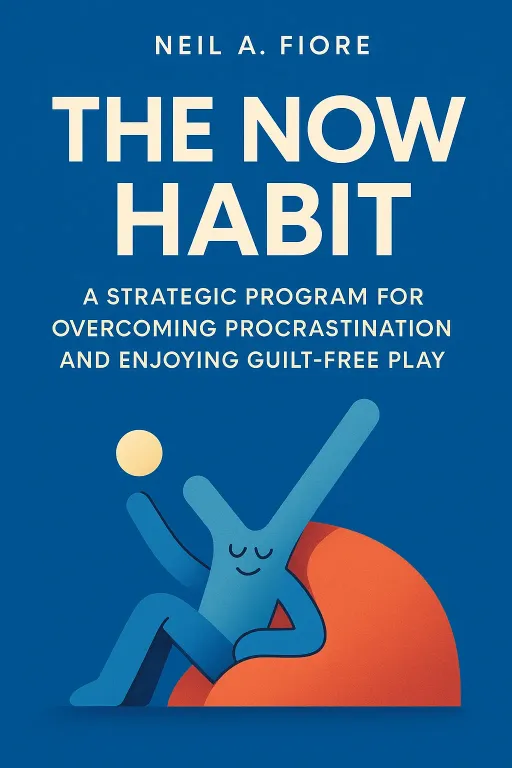
Nova: Imagine you are standing at the open door of a plane, ten thousand feet in the air. The wind is roaring, your heart is hammering against your ribs, and every single nerve ending is screaming, do not jump. You are frozen. Now, most people think the way to get through that paralyzing fear is sheer willpower, or maybe having someone yell at you to just do it. But what if the secret to jumping, and to starting that massive, overwhelming project you have been putting off for months, is actually a radical shift in how you talk to yourself? Welcome to the show. I am Nova, and today we are diving into Neil Fiore's classic productivity masterpiece, The Now Habit. Joining me is Levi, a veterinary medicine student with a deep passion for leadership, entrepreneurship, and agribusiness. Levi, it is so wonderful to have you here.
Levi: It is great to be here, Nova. You know, that paratrooper metaphor really hits home. In veterinary medicine and agribusiness, we are constantly dealing with high-stakes, fast-moving situations where a single decision can affect animal health, farm livelihoods, or entire supply chains. The pressure to be perfect can make you want to freeze right at the door of the plane.
Nova: Oh, absolutely. We often beat ourselves up for freezing, calling ourselves lazy or disorganized. But Fiore completely flips that script. Today, we are going to tackle this book from three game-changing angles. First, we will explore why procrastination is actually a shield against anxiety, not a character flaw, and how to shift from a mindset of pressure to one of choice. Second, we will look at the counterintuitive magic of the Unschedule, which is all about putting play first to pull ourselves into high-quality work. And finally, we will discuss how to embrace messy first drafts and use quick focusing exercises to enter the flow state and build true entrepreneurial hardiness. Ready to dive in, Levi?
Levi: Let's do it, Nova. I am really curious to see how we can apply these psychological tools to the unique challenges of leading teams and running businesses in agriculture.
Deep Dive into Core Topic 1
SECTION
Nova: Let's start with Fiore's core premise, which is honestly so liberating. He argues that procrastination is not a character defect. It is a learned behavior, a coping mechanism to deal with the intense anxiety of starting or completing a task. Think about it. We procrastinate because we associate the task with pain, judgment, or a threat to our self-worth.
Levi: That makes so much sense from an analytical perspective. If we view a task as a threat, our brain's threat-detection system kicks in, and avoidance becomes a highly logical survival strategy. It is like an animal avoiding a predator. But in our case, the predator is the fear of failure or criticism.
Nova: Exactly. Take the story of Clare from the book. Clare was a brilliant young professional in her late twenties working at a rapidly expanding medical marketing company. She received a poor performance evaluation because she was constantly turning things in late. When she went to therapy, she realized her procrastination went all the way back to grade school. She grew up in a highly critical family where her worth was entirely tied to her achievements. So, when her boss gave her a complex project, her inner critic started screaming that if she made a mistake, it meant she was a failure as a person. To protect her self-worth, she delayed starting. That way, if the project was not perfect, she could blame it on a lack of time rather than a lack of ability.
Levi: Wow, that is a classic perfectionist trap. I see this all the time in veterinary school. We are surrounded by high achievers who are terrified of making a mistake on a clinical rotation or misdiagnosing a patient. We raise the stakes so high that the task becomes terrifying. But what Clare's story shows is that the real issue is not time management; it is self-worth management.
Nova: Spot on, Levi. And then there is Larry's story, which shows another side of procrastination: resistance to authority. Larry was a fifty-five-year-old production supervisor at a CD manufacturing company. He felt constantly passed over for promotions and deeply resented his younger manager, Bill. Because Larry felt powerless to express his anger directly, he started procrastinating on reports and ignoring Bill's requests. It was passive-aggressive resistance. Procrastination became his way of reclaiming a sense of control.
Levi: That is an incredible insight for leadership. In agribusiness, you might have farm managers or veterinary technicians who seem to be procrastinating or dragging their feet on protocols. As a leader, it is easy to assume they are just lazy. But Larry's story suggests that their delay might actually be a silent protest against feeling micromanaged or unappreciated. If we do not give people autonomy and a voice, they will use procrastination as a weapon of resistance.
Nova: It is a silent rebellion, right? And the way we fuel this rebellion in ourselves is through our self-talk. We constantly tell ourselves, I have to do this, or I should have started earlier. Fiore points out that these phrases are authoritarian. They create an internal civil war. One part of you says, you have to, and the other part, the rebellious inner child, says, make me!
Levi: Yes, the language of obligation. When I say, I have to study for this pathology exam, I am positioning myself as a victim of my schedule. But when the author was in paratrooper training at Fort Benning, he realized that telling himself, you have to jump, just froze him with fear. He had to shift his language to, I choose to jump because I want to complete this training and maximize my safety. That shift from victim to chooser is everything. It aligns your energy instead of splitting it.
Nova: It really does. In the book, there is also the story of Betty, an administrator for a large insurance company who absolutely dreaded writing the annual report. It made her depressed, fatigued, and gave her terrible insomnia. But once she started challenging every, I have to, with an adult decision, things changed. She told herself, I choose to start on one small section of this report today, and if I decide it is too miserable, I can choose to look for a different job. Just acknowledging that she had a choice removed the feeling of being trapped, and she finished the report without the usual agony.
Levi: That is a powerful shift. As an entrepreneur, you are constantly faced with tasks you do not particularly enjoy, whether it is bookkeeping, regulatory compliance, or dealing with difficult supply chain issues. If you approach them with, I have to, you are going to procrastinate. But if you say, I choose to handle this regulatory paperwork because it protects my business and allows me to pursue my vision, you reclaim your power. You are no longer a victim of the system; you are the leader of your venture.
Deep Dive into Core Topic 2
SECTION
Nova: That leads us beautifully into our second topic, which is the actual system Fiore designed to make this shift practical: the Unschedule. Now, this is highly counterintuitive. Most time-management systems tell you to schedule your work first and then fit in play if you have time. But the Unschedule does the exact opposite. You schedule your guilt-free play, your exercise, your social time, and your meals first.
Levi: When I first read about this, my analytical brain was a bit skeptical. As a busy student balancing veterinary medicine and agribusiness projects, my instinct is to block out twelve hours of study time and hope for the best. But Fiore's point is that when we schedule endless blocks of work, we associate our goals with deprivation. We look at the calendar and see a prison.
Nova: Exactly. It is a psychological prison. The Unschedule leverages reverse psychology. By scheduling your fun activities first, you see that your time is actually limited. You might look at your day and realize, wait, after classes, meals, and my run, I only have three hours of open time. Suddenly, those three hours become precious. You do not want to waste them.
Levi: It is like the difference between a buffet and a scarce delicacy. If you think you have all day to work, you will spend hours drifting, checking your phone, and feeling guilty. But if you know you only have a thirty-minute window before you meet friends for dinner, you are highly focused. Fiore actually recommends committing to just thirty minutes of quality, uninterrupted work at a time. You do not log the work on your Unschedule until you have actually completed those thirty minutes.
Nova: Yes, that is a crucial detail. It is a retrospective logging system. You only get to color in that block on your calendar after you have done the work. It acts as an immediate visual reward. It is based on B. F. Skinner's behavioral research. Skinner actually used a time clock to track his own writing hours. It is not about forcing yourself to work for eight hours; it is about accumulating these high-quality, thirty-minute blocks.
Levi: This is incredibly relevant for agribusiness entrepreneurs. When you are starting a business, there is no boss telling you when to work. The temptation is to work twenty-four-seven, which leads to burnout and decision fatigue. But if you use the pull method of motivation, where you pull yourself toward work by promising yourself a reward, you maintain your energy. Look at Jeff's story in the book. Jeff was a thirty-five-year-old college professor who had been trying to write a scholarly paper for three years. He felt incredibly guilty and lazy. The author told him to stop torturing himself and do something he loved. Jeff joined a community theater, committing twenty to thirty hours a week to rehearsals.
Nova: And what happened? Because he had this massive, joyful commitment outside of work, his available time for writing shrank. He was forced to make his writing periods shorter and more focused. The joy and physical movement of the theater energized him, and he completed and published his paper within a few months. The play actually pulled him into his work.
Levi: That is a beautiful example of the pull method. It reminds me of Carlos, another person mentioned in the book. Carlos came from a working-class family and always held at least two jobs while staying active in sports and social life. He treated his play as earned and revitalizing. He did not feel guilty about resting because he knew it was the fuel for his next productive block. In agribusiness, we need that kind of sustainable energy. If you are managing a farm or running a startup, you cannot afford to burn out. Your team needs you to be sharp, creative, and resilient. Scheduling guilt-free play is not selfish; it is a strategic business decision.
Nova: It really is. It is about maintaining your most valuable asset, which is your own mind and health. If you are constantly running on empty, your decision-making suffers, and in agribusiness, poor decisions can be incredibly costly.
Deep Dive into Core Topic 3
SECTION
Levi: Absolutely. And that brings us to the third major challenge: actually starting when we feel overwhelmed by the sheer scale of a project. As an ENTP, I love the big-picture visioning phase of entrepreneurship. But when it comes to the nitty-gritty execution, the details can feel like a massive brick wall.
Nova: Oh, the brick wall. That is a perfect transition to our third topic: entering the flow state and embracing messy first drafts. Many of us procrastinate because we think our first attempt has to be perfect. We compare our rough, initial ideas with the polished, final products of our competitors or mentors. But Fiore reminds us that initial drafts must be protected from criticism.
Levi: I love the story about the Harvard library drafts. It is such a powerful way to normalize the creative process. New students at Harvard are taken to a special section of the library to look at the rough drafts of famous authors. They see that these geniuses did not just sit down and write a masterpiece in one perfect stroke. Their first drafts were messy, disorganized, and full of crossed-out lines and half-baked ideas.
Nova: It is so comforting to realize that, isn't it? Even the greatest minds in history had to start with a mess. If we expect our first draft to be perfect, we will never start. We have to give ourselves permission to write a bad first draft, to make mistakes, and to learn as we go.
Levi: That is a vital lesson for leadership and entrepreneurship. In agribusiness, if you are developing a new business model or a herd health protocol, you cannot wait for a perfect plan. You have to start with a minimum viable product, a messy first draft, and then iterate based on real-world feedback. If you wait for perfection, the market will pass you by.
Nova: Exactly. And to help us get over that initial friction of starting, Fiore introduces a simple, two-minute focusing exercise to help us enter the flow state. The flow state is that magical zone where time seems to disappear, distractions fade away, and you are fully immersed in the task.
Levi: Yes, and the key to entering that state is calming our physical nervous system. Think about Jacob's story. Jacob was a forty-year-old carpenter who transitioned into being a contractor. Suddenly, he was out of his comfort zone. Instead of working with his hands, he had to manage employees, talk to clients, and make complex business decisions. He felt completely overwhelmed and started avoiding phone calls and delaying projects. He learned to use the two-minute focusing exercise. He would close his eyes, take a few deep, slow breaths, let go of the past and future, and focus entirely on the present moment.
Nova: It sounds so simple, but it is incredibly powerful. By taking those two minutes, Jacob was able to quiet his anxiety and remind himself that he did not have to solve every problem at once. He just had to take the next small step. It created a sanctuary of calm in his busy day, allowing him to step onto the board with a safety net.
Levi: That board metaphor is brilliant. If you ask someone to walk across a narrow board on the ground, they can do it easily. But if you suspend that same board a hundred feet in the air, they freeze because the risk of falling is too high. Procrastination is like walking that high board without a net. We make the stakes so high that we are terrified of falling. But the focusing exercise, and the commitment to self-worth independent of performance, creates a safety net. It lowers the board back to the ground so we can just walk.
Nova: I love that connection, Levi. When we feel safe, we can take risks, we can be creative, and we can enter that flow state. We are no longer fighting our own anxiety; we are channeling all our energy into the task at hand.
Synthesis & Takeaways
SECTION
Levi: This has been such an eye-opening conversation, Nova. Looking at through the lens of leadership and agribusiness really highlights how these tools are not just about personal efficiency. They are about building a resilient, high-performing culture.
Nova: They really are. Let's do a quick recap of the major shifts we discussed today. First, we need to stop blaming ourselves for procrastinating and recognize it as a signal of anxiety. We can dismantle that anxiety by shifting our self-talk from, I have to, to, I choose to. Second, we can use the Unschedule to prioritize guilt-free play, using the pull method to make our work periods highly focused and rewarding. And third, we must embrace messy first drafts and use quick focusing exercises to lower the stakes, create a safety net, and enter the flow state.
Levi: Absolutely. For anyone listening who is leading a team, running a business, or just trying to survive a demanding academic program, my challenge to you is this: pick one project you have been putting off. Do not try to finish it. Just commit to thirty minutes of focused work today, and promise yourself a specific, guilt-free reward immediately afterward. Create that safety net for yourself.
Nova: That is a perfect call to action, Levi. Thank you so much for sharing your incredible insights and connecting these psychological principles to the vital world of agribusiness and leadership.
Levi: Thank you, Nova. It was an absolute pleasure.
Nova: And to our listeners, thank you for tuning in. Remember, you do not have to be perfect to start. You just have to keep starting. Until next time, keep building your pasture of productivity, and enjoy your guilt-free play!









