

The Anti Procrastination Blueprint
Golden Hook & Introduction
SECTION
Nova: Laziness is a myth. If you were actually lazy, you wouldn’t feel guilty when you aren’t working. The fact that you feel bad means you care, and that is actually the root of the problem.
Atlas: That hits hard. Most people label themselves as lazy because they can’t get that one project across the finish line. Are you telling me that my inability to start this report isn't a character flaw?
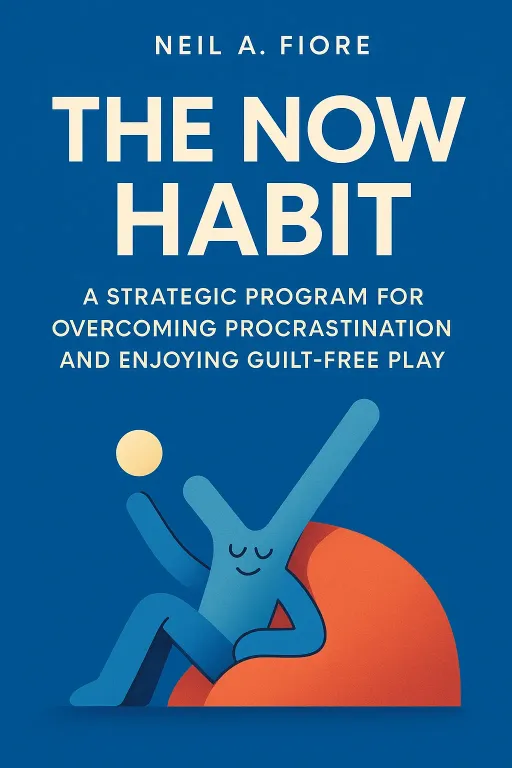
Nova: It is absolutely not a character flaw. Today, we are dismantling the architecture of procrastination using insights from Neil A. Fiore’s classic book, The Now Habit, and pairing it with the modern, razor-sharp anxiety-management framework from Sarah Knight’s Calm the F*ck Down.
Atlas: I am familiar with the feeling of drowning in tasks, but I’ve always viewed it as a discipline issue. You are suggesting that my brain is actually trying to protect me from something.
Nova: Exactly. Neil Fiore was a psychologist who realized that the most chronic procrastinators were often high achievers who held themselves to impossible standards. He uncovered that procrastination is a psychological defense mechanism against the fear of failure and the weight of perfectionism.
Atlas: That is a fascinating way to frame it. Usually, I think of procrastination as a lack of willpower, but you are describing it as a survival instinct.
Nova: Think of it this way. If you never start the project, you can never fail at the project. It is a way to keep your self-worth intact. Sarah Knight takes this further by helping us triage the chaos. She provides a method to separate what we can control from what we cannot, ensuring we save our mental bandwidth for the things that actually matter.
Atlas: I like the idea of triage. In my world, everything feels like a priority, which means nothing is. Let us break down how we stop this cycle, starting with why our brains are sabotaging us in the first place.
The Psychology of Defense
SECTION
Nova: We have to start with the concept of the Fear of Failure. When you have a massive task looming, your brain perceives it as a threat. It is the same physiological response as seeing a predator. You want to run away, or in this case, hide in a distraction.
Atlas: That feels incredibly accurate. When I have a high-stakes presentation, I suddenly find it fascinating to reorganize my email folders or research something completely irrelevant. I thought I was just avoiding work, but you are saying I am avoiding the potential judgment of that presentation.
Nova: Precisely. You are protecting your ego. Fiore explains that if you wait until the last minute, you create an excuse. If you fail, you can tell yourself, well, I only had two hours to do this, so it is not my fault. It is a safety net.
Atlas: That is a brilliant observation. I have done that so many times. I sabotage my own time so that I have a ready-made excuse for why the output wasn't perfect. It is a perverse kind of self-protection. But how do we get out of that loop? I cannot just turn off my need to be successful.
Nova: You do not need to turn it off. You need to reframe it. The problem is that we view work as a punishment that consumes our entire existence. We think that if we start, we will never have free time again. This is where the Unschedule comes in.
Atlas: I have heard that term before, but it sounds counter-intuitive. How does scheduling less work help me get more done?
Nova: It is about changing your relationship with time. Most people create a to-do list that is a mile long and then try to fit their life into the gaps. Fiore suggests the opposite. You block out your non-work activities first. Sleep, meals, gym, social time, your favorite shows. You treat those as non-negotiable commitments to yourself.
Atlas: Wait, hold on. If I block out all my downtime first, I am going to have even less time for work. That sounds like a recipe for a missed deadline.
Nova: That is the fear talking. What happens is that you prove to your brain that you have a life. You are not a machine designed to grind until you collapse. When you see that you have dedicated time for yourself, the work tasks no longer feel like a threat to your entire identity. They become small, manageable slots in your day.
Atlas: I see where you are going with this. By guaranteeing my downtime, I remove the scarcity mindset. I am not fighting for my life; I am just managing my hours.
Nova: Exactly. And here is the kicker. You only commit to fifteen minutes of focused work on your hardest task at a time. That is it.
Atlas: Fifteen minutes? That feels almost too easy. I can do anything for fifteen minutes.
Nova: That is the point. The barrier to entry for fifteen minutes is incredibly low. You are not committing to the whole project; you are just committing to starting. Once you start, the momentum often carries you forward. But even if it doesn't, you have fulfilled your commitment. You have made progress.
Triage and Bandwidth
SECTION
Atlas: Okay, I am sold on the Unschedule for the mechanics of getting things done. But what about the mental noise? I can get the work done, but I spend the whole time worrying about five other things that might go wrong. That is where I feel like Sarah Knight’s approach comes in.
Nova: You are spot on. While Fiore gives us the structure, Knight gives us the mental clarity. Her method is about triaging your anxiety. We often treat every problem like a five-alarm fire. A typo in a report? Fire. A delayed email from a client? Fire. A global economic shift? Fire.
Atlas: I definitely do that. I treat a minor inconvenience with the same emotional intensity as a genuine catastrophe. It drains me.
Nova: Knight suggests a simple mental exercise. When something triggers your anxiety, ask yourself: is this something I can control, or is it something I cannot? If you can control it, take action. If you cannot, you must categorize it as something you are not going to give any mental bandwidth to.
Atlas: That sounds simple, but it is incredibly difficult to execute in the moment. How do I actually stop caring when my brain is screaming that this is important?
Nova: It is a practice of detachment. You have to be ruthless with your mental resources. Think of your brain as having a limited amount of fuel. Every time you worry about something you cannot change, you are burning fuel that you need for the work that actually moves the needle.
Atlas: That is a powerful analogy. I am essentially wasting my limited energy on background radiation.
Nova: Yes. And Knight emphasizes that being calm is not about ignoring reality. It is about accepting the reality of what is in your power. If you are stressed about a project, focus on the step you can take right now. The rest? You have to let it go.
Atlas: I am thinking about our listeners who are in high-pressure roles, maybe managing teams or transitioning their careers. They probably feel like they have to worry about everything to be responsible.
Nova: That is the trap. Responsibility is not the same as worry. You can be responsible for a project without suffering over it. The goal is to be a high-performer who is also a high-functioning, calm human being.
Atlas: It sounds like a shift from being reactive to being strategic. Instead of letting the environment dictate my stress levels, I am choosing where to place my focus.
Nova: Precisely. You are the architect of your own mental space. By using the Unschedule, you secure your time. By using the Triage method, you secure your peace of mind.
Synthesis & Takeaways
SECTION
Atlas: It is interesting that both of these approaches, while different in technique, are ultimately about agency. Fiore is about taking control of your time, and Knight is about taking control of your attention.
Nova: That is the perfect synthesis. If you control your time and your attention, you are no longer a victim of your circumstances. You are a driver.
Atlas: I want to make sure I understand the action plan for this week. I am going to block out my non-negotiables first. Not just work, but the things that keep me sane.
Nova: Yes, and be honest with those blocks. If you need an hour for a workout, put it in the calendar as a firm appointment. Then, when you sit down to work, set a timer for fifteen minutes. Just fifteen. No expectations of finishing the whole thing. Just starting.
Atlas: And when the anxiety creeps in about whether it is good enough, or whether it will be finished in time, I check my triage list. Is this in my control? If yes, act. If no, let it go.
Nova: Exactly. And remember, the goal isn't to be perfect. The goal is to be present. You are building a legacy, and that requires sustainability. You cannot build anything lasting if you are constantly burning out from the fear of failing.
Atlas: This feels like a shift from a "hustle culture" mindset to a "high-performance" mindset. One is about burning out, the other is about endurance.
Nova: It is about the long game. The people who make the biggest impact are the ones who learn how to manage their energy, not just their hours.
Atlas: I think I am going to try the fifteen-minute rule on that project I have been avoiding all week. It feels much less daunting when you frame it as a short sprint rather than a marathon.
Nova: That is the spirit. And if it only takes fifteen minutes, you have already won. You have broken the paralysis.
Atlas: I love that. It’s not about the magnitude of the work; it’s about the consistency of the effort. Thank you for breaking this down. It makes the idea of "getting things done" feel much more human and achievable.
Nova: It is always a pleasure to dissect these ideas with you. Remember, your time and your focus are your most valuable assets. Protect them.
Atlas: We have covered a lot of ground today, from the psychological roots of procrastination to the practical tools to regain your focus. I hope our listeners feel empowered to reclaim their schedules and their peace of mind starting today.
Nova: This is Aibrary. Congratulations on your growth!









