

Conquering Procrastination and Designing Your Day
Golden Hook & Introduction
SECTION
Nova: Atlas, if you had to review your relationship with your calendar in exactly five words, what would they be?
Atlas: Constant guilt, zero actual fun.
Nova: That is a classic symptom of the productivity trap. We often treat our schedules like a strict schoolmaster holding a ruler, when they should feel more like a ticket to a theme park.
Atlas: Oh, I know that feeling of looking at a completely packed day and instantly wanting to crawl back under the covers. It feels like a list of obligations rather than a life.
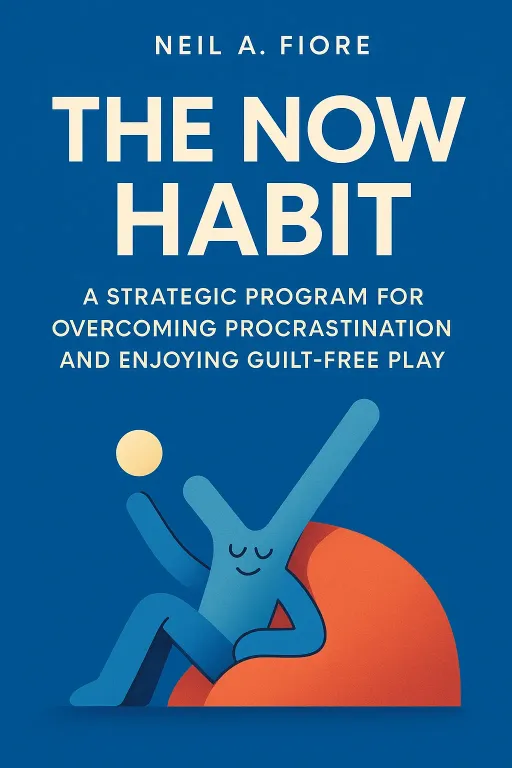
Nova: Exactly. Today we are diving into the groundbreaking work of psychologist Neil Fiore, specifically his widely acclaimed book, The Now Habit. Fiore spent years studying high-achieving doctoral students who were completely paralyzed by their dissertations. He realized that traditional productivity advice, which basically boils down to working harder and scheduling every single minute, was actually making the procrastination worse.
Atlas: That makes perfect sense because the more pressure you put on yourself, the more you want to run away from that pressure. It is a vicious cycle.
Nova: It really is. Fiore uncovered that procrastination is not a character flaw or a sign of laziness. It is actually a coping mechanism, a way to deal with the intense anxiety of starting a task. Today, we are going to explore how to completely dismantle that anxiety using two of his most powerful concepts: shifting our internal dialogue, and a highly counterintuitive tool called the Unschedule.
The Language of Agency
SECTION
Nova: Let us start with the way we talk to ourselves. Think about the phrases that run through your head when you have a big project looming. For most of us, it is a constant loop of, I have to finish this, or, I should be working right now.
Atlas: Oh boy, that is the background track of my entire week. I have to get this done, I must reply to these emails, I should be more productive. It feels like a constant scolding from an invisible boss.
Nova: It does. And psychological research shows that when we use words like have to, should, or must, we are actually triggering a subtle stress response. We are framing the task as an external demand, an obligation forced upon us. Our brain interprets this as a threat to our personal freedom.
Atlas: That explains why my immediate reaction to I have to is usually to go clean the kitchen or watch videos. It is like an inner rebel kicking against a bossy parent.
Nova: That is a perfect analogy. The inner rebel is trying to protect your autonomy. When you tell yourself you have to do something, you are putting yourself in the position of a victim. Fiore suggests a simple yet incredibly profound shift in your internal dialogue. He wants us to replace I have to with I choose to.
Atlas: Wow, that sounds almost too simple to work. Does changing a couple of words really make that much of a difference?
Nova: The magic is in how it alters your brain's perception of control. When you say, I choose to start this project, you are reclaiming your power. You are reminding yourself that you are in the driver's seat. Even if the task is something you do not particularly enjoy, choosing to do it because you want the outcome is a completely different psychological state than feeling forced to do it.
Atlas: I can see how that would change the energy. It is the difference between being dragged to the gym and walking in because you want to feel strong. But what about when the task is truly miserable? Like doing taxes. How do you say I choose to do my taxes with a straight face?
Nova: You frame it around the choice of consequences. You can say, I choose to do my taxes because I choose to avoid audit fees and keep my peace of mind. You are still the decision-maker. You are choosing the path that leads to the best outcome for you. It removes the feeling of being victimized by your to-do list.
Atlas: That is a really empowering way to look at it. It takes the moral weight out of the equation. It is no longer about being a good or bad person, just about making choices and accepting the results.
Nova: Precisely. Fiore also points out another common linguistic trap: I have to finish. This phrase focuses entirely on the distant, monumental end product, which can feel incredibly overwhelming. If you think about writing a whole book, or launching a massive marketing campaign, the sheer scale of it paralyzes you.
Atlas: Right, because you cannot do it all in one go, so you do not even know where to start.
Nova: Exactly. So the second shift is moving from, I have to finish, to, when can I start? Or even better, I choose to start for just fifteen minutes. By focusing on starting rather than finishing, and by keeping the time commitment tiny, you lower the barrier to entry. Anyone can work on something for fifteen minutes.
Atlas: That sounds like a brilliant way to trick your brain. Once you actually start, the momentum usually takes over, doesn't it?
Nova: It does. The hardest part of any task is almost always the transition from not working to working. Once you get over that initial friction, it becomes much easier to keep going. By focusing on the finished product, we make that friction point feel like a mountain instead of a speed bump.
The Unschedule Framework
SECTION
Nova: This brings us to Fiore's most famous and perhaps most radical concept: the Unschedule. Most productivity systems tell you to block out your work hours first. You open your calendar, you put in big blocks of time for project writing, meetings, and deep work, and then you squeeze your life into whatever gaps are left over.
Atlas: That is exactly how I have always done it. And honestly, it makes my calendar look like a prison sentence. Every hour is claimed by some task, and it feels like there is no breathing room.
Nova: And what happens when you inevitably fail to stick to that rigid schedule?
Atlas: Oh, the guilt is immediate. If I miss one block, the whole day feels ruined, so I just give up and procrastinate even more.
Nova: You are not alone in that. That is the standard cycle. The Unschedule completely reverses this dynamic. Instead of scheduling your work first, Fiore tells us to schedule our guilt-free play first.
Atlas: That sounds a bit out there. Are you saying I should put video games and hanging out with friends on my calendar before I even think about my actual job?
Nova: That is exactly what he is saying. You start by blocking out the non-negotiables of life: sleep, meals, exercise, commute, and most importantly, your recreational activities. You schedule your social outings, your hobbies, your reading time, your gym sessions. You make sure your leisure time is locked in and guaranteed.
Atlas: But how does the actual work get done if my calendar is full of fun stuff?
Nova: Here is the brilliant twist. You do not schedule any work at all on the Unschedule. You leave those spaces completely blank.
Atlas: Wait, let me check if I got that right. My calendar has sleep, lunch, dinner, a movie with friends, and a run. The rest of the page is just empty white space?
Nova: Yes. The work hours are left blank. And you are only allowed to log your work after you have actually done it. You treat your calendar as a record of achievement rather than a list of demands.
Atlas: Oh, I see. So it is like a reverse diary. I do thirty minutes of writing, and then I get to color in that block on my calendar?
Nova: Exactly. You only write down work sessions that last at least thirty minutes of focused, uninterrupted effort. If you get distracted after ten minutes, it does not go on the calendar. This turns the act of working into a game where you are collecting thirty-minute blocks of achievement.
Atlas: That is fascinating. It is like getting a gold star for actually doing the work, rather than getting a red mark for failing to do it. But why does scheduling the fun stuff first actually help you start working?
Nova: It addresses the core psychological reason we procrastinate: the fear of losing our freedom. When we look at a traditional schedule, we see a desert of endless work with no oasis of fun in sight. We subconsciously feel that if we start working, we will never get to play. So we resist starting.
Atlas: That makes so much sense. You procrastinate because you want to grab some fun right now, before the work swallows you whole.
Nova: Yes. But when you look at the Unschedule, you see that your play is already guaranteed. You know that at five o'clock, you are meeting a friend for dinner. You know that at noon, you have a relaxing lunch. The leisure is safe. It is not something you have to earn by working; it is already there. This dramatically reduces the psychological resistance to starting your work, because you know the work is not going to expand infinitely and steal your life.
Atlas: That is a massive paradigm shift. It is like realizing you do not have to starve yourself to deserve a good meal. The meal is already on the table, so you can actually enjoy the preparation.
Nova: That is a beautiful way to put it. And there is another benefit. When you see how little blank space you actually have left after scheduling sleep, meals, and play, you realize that your time is highly limited. If you only have three hours of unstructured time in a day, you are much more likely to use it efficiently because you feel the scarcity of that time.
Atlas: Right, instead of thinking I have all day to do this, you realize you only have a small window before your scheduled run. It creates a natural, healthy sense of urgency.
Overcoming Resistance & Real-world Implementation
SECTION
Atlas: I can hear a lot of our listeners who are managing high-pressure teams or working in demanding corporate environments thinking, this sounds great in theory, but my boss expects me to be available and working all day. How does someone in a high-stakes environment actually implement this without getting fired?
Nova: That is a very valid concern. It is important to clarify that the Unschedule is an internal tool for managing your own psychology, not necessarily something you present to your corporate managers. You do not have to show your boss a calendar that only has lunch and video games on it.
Atlas: That would certainly make for an interesting performance review.
Nova: It definitely would. Instead, you use the Unschedule to manage your own mental energy. Even in a demanding job, you still have control over your breaks, your evening hours, and how you frame your tasks. You can still block out your evening relaxation, your morning workout, and your lunch break first. This creates those essential boundaries that protect your mental health.
Atlas: That makes sense. It is about creating a mental sanctuary. Even if the middle of the day is chaotic, you know that your morning and evening are protected.
Nova: Exactly. And within those blank spaces of your workday, you apply the rule of recording your progress. You might have a chaotic day of meetings, but you look for those moments where you can get just thirty minutes of focused, uninterrupted work on your key project. When you achieve that, you log it. It helps you see that even in a chaotic environment, you are making tangible progress.
Atlas: I love that. It shifts the focus from what you did not get done to what you actually accomplished. But what about the temptation to cheat? What if I just sit at my desk, stare at a blank document for thirty minutes, and then write down that I worked?
Nova: Fiore is very strict about this. To log a block, it must be thirty minutes of quality, focused work. If you spend twenty minutes of that time scrolling through social media or checking news, it does not count. You have to be honest with yourself. The goal is to build self-trust. Procrastinators often have a very damaged relationship with themselves because they constantly break their own promises.
Atlas: Oh, I have been there. You promise yourself you will start at nine, then it is ten, then you promise you will work through the weekend, and by Sunday night you just feel like a failure.
Nova: Yes, and that failure further erodes your confidence, making you more anxious the next time you face a task, which leads to more procrastination. It is a downward spiral. The Unschedule helps rebuild that self-trust. By starting with small, honest, thirty-minute blocks, you prove to yourself that you can follow through. You build positive momentum.
Atlas: It sounds like we are training ourselves like athletes. You do not start by running a marathon; you start with a short jog, and you celebrate that jog.
Nova: That is a perfect example. And just like an athlete, you need recovery time. In fact, Fiore argues that high-quality recreation is absolutely essential for high-quality work. He calls it guilt-free play. If your play is filled with guilt because you feel you should be working, it is not actually restorative. You go back to work just as tired and anxious as before.
Atlas: That explains why scrolling on your phone for an hour doesn't actually feel relaxing. You are doing it to avoid work, so the whole time you have this background hum of anxiety.
Nova: Precisely. It is junk food leisure. It fills the time, but it does not nourish you. Guilt-free play, on the other hand, is active, intentional, and fully enjoyed because you have decided that this is your designated time to recharge.
Synthesis & Takeaways
SECTION
Atlas: This whole approach really challenges the cultural narrative that we have to suffer and sacrifice our lives to be successful. It suggests that happiness and balance are actually the prerequisites for high performance, not the reward at the end of a long career.
Nova: You have hit on the deepest insight here. We live in a society that fetishizes busyness and treats exhaustion as a badge of honor. We are conditioned to believe that if we are not working, we are wasting time. But Fiore's work shows that this systemic obsession with constant productivity is actually what drives us to procrastinate. We avoid work because we have turned it into a monster that threatens to consume our entire lives.
Atlas: That is a profound realization. By reclaiming our play, we are actually reclaiming our work. We are making work a sustainable, chosen part of a full life, rather than an all-consuming obligation.
Nova: Exactly. When we protect our leisure, we remove the threat. Work stops being a monster and becomes just another choice we make in a well-designed day.
Atlas: So, for our listeners who want to start repairing their relationship with time this week, what is the first step?
Nova: The first step is the Unschedule experiment. This week, open your calendar and block out your meals, your sleep, and your recreation first. Secure your guilt-free play. Then, leave the work hours blank and commit to logging only the focused, thirty-minute sessions of work you actually complete. Watch how knowing your leisure is safe reduces the psychological resistance to starting.
Atlas: I am definitely going to try that. It feels like a much friendlier way to live.
Nova: It really is. It is about treating yourself with compassion and respect, rather than trying to bully yourself into productivity.
Atlas: This is Aibrary. Congratulations on your growth!









