

The War Between Networks
Introduction
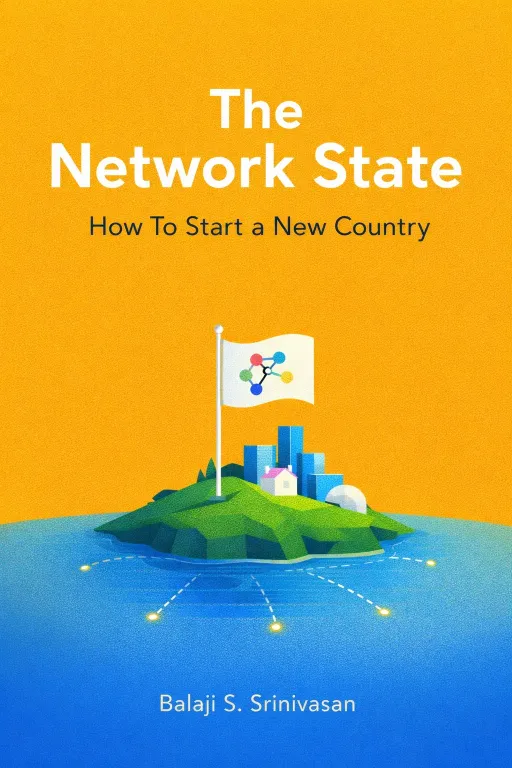
Narrator: What if the next civil war wasn't fought between states, but between networks? A war not for territory, but for the control of minds, waged between the centralized power of the US Dollar and the decentralized power of Bitcoin. This isn't just a far-fetched sci-fi plot; it's a potential future explored in Balaji Srinivasan's provocative book, The Network State. The book argues that the age of the traditional nation-state, a system that has dominated the globe for nearly 400 years, is coming to an end. In its place, Srinivasan offers a radical blueprint for building new countries from scratch, starting with nothing more than an internet connection and a shared idea. It’s a guide to moving from protest to creation, from arguing with the old world to building a new one.
History is a Weapon in the War Between Narrative and Truth
Key Insight 1
Narrator: Before one can build a new society, Srinivasan argues, one must understand how the old ones are maintained. The book posits that history is not a neutral academic subject but a practical and often weaponized tool. It’s used to win arguments, justify laws, and shape a population's moral beliefs. This leads to a provocative conclusion: "If the News is Fake, Imagine History." If contemporary media can be biased, then historical narratives, written by the victors, are even more suspect.
This creates a fundamental conflict between what the book calls "political power" and "technological truth." Political power relies on narratives that are true simply because enough powerful people believe them. Technological truth, in contrast, is verifiable regardless of belief. The book offers a compelling case study in the clash between Tesla and the New York Times. When a reporter claimed a Tesla car had a design flaw that caused it to run out of charge, Elon Musk didn't just issue a press release. He released the car's data logs—the technological truth—which showed the reporter had intentionally driven in circles to drain the battery. The verifiable data defeated the political narrative. For Srinivasan, this is a microcosm of a larger shift. Technologies like the blockchain, which create an unchangeable, verifiable history of transactions, represent the ultimate form of technological truth, a powerful new weapon for individuals against the narratives of the state.
The One Commandment Principle for Building Parallel Societies
Key Insight 2
Narrator: If history is a tool for critiquing the present, how does one begin building an alternative? Srinivasan’s answer is the "One Commandment." Instead of trying to create a perfect, all-encompassing utopia, a startup society should begin by identifying a single moral flaw in the current world and dedicating itself to fixing it. This focused approach, much like a tech startup focusing on a single product innovation, makes the monumental task of societal creation manageable.
The book provides several vivid examples. A "Keto Kosher" society could be founded on the commandment that "sugar is bad." This online community would crowdfund physical properties—apartments, gyms, and eventually towns—where processed foods and sugar are banned. A "Digital Sabbath" society might follow the commandment that "24/7 internet is bad," creating physical spaces with scheduled internet shutdowns and Faraday cages to foster intentional disconnection. These "parallel societies" don't seek to overthrow the existing system but to build opt-in alternatives alongside it. They critique by building, demonstrating the value of their chosen moral innovation and attracting citizens who share that one core belief.
The World is Fracturing into a Tripolar Order
Key Insight 3
Narrator: The urgency for building these new societies comes from the book’s analysis of our chaotic global landscape. Srinivasan argues the world is no longer unipolar or bipolar, but is rapidly becoming tripolar. The three competing poles are not just countries, but global networks with distinct ideologies.
First is "NYT," representing the American Establishment and its ideology of "Woke Capital." Its primary tool is Moral Power, wielding influence through media narratives, decentralized censorship, and cancel culture. Second is "CCP," the Chinese Communist Party, which represents "Communist Capital." Its primary tool is Martial Power, exercising top-down control through a pervasive party-state apparatus and a formidable manufacturing base. The third and newest pole is "BTC," representing the global internet and the ideology of "Crypto Capital." Its primary tool is Money Power, offering stateless capitalism, censorship-resistance, and individual sovereignty through technologies like Bitcoin. These three forces—NYT, CCP, and BTC—are now in a constant state of conflict and shifting alliances, creating a volatile environment where the old rules no longer apply.
Navigating the Future: American Anarchy vs. Chinese Control
Key Insight 4
Narrator: Projecting this tripolar conflict into the future, the book paints a stark, speculative scenario. On one side is "American Anarchy." As the US establishment (Dollar Green) loses control and legitimacy, it enters into a digital civil war with a rising, decentralized insurgency built around cryptocurrency (Bitcoin Orange). This isn't a war for land, but a "War Between the Networks" for control of information and capital, leading to societal chaos and fragmentation.
On the other side is "Chinese Control." In this scenario, the CCP, facing its own internal threats, perfects a total surveillance state. Using a digital yuan, AI monitoring, and social credit systems, it achieves unprecedented control over its population, effectively solving the central planning problem and creating a highly efficient, if authoritarian, society. It then begins to export this model of digital control to other nations. Faced with these two dystopian extremes, the book argues for the necessity of an "International Intermediate"—a third way, built by pragmatic founders who seek to create a "recentralized center" of high-trust, opt-in startup societies as an escape from both chaos and tyranny.
The Blueprint for a Network State
Key Insight 5
Narrator: The Network State provides a detailed blueprint for this third path. It is defined as a social network with a moral innovation, a recognized founder, and the capacity for collective action, that eventually crowdfunds territory around the world and achieves diplomatic recognition. The process unfolds in stages. It begins as a "startup society" or "network union," a purely online community. As it grows, it becomes a "network archipelago," a collection of crowdfunded physical enclaves, from apartments to neighborhoods, connected digitally. The final goal is to become a true "network state," a decentralized nation with a large enough population, a significant crypto-economy, and a coherent social contract to petition for sovereignty on the world stage.
This is made possible by a convergence of modern technologies. The internet provides the "land" for a nation to form, remote work allows citizens to live anywhere, and cryptocurrency provides a sovereign financial system. With an on-chain census to verifiably count its citizens and capital, a network state can prove its legitimacy in a way no new nation could before. It represents a fundamental shift: cloud first, land last.
Conclusion
Narrator: The single most important takeaway from The Network State is that the tools to peacefully create new, voluntary societies now exist. For centuries, starting a new country required conquest, revolution, or the consent of powerful empires. Srinivasan argues that technology has opened a third path: entrepreneurial state-building. It’s a call to action for innovators to stop arguing about broken systems and start building better ones, one "One Commandment" at a time.
The book leaves readers with a profound and challenging question. It demonstrates that we can build new countries, but it forces us to ask whether we should. Will these network states become beacons of freedom, innovation, and conscious governance, or will they simply become new forms of exclusive, digitally-gated communities? The answer will depend on the moral commandments chosen by their founders and the willingness of people to opt-in to a radically new vision of the future.