

The Network Effect: Why Connection Drives Value in Modern Markets
Golden Hook & Introduction
SECTION
Nova: You know that feeling when you're meticulously analyzing every single data point, every component, every individual piece of a puzzle? What if I told you that very precision, that hyper-focus on the individual, might be the biggest blind spot in understanding true value today?
Atlas: Whoa, that's quite a claim, Nova. My analytical mind is already buzzing. How can deep analysis actually be a? It sounds almost counter-intuitive.
Nova: It absolutely does, doesn't it? But that's exactly what we're diving into today, inspired by the powerful insights in "The Network Effect: Why Connection Drives Value in Modern Markets." We're talking about a fundamental shift in perspective, moving from isolated entities to interconnected systems.
Atlas: Right, because for anyone trying to discern patterns and master complexity, especially in rapidly evolving markets, a blind spot is the last thing you want. So, what are the big ideas that help us see past it?
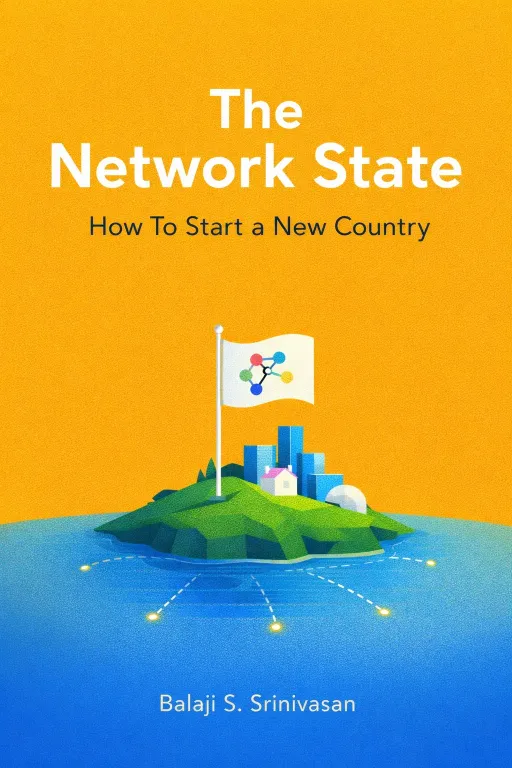
Nova: Well, two books really illuminate this for us. First, there's Balaji Srinivasan's "The Network State," a visionary look at how new forms of social and political organization emerge from online communities. Balaji, for anyone who doesn't know, is a Silicon Valley entrepreneur and investor; his ideas aren't just theoretical, they come from deep engagement with building the future of tech.
Atlas: Ah, so someone who's seen these network effects play out firsthand. That definitely adds weight.
Nova: Exactly. And then we have Geoffrey West's "Scale," which explores the universal laws of scaling in everything from biology to cities. Together, these works fundamentally shift our focus from individual components to the powerful, often exponential, growth generated by interconnected systems. It's about recognizing that overlooked value often hides in the collective.
The Blind Spot: Overcoming Individualistic Analysis with Network Thinking
SECTION
Nova: So, let's start with this "blind spot." Imagine you're a chef, and you're analyzing every single ingredient in a dish—the salt, the spice, the main protein—in isolation. You might understand each one perfectly, but you'd completely miss the magic, the synergy, the that happens when they combine. That's essentially what happens when we ignore network effects.
Atlas: That's a great analogy. So, for a strategic analyst, someone who's used to dissecting balance sheets or product roadmaps, how do you even begin to this blind spot? Because the instinct is to break things down.
Nova: The instinct is powerful, and it serves us well in many areas. But in modern markets, especially in technology and digital assets, value creation is increasingly non-linear. Think about a social media platform. Its individual features—the ability to post, to like—are important, but their value explodes exponentially with each new user who joins and connects. The true value isn't in the single post button; it's in the millions of connections it facilitates.
Atlas: So, it's not just about counting the features, it's about counting the those features enable.
Nova: Precisely. And Geoffrey West's "Scale" gives us the scientific underpinning for this. He shows how network structures are fundamental to how things grow and operate efficiently. Whether it's the circulatory system in an animal, the roads in a city, or the communication pathways in a company, the way things are connected dictates their growth and longevity. Small changes in a network can have massive, non-linear effects.
Atlas: Like a tiny traffic jam eventually gridlocking an entire city, or one small viral post reaching millions. Can you give me a clear example where this individualistic analysis and network thinking in a tech context?
Nova: Absolutely. Think about the early days of something like Wikipedia. If you looked at it purely from an individual content creator's perspective, it seemed chaotic, potentially unreliable, and certainly not a viable business model. A traditional analyst might have said, "Where's the centralized control? Where's the editorial oversight? This can't possibly work."
Atlas: They'd be looking at each individual contributor, each article, and finding flaws.
Nova: Exactly. But the genius, the of Wikipedia, was in the collective intelligence, the decentralized collaboration of millions of editors. The value wasn't in any single entry; it was in the of knowledge, the self-correcting mechanisms, and the sheer volume of contributors. The cause was enabling millions to connect and contribute; the process was iterative, self-organizing knowledge creation; and the outcome was an encyclopedia vast beyond imagination, something no traditional, individually-authored encyclopedia could ever hope to achieve.
Atlas: That's a powerful point. It really highlights how focusing on the individual component would have completely missed the revolutionary potential. But what about the flip side? Are there times when network effects can be detrimental, or when this kind of thinking might actually mislead us?
Nova: That's a crucial question. Network effects can certainly create monopolies or amplify misinformation, for instance. The same exponential growth that creates immense value can also create immense problems if the network is designed or used poorly. It's not a silver bullet, but a powerful force that needs to be understood and directed. And that brings us perfectly to how we can use these principles to value.
Unlocking Hidden Value: Applying Network Principles to Innovative Technologies
SECTION
Nova: So, if seeing the blind spot is step one, then step two is actively using these network principles to the hidden value. And this is where Balaji Srinivasan's "The Network State" becomes incredibly relevant for understanding innovative technologies.
Atlas: Okay, so we've acknowledged the blind spot. Now how do we actually with this new lens? For a strategic analyst looking at innovative tech, what does a "network state" actually like, and how does it reveal value that a traditional valuation model would miss?
Nova: Great question. A "network state" is essentially a highly aligned, digital community that eventually achieves real-world governance, a kind of startup country. Its value isn't just in its underlying technology—the blockchain, the communication tools—but in the collective intelligence, the shared vision, and the coordinated action of its members. Traditional models might struggle to quantify the value of 'community cohesion' or 'collective alignment.'
Atlas: So, you're saying value isn't just in the code or the user interface, but in the and the that binds people together?
Nova: Exactly. Think about open-source software projects. Their value isn't just in the lines of code; it's in the global network of developers who contribute, audit, and improve it. Or consider a Decentralized Autonomous Organization, a DAO. Its power comes from its members collaboratively making decisions and allocating resources, creating a collective entity that can achieve things no single individual or traditional corporation could.
Atlas: So, for someone trying to identify overlooked value in these spaces, they need to look beyond the typical metrics. What are they looking for instead? How do you measure the health of a "network state" or a network-driven project?
Nova: You're looking at indicators of and. That means examining things like the depth of user engagement, the quality of community discussions, the velocity of contributions, the self-organizing capacity, and the alignment around a shared mission. It's about asking: how strong are the connections? How effectively can this network coordinate and execute? This is where the non-linear growth West talks about in "Scale" comes into play. A network with strong connections can grow and adapt with incredible efficiency, far beyond what a traditional, hierarchical organization could.
Atlas: But how does this connect back to Geoffrey West's "Scale"? Are we talking about similar underlying mechanisms even if one is digital and the other is physical?
Nova: Absolutely. West's work shows that across vastly different systems—from metabolic rates in organisms to the infrastructure of cities—there are universal scaling laws. Larger networks, up to a point, become more efficient per unit of size. For instance, cities grow super-linearly in terms of innovation and wealth, but sub-linearly in terms of infrastructure needs. This means a well-structured network can do as it grows.
Atlas: So, a thriving digital community, a 'network state,' if it's structured effectively, should also exhibit these scaling efficiencies. It should be able to achieve disproportionately more impact or innovation with each additional member or connection.
Nova: Precisely. The principles of interconnected systems driving non-linear growth apply across both. The value isn't just additive; it's multiplicative. And for a strategic analyst, understanding this allows you to identify technologies where the network itself is the product, where the connections are the most valuable asset, and where the potential for growth is exponential, not merely incremental.
Synthesis & Takeaways
SECTION
Nova: So, what we've really been discussing today is a paradigm shift. It’s about moving beyond the comfortable, but often limiting, lens of individual components, and embracing the profound power—and often overlooked value—of interconnected systems.
Atlas: And for an analyst who thrives on understanding patterns and mastering complexity, this isn't just an academic exercise. It's about equipping yourself with a new way of seeing, a new framework to identify the true engines of growth in modern markets. It sounds like trusting your intuition, but grounding it in this new kind of analytical framework.
Nova: Exactly. The overlooked value isn't hiding in some obscure corner; it's often right there in the connections, in the collective intelligence, in the way things scale and self-organize. It's about recognizing that the whole is not just greater than the sum of its parts, but often exponentially more valuable.
Atlas: So, for our listeners, I'd say the real takeaway is to challenge your own analytical defaults. Next time you're evaluating an innovative technology or a new market, ask yourself: what are the networks at play here? How are they creating value that I might be missing? Where are the non-linear effects hiding?
Nova: That's the key. It's about cultivating that 'network mindset' to unlock insights and opportunities that others might simply overlook.
Atlas: This is Aibrary. Congratulations on your growth!