

Mapping the Geopolitical Architecture of Digital Sovereignty
Golden Hook & Introduction
SECTION
Nova: The traditional nation-state is facing a quiet, digital rebellion. For centuries, geography was destiny, but today, we are witnessing a fundamental decoupling of power from physical location.
Atlas: That is a bold way to start, but I suspect many people listening right now are looking at their passports and thinking, wait, the state is still very much in control.
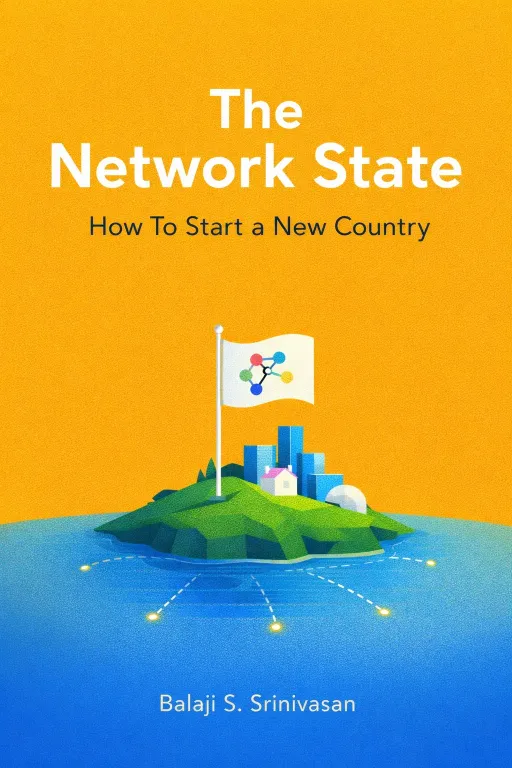
Nova: They are, but the architecture of that control is shifting. Today, we are exploring this transformation through two very different, yet complementary, lenses. We are looking at The Network State by Balaji Srinivasan and The Fourth Industrial Revolution by Klaus Schwab.
Atlas: Two heavy hitters. Balaji is known for his intense, almost prophetic, belief in crypto-economics and decentralized systems. And Klaus Schwab, of course, is the founder of the World Economic Forum, so he is coming at this from the perspective of global institutional change.
Nova: Exactly. Balaji provides the playbook for how a digital community can actually evolve into a sovereign entity. Schwab provides the landscape of the technological fusion that is making this transition inevitable. Together, they explain why the old industrial power structures are struggling to keep up with decentralized, digital systems.
Atlas: I am curious to see how these two disparate views reconcile. Let us jump into the mechanics of this shift.
The Rise of the Network State
SECTION
Nova: Let us start with Balaji Srinivasan’s core premise in The Network State. He argues that we have reached a point where digital communities have enough economic and social weight to transition from online affinity groups into something that looks and acts like a country.
Atlas: That sounds like a fascinating, if not slightly polarizing, idea. When I hear affinity group, I think of a subreddit or a Discord server. How does a group of people arguing on the internet actually become a sovereign state?
Nova: Balaji outlines a specific progression. It starts with an online community built around a shared value or goal. Then, they use blockchain technology to create a native economy, effectively bootstrapping their own currency and social contract. The final, critical stage is physical concentration. They move from the digital realm into physical territory, eventually seeking diplomatic recognition.
Atlas: So, it is not just about having a website. It is about building a parallel infrastructure. But here is the friction point for me. Diplomatic recognition is a gatekept club. How does a startup society convince existing nations to treat them as an equal?
Nova: That is the ultimate test. Balaji posits that legitimacy follows utility. If a network state provides better services, more security, or a more efficient economic environment than the incumbent state, people will move there. The physical territory becomes a byproduct of the digital success. It is the inversion of the traditional model where the state defines the territory first, and then the people follow.
Atlas: I see the logic there. It is essentially voting with your feet, but on a massive, organized scale. For our listeners who are navigating leadership roles, this is a lesson in how community and infrastructure are becoming inseparable. If you are building a team or a company, you are not just managing people; you are building the digital architecture of their environment.
The Fourth Industrial Revolution and the Fusion of Realities
SECTION
Nova: And that brings us perfectly into the second lens, Klaus Schwab’s The Fourth Industrial Revolution. While Balaji focuses on the geopolitical shift, Schwab focuses on the technological fusion that makes this all possible. He describes a world where the lines between the physical, digital, and biological spheres are dissolving.
Atlas: I have heard this term thrown around in boardrooms constantly, but it often feels abstract. What does the fusion of these three spheres actually look like in practice?
Nova: It looks like the disruption of the fundamental systems we rely on. Consider how we manage identity. In the past, your identity was tied to a physical ID card issued by a state. Now, with digital and biological fusion, your identity is increasingly tied to biometric data, digital credentials, and your online behavioral footprint. The technology is so integrated that the physical hardware, the software code, and the biological user are one continuous system.
Atlas: That is a stark way to put it. It sounds like we are moving away from the era of distinct tools and into an era of integrated ecosystems. If the physical, digital, and biological are fused, then governance has to change too, right? You cannot govern a fused reality with siloed, industrial-age bureaucracy.
Nova: Precisely. Schwab argues that this is why governance, business models, and even human identity are being disrupted. The old, centralized, slow-moving industrial power structures cannot react quickly enough to the speed of this technological fusion. This is where the connection to Balaji’s work becomes so clear.
Atlas: Because the centralized systems are too rigid to handle the fusion, they create a vacuum. And that vacuum is exactly where these decentralized network states can emerge.
Nova: You hit the nail on the head. The Fourth Industrial Revolution creates the technological capacity to operate outside traditional borders, and The Network State provides the social and economic framework to actually do it. It is a one-two punch that makes the traditional, centralized industrial model look increasingly like a legacy system.
Atlas: I am thinking about the audience listening to this. They are likely professionals, architects of their own careers. If they are operating in a world where these systems are fusing, the old way of working—where you just show up, do your job, and let the institution handle the rest—is becoming a liability.
Synthesis & Takeaways
SECTION
Nova: That is the most important takeaway. The shift from centralized industrial power to decentralized digital systems is not just happening at a global geopolitical level. It is happening in every team and every company.
Atlas: So, how does someone apply this today? We talked about the big picture, but let us get tactical. What is the tiny step our listeners can take this week to start optimizing for this reality?
Nova: It comes down to autonomy. If the future is decentralized and fused, then the most valuable asset is a team that can operate with maximum autonomy. I suggest listeners map out one digital tool or decentralized protocol their team currently uses.
Atlas: A digital tool or protocol. Okay, give me an example of how to optimize that for autonomy.
Nova: Let us say your team uses a project management tool. Most teams use it just for reporting tasks up to a manager. That is an industrial, centralized model. To optimize for autonomy, you shift the protocol. Use that tool to set clear, objective criteria for success so that the team can self-organize without waiting for approval at every step.
Atlas: I like that. You are effectively turning the project management tool into a decentralized protocol for decision-making. You are removing the need for constant, centralized oversight.
Nova: Exactly. You are building a mini-network state within your own team. You are shifting the power from the manager’s command-and-control to the system’s defined rules and objectives. It increases agility, it reduces friction, and it prepares the team for the reality of the Fourth Industrial Revolution.
Atlas: It is a shift in mindset. You are not just using software; you are building the governance of your team. This is about making every minute count toward your next leadership milestone by focusing on systemic output rather than just hours logged.
Nova: That is the core of it. We are moving toward a world where autonomy is the primary currency. Whether it is a nation-state or a marketing team, the entities that can adapt, integrate technology, and empower their members to act independently are the ones that will thrive.
Atlas: It is a lot to digest, but it makes the future feel much more manageable. It is not just happening to us; it is something we can actively build.
Nova: And that is the most empowering part of this shift. We are not just subjects of these changes; we are the architects.
Atlas: Well said. This has been a great exploration of how we navigate these new systems.
Nova: Thank you for joining us in this analysis. Keep looking for those opportunities to decentralize and optimize. This is Aibrary. Congratulations on your growth!