

From Subreddit to Sovereignty
Golden Hook & Introduction
SECTION
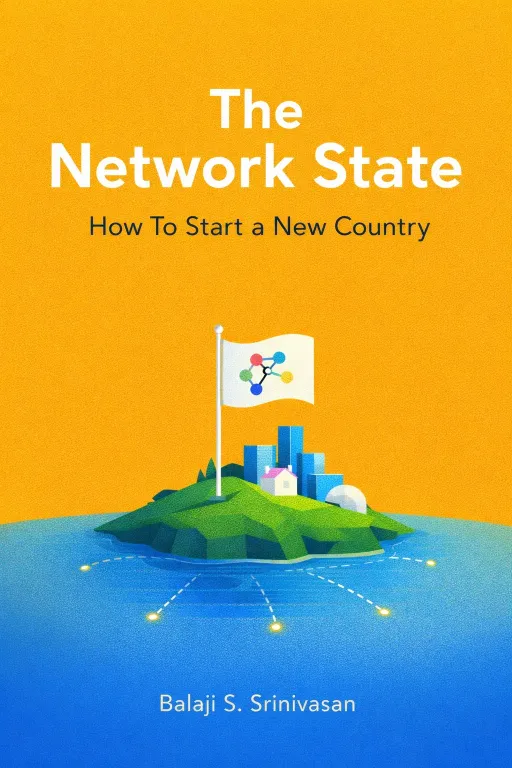
Joe: Alright Lewis, I've got a book for you. If you could start your own country today, what would be its one, single, unbreakable law? Lewis: Easy. Anyone who puts pineapple on pizza is exiled. Immediately. No trial. But I'm guessing the book we're talking about has slightly grander ambitions? Joe: Slightly! Today we're diving into The Network State: How To Start a New Country by Balaji Srinivasan. Lewis: Ah, Balaji. I know the name. Joe: And he is the perfect person to write this. He's a well-known tech investor and futurist, a former CTO of Coinbase. He’s someone who looks at society like an engineer looks at a system that needs debugging. Lewis: And it's a book that has made huge waves. It's been praised as visionary in some tech and crypto circles, but also heavily criticized as unrealistic and even elitist by others. It's definitely polarizing. Joe: Exactly. And to understand why it's so polarizing, we have to start with the core idea, which completely flips our understanding of what a country is.
Cloud First, Land Last: What is a Network State?
SECTION
Lewis: Okay, lay it on me. When I think 'country,' I think a shape on a map. France, Japan, Brazil. Land. Joe: Right. That’s the model we’ve had for centuries, since the Peace of Westphalia. A government controls a contiguous piece of territory. Srinivasan argues that’s an obsolete model for the internet age. He proposes a radical inversion: "cloud first, land last." Lewis: Cloud first, land last. What does that even mean? Joe: It means you start a country not with an army or a piece of dirt, but with an online community. He lays out a seven-step process. It starts with a founder who launches a startup society online, united by a common purpose. Lewis: Like a subreddit or a Discord server? Joe: Precisely. Step two is to organize that community into what he calls a "network union," capable of collective action. Step three, you build an internal economy using cryptocurrency. Only then, much later, do you get to step four: you start crowdfunding physical territory. Lewis: Hold on, physical territory? So you’re buying up land? Joe: Yes, but not all in one place. He calls it a "network archipelago." The community might crowdfund an apartment building in Tokyo, a co-working space in Lisbon, a farm in Costa Rica. They're all disconnected physically but are digitally linked as sovereign territory of this new network. Lewis: A network archipelago... so we're talking about a country made of disconnected bits of land all over the world? Like a WeWork for nations? Joe: That’s a great analogy. And from there, the goal is to grow the population to millions, build out a full system of digital governance, and finally, the most ambitious step: seek diplomatic recognition from existing governments to become a true Network State. Lewis: Wow. Okay, the ambition is off the charts. But my earlier question stands: how does a Discord server become a 'nation'? My Dungeons & Dragons group has a shared purpose, but I don't think we're ready for a seat at the UN. Joe: That's the critical distinction he makes between a 'nation' and a 'state'. A state is the governance apparatus. A nation is a group of people with a shared consciousness. He argues that for centuries, we’ve tried to force diverse, often conflicting, groups of people onto one piece of land and call it a nation-state. The Network State flips that. It lets a true, digitally-formed nation of like-minded people emerge first, and then they build the state around themselves. It's a nation built on shared values, not shared soil.
The Tripolar Moment: Why the World is Ripe for Disruption
SECTION
Lewis: I can see the appeal of that. Our current political climate feels more divided than ever. Joe: And that brings us to the book's big "Why now?" question. Srinivasan's answer is that the old system of nation-states, guaranteed by a dominant American power, is breaking down. He calls this the 'Tripolar Moment.' Lewis: Tripolar? Like a new Cold War with an extra player? Joe: Exactly. He argues the world is fracturing into three competing power networks, each with its own source of truth and ideology. He uses three symbols for them: NYT, CCP, and BTC. Lewis: Okay, I'm guessing CCP is the Chinese Communist Party and BTC is Bitcoin. But NYT? The New York Times? Joe: It's a symbol. NYT represents what he calls 'Woke Capital'—the moral power of the American establishment, its media, and its cultural institutions. Their source of truth is the paper, the narrative. CCP represents 'Communist Capital'—the martial power of a centralized state. Their source of truth is the party. And BTC represents 'Crypto Capital'—the money power of a decentralized, global network. Its source of truth is the protocol, the code. Lewis: Okay, this feels a little... conspiratorial? Lumping the entire 'American Establishment' into 'The New York Times' seems like a huge caricature. Is he being serious? Joe: It's definitely a provocative framing, but he's using them as ideological archetypes. The point isn't that the actual newspaper runs the world. The point is that these three forces represent fundamentally different ways of organizing society and defining truth. You have the Western model of narrative control, the Chinese model of state control, and the emerging crypto model of decentralized, mathematical control. Lewis: And the clash between them is the opportunity? Joe: Yes. He argues this clash is causing a massive breakdown in trust. People no longer believe in the institutions that run the legacy world. He has this killer line: "If the News is Fake, Imagine History." When people lose faith in the official stories, they start looking for alternatives. They start looking for an exit. And that's the opening for a Network State to present itself as a credible new option.
The One Commandment: How to Actually Build a New Society
SECTION
Lewis: So if the world is this chaotic mess, how do you actually build a stable alternative? You can't just declare 'I'm a country' on Twitter and expect it to work. It seems like it would descend into chaos. Joe: This is where the book gets surprisingly practical. He says a startup company begins with a technological innovation. A startup society, on the other hand, begins with a moral innovation. And to keep it from becoming chaotic, you focus on just one. He calls it "The One Commandment." Lewis: One Commandment. Like, 'Thou shalt not...'? Joe: Exactly. The idea is to not try and build a perfect, all-encompassing utopia. That's too complex and always fails. Instead, you find one specific thing that modern society gets profoundly wrong, and you build an entire community dedicated to setting that one thing right. Lewis: Can you give an example? This sounds very abstract. Joe: He gives some fantastic, almost sci-fi examples. One is a society he calls "Keto Kosher." Its one commandment is basically 'Sugar is poison.' The community is founded on the historical critique of the USDA food pyramid and its health consequences. So, they crowdfund properties—apartments, gyms, restaurants, maybe even a small town—where processed foods and sugar are banned. It's a society you opt into for a specific, shared health goal. Lewis: That's wild. So you'd have, like, carb police at the border? But I can actually see the appeal. You're not just complaining about public health; you're 'critiquing by building' something better for a group of people who want it. Joe: Precisely. And they don't all have to be physical. He gives another example of a purely digital society: the "Cancel-Proof Society." Its one commandment is 'No cancellation without due process.' It would be a digital guild, maybe on Discord, for writers, artists, and creators. Lewis: Like a mutual insurance policy against online mobs. Joe: Exactly. For the 99% of the time when things are normal, they promote each other's work and network. But for the 1% of the time a member gets unfairly attacked, the entire network mobilizes. They might collectively respond, or more likely, quietly support that person with new job opportunities and conduct their own internal, fair process. Lewis: Ah, so the 'One Commandment' determines the structure. The Keto society needs land, the cancel-proof one can be purely digital. That makes a lot of sense. It makes the whole grand idea feel much more achievable, more modular. Joe: It’s a portfolio of experiments in governance. Each one is a focused bet on a better way to live, starting with just one rule.
Synthesis & Takeaways
SECTION
Joe: And that's really the core of it. The Network State isn't just one idea. It's a stack: a diagnosis of a fracturing world with the Tripolar Moment, a radical new model for society with 'Cloud First, Land Last,' and a practical, startup-like playbook with 'The One Commandment.' Lewis: It's an incredibly ambitious, and as we said, controversial vision. It feels like it could either be a path to more freedom and innovation, or a recipe for a kind of digital feudalism and greater inequality, where the rich can just buy their own sovereignty. It really forces you to ask what a 'country' even is in the 21st century. Joe: Exactly. And maybe the most powerful takeaway isn't even about literally starting a new country. It's that idea of 'critiquing by building.' For decades, the main way to change society was to fight over the existing systems. This book proposes a different path. Lewis: A path of exit. Joe: A path of peaceful exit. Instead of just fighting the old systems, you create parallel, opt-in alternatives that are so demonstrably better, people willingly choose to leave the old for the new. In a way, that's a powerful form of peaceful revolution, driven by creation, not destruction. Lewis: It definitely leaves you thinking. For our listeners, it poses a fascinating question: If you could build a new community around one single rule to make life better, what would your 'One Commandment' be? Joe: This is Aibrary, signing off.